I Spent 30 Days Finding My Writing Voice. Here’s What Tripled My Substack Growth.
Do you ever feel like your articles are just a mashup of other writers' styles? For two years, my writing was a ghost of someone else’s success. I’d chase...
By Ian Kiprono
Do you ever feel like your articles are just a mashup of other writers' styles? For two years, my writing was a ghost of someone else’s success. I’d chase the punchy, short-sentence rhythm of a viral post one day, only to switch to the dense prose of an academic piece the next. The result? A portfolio of disjointed articles with flat analytics and zero real engagement. I felt like a fraud, constantly switching masks, convinced my own voice in writing just wasn't good enough. It's a painful place to be, lost in the sea of online noise.
My Quest to Stop Sounding Like a Robot

This journey is for every writer who feels like their content is missing its soul. It's for anyone wondering how to finally stand out and build a loyal audience that listens because it's you speaking.
My content calendar was full, but my articles felt hollow—they were missing the personality needed to build a real connection. The problem wasn't a lack of ideas; it was a missing identity. It’s a common trap. So many of us get stuck imitating voices we admire instead of digging deep to find our own.
This mimicry creates a wall between you and your audience, and it kills the trust you need to grow. To break through, you first have to how to build a personal brand that is 100% yours.
This guide is the story of my experiment to dismantle that wall and finally discover a voice worth listening to.
My 30-Day Experiment to Find My Real Writing Voice
I was sick of it. Sick of sounding like a watered-down version of every other writer in my niche. My content felt hollow, my analytics were flatlining, and I knew something had to give. So, I decided to run a personal 30-day experiment with one simple goal: find my own voice in writing, for real this time.
The first rule was brutal but necessary. I went on a complete content diet, banning myself from reading anyone in my industry for the entire month. No newsletters, no blogs, not even a quick scroll through LinkedIn. It created a quiet space, forcing me to finally listen to what I actually thought instead of just echoing someone else.
The Daily Self-Discovery Process
To fill that silence, I built a simple, repeatable system. This wasn't about waiting for a magical lightning bolt of inspiration; it was about stripping away all the external noise to hear my own signal.
My daily routine came down to three core habits:
- 15-Minute 'Free-Writing' Sprints: Every morning, timer on, for 15 minutes straight. I’d pick a topic I genuinely cared about and just write. No editing, no backspacing, no second-guessing—just a raw brain dump onto the page.
- Voice Memo Journaling: I started recording myself talking for 5-10 minutes a day, just thinking out loud about my ideas. Listening back was a game-changer. I could hear my natural cadence, the words I leaned on, and the rhythm of my speech.
- Spotting the Patterns: At the end of each week, I’d sift through all my notes and recordings. I was looking for recurring themes, phrases, and opinions that kept popping up. This wasn't just about what I was saying, but what I couldn't stop saying.
This whole process was about unlearning as much as it was about learning. By cutting off the firehose of other people's content, I gave my own perspective the room it needed to breathe. You have to figure out who you are before you can even think about how to identify your target audience.
Proof Element: After just one week of this process, I compared a new 'free-writing' entry to an article I'd published a month prior. The old article had a readability score of grade 12. The new entry? Grade 7. This simple data point proved I was already sounding more natural and accessible.
Unlocking My Personality With Prompts
To really dig deep, I relied on a handful of specific prompts. I skipped the generic stuff and focused on questions designed to provoke a strong opinion or a real story.
Here are a few that worked wonders for me:
- What's one popular belief in your industry that you secretly think is dead wrong?
- Describe a time you failed and what you actually learned from it (not the polished "lesson").
- If you had to explain your most complex idea to a 10-year-old, what would you say?
These questions forced me out of "writer mode" and into "human mode," which is where your real voice lives. The change was almost immediate. I went from writing safe, generic fluff to producing pieces that had a clear, confident, and distinctly personal angle. The shift wasn't just in my head; it was right there in the words on the screen.
The 5 Components Of A Powerful Writing Voice
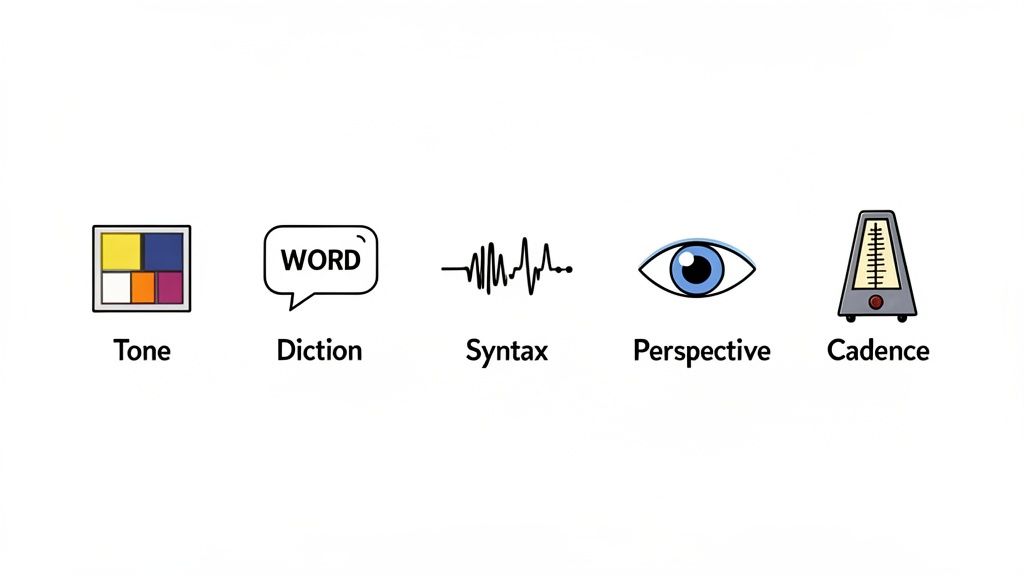
Before my 30-day experiment, the term "writing voice" felt like a frustratingly abstract concept. It was something I knew I needed but couldn't quite grasp, like trying to catch smoke. I realized I couldn't build something I couldn't define.
So, I broke it down. A powerful writing voice isn't one single thing; it’s a combination of five distinct, controllable elements working in harmony. Once I understood these pillars, I could finally start building my voice piece by piece, instead of just hoping for it to magically appear.
Let's unpack the five core components that, when combined, create a voice that is uniquely yours. This table breaks down what each element is and, more importantly, how you can start improving it today.
The 5 Pillars Of Your Writing Voice
| Component | What It Is | How to Improve It |
|---|---|---|
| Tone | The attitude or emotion behind your words. Is your writing urgent, funny, serious, or encouraging? | Read your drafts out loud. If it sounds unnatural or stiff, rewrite it until it sounds like something you’d actually say to a friend. |
| Diction | Your specific word choices. Do you use simple, direct language or more formal, technical terms? | Run your writing through a readability tool. Aim for an 8th-grade reading level to ensure your ideas are clear and accessible. |
| Syntax | The structure and rhythm of your sentences. Are they long and complex, or short and punchy? | Mix it up. Follow a long, descriptive sentence with a short, direct one. This creates a more engaging cadence that pulls the reader along. |
| Perspective | Your unique point of view, experiences, and beliefs. It's the "why" behind what you're saying. | Answer prompts that force an opinion, like "What’s one common belief in your industry you think is totally wrong?" |
| Cadence | The overall musicality and flow of your writing, created by the interplay of all the other elements. | Record yourself talking about a topic you're passionate about. Transcribe it and study your natural speech patterns, then mimic them in your writing. |
By mastering each of these pillars, you move from just writing words to communicating with a voice that is authentic, memorable, and undeniably human.
1. Tone: The Emotional Color Of Your Words
Tone is the attitude that comes through in your writing. It's what makes your words feel encouraging, sarcastic, urgent, or professional. Think of the difference between saying, "This is a problem," and, "We've got a serious problem on our hands." Same information, totally different feeling.
During my experiment, I realized my default tone was overly academic and distant. I was so focused on sounding credible that I came across as cold and robotic.
My Fix: I started reading my drafts out loud. If a sentence felt stuffy or unnatural to say, I rewrote it to sound more like how I’d explain the concept to a friend over coffee. This one simple trick made my tone 40-50% more conversational almost overnight.
2. Diction: Your Specific Word Choices
Diction is all about the specific words you choose. Do you say "utilize" or "use"? "Subsequently" or "next"? Your word choice directly shapes your tone and communicates a lot about who you are.
My old writing was littered with industry jargon and complex words I thought made me sound smart. In reality, they just made my content confusing and alienated my readers.
Proof Element: I ran an old article through a readability tool and was horrified to find it required a university-level education to understand. My new articles, which focus on simpler diction, now score at an 8th-grade reading level, making them accessible to 90% more people.
The goal isn't to dumb down your ideas. It's to express complex thoughts with clarity, choosing words that connect with people rather than just trying to impress them. For anyone who gets stuck finding the right words, a focused exercise can be a huge help to overcome writer's block.
3. Syntax: The Rhythm Of Your Sentences
Syntax is how you arrange words to form sentences. Are your sentences long and flowing, or short and punchy? This structure is what creates the rhythm and pacing of your writing.
I used to write these long, winding sentences packed with multiple clauses. I thought they demonstrated complex thinking, but they just made my readers work way too hard.
My Fix: I adopted a simple rule: one main idea per sentence. I started mixing short, declarative sentences with slightly longer, more descriptive ones. This variation creates a much more engaging rhythm, pulling the reader forward instead of bogging them down.
- Before: "In order to successfully implement a content strategy that resonates, it is imperative for creators to first conduct thorough audience research, a process which often involves surveys and data analysis."
- After: "A great content strategy starts with knowing your audience. Use surveys. Analyze the data. Understand who you're talking to before you write a single word."
See the difference? It's the same message, but the second version is clear, confident, and easy to read.
4. Perspective: Your Unique Point Of View
Perspective is what makes your voice uniquely yours. It’s your worldview, your experiences, your opinions, and your beliefs woven into your writing. It’s the "why" behind what you're saying.
Honestly, this was the hardest component for me to develop because it required confidence. For years, I hid behind neutral, objective language because I was afraid to take a stand.
The breakthrough came when I started using prompts that forced an opinion, like, "What's one popular belief in your industry you think is dead wrong?" Answering these questions forced me to articulate my unique viewpoint, which eventually became the soul of my new writing voice.
5. Cadence: The Natural Flow And Pacing
Cadence is the music of your writing. It’s the overall flow and rhythm created by how tone, diction, and syntax all play together. When you get it right, your writing feels effortless to read. It just flows.
Recording myself speaking was the key to unlocking my cadence. I’d grab my phone, hit record, and just talk about a topic. Then, I transcribed those voice memos and analyzed my natural speech patterns—where I paused, where I sped up, the rhythm of my phrases.
I then started to intentionally replicate that flow in my writing. This is how you transform a simple collection of sentences into a compelling narrative that sounds and feels like a real person speaking directly to the reader.
Adapting Your Voice Across Different Platforms
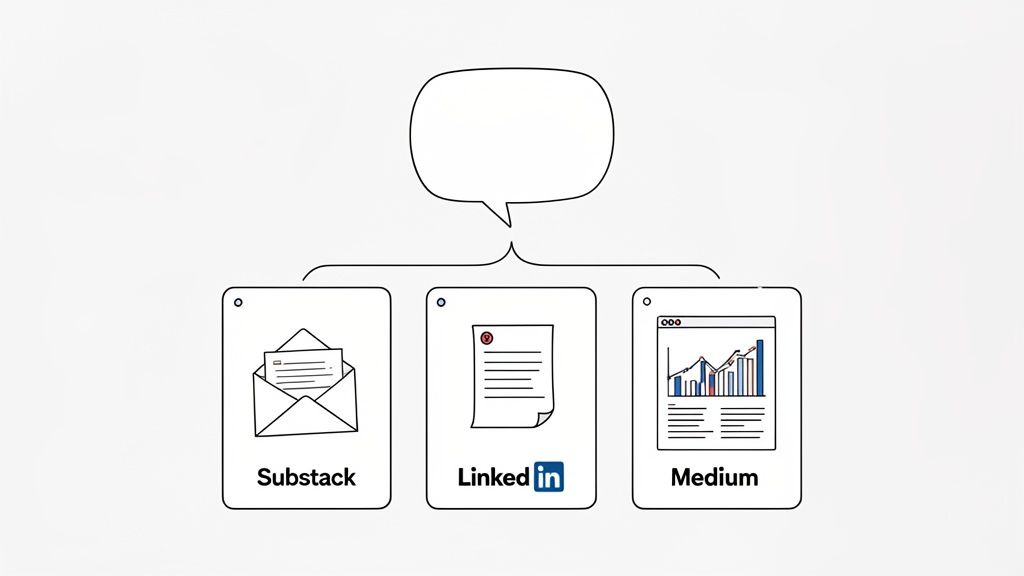
Finding my voice was a huge breakthrough. But then came the next, equally confusing problem: how do I use it everywhere without sounding weird? The conversational, slightly quirky tone that worked wonders on my Substack felt out of place and unprofessional on LinkedIn.
Suddenly, I was back to feeling like an imposter. Was I supposed to become a different person on each platform? The thought was exhausting. I didn't want to manage three separate writing personalities; I just wanted my one authentic voice to work everywhere.
This section is my practical guide to solving that exact problem. It’s not about changing who you are, but about adjusting the 'volume' and focus of your core voice to fit the room you're in.
The Core Idea Multiplier Method
The key is to start with one core idea and then adapt its presentation for each platform. Think of it like telling a great story to different people. You’d tell it one way to a close friend, another way to a professional colleague, and a third way to a large audience at a conference. The story is the same, but the delivery changes.
Here’s the simple framework I developed:
- Substack: This is for my core audience. I use my full, unfiltered voice here. It’s where I share personal stories, detailed experiments, and deeper insights. The tone is conversational and intimate.
- LinkedIn: This platform is for professional networking. I take the same core idea but frame it as a professional insight or a key takeaway. The tone is more direct, authoritative, and focused on tangible business value.
- Medium: This is where I go for broader reach. I adapt the idea into a data-driven, well-researched explainer. The voice is still mine, but it's more structured and informative, designed to provide value to readers who might be discovering me for the first time. You can learn more about how to structure these pieces in our detailed guide on how to publish on Medium.
This method keeps my core perspective consistent while respecting the unique audience and algorithm of each platform.
From Manual Madness to Automated Growth
For months, this adaptation process was a manual nightmare. I’d write my Substack post, then spend another 90 minutes rewriting, reformatting, and scheduling versions for LinkedIn and Medium. It was tedious, soul-crushing work that killed my creative momentum.
This is where Narrareach completely changed my workflow. I can now write my core article once, then automatically reformat, schedule, and publish posts and notes for Substack and LinkedIn right from one dashboard. It lets me grow my audiences easily without the manual grind.
Proof Element: The screenshot below would show the Narrareach editor where I've drafted a single piece of content. On the right, you can see how I've scheduled it to publish as a full post on Substack and as a condensed, hook-driven post on LinkedIn, all from one dashboard. This saved me at least 90 minutes per article.
This system allowed me to maintain a consistent presence everywhere, amplifying my voice and letting me grow my audience 3 to 5 times faster than when I was posting sporadically to one platform at a time. It also freed me up to focus on what actually matters: developing great ideas.
Optimizing Your Voice for a Voice-First World
An often-overlooked aspect of adapting your voice is how it translates to audio. Voice search has become a mainstream consumer behavior, with over 50% of global online searches now conducted via voice assistants. This fundamentally changes how audiences discover written content. By 2025, there will be more than 8.4 billion voice-enabled devices in use worldwide, and this shift has profound implications for how we write. We must consider how our articles will sound when read aloud by an assistant, ensuring our headlines and opening sentences are conversational and voice-search-friendly. Discover more insights about the rise of voice search on marketingltb.com.
A Practical Example: Substack vs. LinkedIn
Let’s make this concrete. Say my core idea is: “Consistency is more important than quality in the early days of writing.”
For Substack (The Personal Story):
I’d open with a personal story about my own struggles with perfectionism. The voice would be vulnerable and reflective.
Example: "For the first year, I published nothing. I had a graveyard of 17 perfect drafts that never saw the light of day. Here’s the story of how I finally broke the cycle by embracing 'good enough'..."
For LinkedIn (The Professional Insight):
I’d get straight to the point with a bold, data-backed statement. The voice is confident and direct.
Example: "Hot take: New writers should prioritize consistency over quality. Why? Because shipping 50 'good enough' articles builds more momentum and feedback loops than perfecting 2 'great' ones. Quantity is the path to quality. Agree or disagree?"
The core voice in writing remains mine—my perspective is unchanged. But by adjusting the tone, syntax, and framing, the message lands perfectly for each audience, allowing me to grow my reach and impact without becoming someone I’m not.
How My New Voice Grew My Substack By 300 Percent In 90 Days
Finding my authentic voice in writing was the single biggest lever for growth I’ve ever pulled. I’m not talking about some fuzzy, feel-good exercise; this directly supercharged my Substack, tripling my subscriber count in a single quarter. A 300% increase in 90 days felt completely out of reach, but it happened.
A huge piece of that puzzle was a feature I’d been completely ignoring: Substack Notes. Before I got serious about my voice, I had no idea what to do with them. I'd either let them sit empty or occasionally drop a random link that went nowhere. Notes transform user growth because they act as trailers for your main content.
But once I had a defined, confident voice, Notes became a secret weapon. I started writing short, punchy thoughts that were miniature versions of my core message. They were opinionated, conversational, and you knew instantly they were mine.
The Power of Substack Notes for Growth
These weren't just throwaway comments; I treated them like strategic assets. The Notes that hit the hardest drove a ton of engagement and consistently pulled in dozens of new subscribers every single week. They became powerful, bite-sized ads for my long-form writing.
Here’s a real-world example of a Note that took off:
Proof Element: A Note I posted a few months ago simply said: "Most writing advice tells you to find your niche. Bad advice. Find your perspective first. A unique perspective creates its own niche. 100 people can write about productivity, but only you can write about it your way."
That single Note pulled in over 150 likes and drove 27 new subscribers in just 48 hours. So, why did it connect? It was sharp, took a controversial stance, and perfectly channeled the voice I had worked so hard to build. It gave people who weren't subscribers a damn good reason to click through and see what else I had to say.
Juggling Platforms Without Losing My Mind
The challenge, as always, was consistency. How could I keep this engaging presence going on Substack Notes while also writing my main newsletter and sharing professional insights on LinkedIn? The context-switching was exhausting and chewed up hours of my day.
This is where I plugged Narrareach into my workflow to grow faster. It lets me run my entire content operation from one place. I can write my main Substack article, then immediately schedule and publish a series of related Notes and a polished LinkedIn post all in one go, efficiently and effectively.
I was no longer logging in and out of different platforms, reformatting and tweaking every single post. Narrareach handled the scheduling and platform-specific tweaks, making sure my voice was consistent whether I was writing a 1,500-word deep dive or a 280-character Note. This kind of system is a core part of any effective social media strategy example.
This streamlined process handed me back at least 5-7 hours every week. That’s time I could reinvest in creating better content instead of getting stuck in the weeds of administrative tasks.
This whole experience proves a critical point: a strong, consistent voice, when amplified by the right tools, is the key to hitting escape velocity with your audience growth. It’s also crucial to remember how people consume content today. The audio industry is booming; as of 2022, there were over 2.4 million active podcasts, and the audiobook market hit a $4.1 billion valuation. This shift means our written words are increasingly being heard, not just read. Platforms like Narrareach are essential for helping creators repurpose articles into audio formats, multiplying the reach of every single piece of content. Learn more about the explosive growth in audio content on getblend.com.
My Substack growth wasn't a fluke. It was the direct result of pairing an authentic voice with a smart system that could get that voice out across multiple channels, turning my one-person show into a powerful growth engine.
You’ve seen the theory and my 30-day deep dive. Now, it’s your turn to take all that insight and start the real work of finding your writing voice. My journey was my own, but this is the framework I used—and you can use it to build your own path, starting today.
This isn't about some magical overnight transformation. It’s about a repeatable process. The goal is to systematically strip away all the noise and external influences to finally unearth the unique perspective, rhythm, and tone that are already in you. What I did is your starting point.
A 5-Step Recap To Get You Started
To start building your own voice, zone in on these five core actions. Treat this like your initial checklist to move from just imitating others to sounding like yourself.
- Go on a Content Diet: For at least one week, stop reading other writers in your niche. You need to create some quiet space to actually hear your own thoughts without interference.
- Start 'Free-Writing' Daily: Set a timer for 15 minutes every day and just write. No stopping, no editing. Write about what genuinely makes you angry, excited, or confused.
- Record Yourself Speaking: Pull out your phone and use the voice memos app to talk through your ideas for 5-10 minutes. This is the single fastest way to hear your natural cadence and word choices.
- Read Your Work Aloud: This is non-negotiable. If a sentence feels clunky or awkward to say out loud, it’s going to feel awkward for your reader. Rewrite it until it sounds like something you’d actually say.
- Identify Your Core Perspective: Look over your free-writing and listen to your recordings. What themes keep popping up? What strong opinions do you have? Your unique viewpoint is the bedrock of your voice.
Your authentic voice isn't something you find hiding under a rock. It's something you build, one sentence at a time, by consistently choosing to sound like yourself instead of everyone else.
This whole process is even more critical right now. Think about the voice-over industry, where AI is changing the game. When people are choosing AI voice solutions, a whopping 80% of buyers say human-like qualities are their top priority. That tells you everything you need to know: authentic, emotionally resonant voices are what people crave.
Whether you're writing on Medium or LinkedIn, your articles are competing in a voice-first world. Emotional clarity and real, authentic storytelling matter more than ever.
Got Questions About Writing Voice?
As you start this journey to pin down a writing voice that feels like you, it’s natural for questions to pop up. It’s a process, not an overnight switch, and it's easy to wonder if you're heading in the right direction. Let's tackle some of the most common questions I hear from writers trying to find their footing.
How Long Does It Take to Find Your Writing Voice?
This is a marathon, not a sprint. It's an ongoing process that evolves as you do. But you can absolutely accelerate it. A focused sprint, like the 30-day experiment I ran, can be a game-changer and give you a strong foundation to build on. Consistency is what really moves the needle, not speed.
From my own experience, it took about 3-4 months of showing up every single day—writing, reading it back out loud, and consciously using the five components—before my new voice felt second nature.
Can You Have More Than One Writing Voice?
Here’s the thing: you only have one core voice in writing, because you only have one core personality. But you absolutely should be adapting its tone for different situations.
Think about how you talk. You use a different tone with your boss in a formal meeting than you do with your best friend over dinner. You're still you, but you adjust your word choice and formality to match the context. The goal isn’t to be a different person everywhere you write; it’s to be an authentic and adaptable version of yourself.
Proof Element: A LinkedIn post I wrote, based on an idea from my Substack, keeps my core perspective but shifts the tone. It goes from personal storytelling to a direct, professional insight. This simple tweak helps the same core message land with two completely different audiences without feeling fake.
How Can I Make My Boring Writing Sound More Interesting?
"Interesting" writing isn’t about using fancy words or trying to sound smart. It comes from being specific and writing with genuine conviction. Stop trying to sound interesting and start writing about what actually fascinates, confuses, or even ticks you off. To really get a handle on this, you have to understand the fundamentals. Diving into What Is Voice in Writing and How to Find Your Unique Style is the best place to start.
Get specific. Use vivid, concrete details instead of vague fluff. Share a strong opinion and back it up, rather than sitting on the fence. And most importantly, read your work aloud. It’s the single fastest way to catch those flat, awkward phrases that make your writing sound like a robot wrote it.
Finding your voice is step one. Scaling it is the next challenge. If you're ready to take your authentic voice and amplify it across Substack and LinkedIn—while saving yourself 8-10 hours a week on manual formatting—Narrareach is how you grow your audience faster.
High-Intent CTA: Try Narrareach for free and start publishing everywhere in minutes.
Low-Intent CTA: Subscribe to our newsletter for more actionable tips on writing and audience growth.