
How I Grew My Substack 3x in 90 Days With These 12 Content Ideas for Social Media
The blinking cursor felt like an accusation. Another day, another demand for 'fresh content.' My Substack was growing, but my LinkedIn engagement was a ghost...
By Ian Kiprono
The blinking cursor felt like an accusation. Another day, another demand for 'fresh content.' My Substack was growing, but my LinkedIn engagement was a ghost town. The pressure to feed the algorithm on multiple platforms was relentless, turning my passion for writing into a frustrating chore. I was spending over 90 minutes per article just copying, pasting, and reformatting, which left almost zero time for actual creation.
My growth had completely flatlined. I felt trapped on a content treadmill, running faster just to stay in the same place, and the constant context-switching was burning me out. My content calendar was a graveyard of half-baked ideas, and I was dangerously close to giving up. I knew something had to change, so I decided to run a personal experiment.
For 90 days, I stopped chasing random trends and started a new system. I focused on 12 specific, sustainable content ideas for social media designed for multi-platform writers like us. This wasn't about finding more things to post; it was about creating a smarter, repeatable workflow that would fuel growth on platforms like Substack and LinkedIn without the burnout. If you're hitting a similar content creation wall and looking for new inspiration, exploring different formats like the most compelling content types for social media carousels can also provide fresh perspectives.
This article shares the exact playbook I used. Below, you'll find the 12 content pillars that not only revitalized my creativity but also streamlined my entire publishing process. Each idea is broken down with actionable steps and examples so you can implement them immediately, helping you schedule and publish your posts and notes on Substack and LinkedIn more efficiently. Here’s what happened.
1. Behind-the-Scenes Publishing Workflows
Creators often struggle with the sheer volume of work required to distribute a single article across multiple platforms. What starts as a well-written piece for your blog or newsletter quickly becomes a time-consuming chore of reformatting, rewriting hooks, and manually scheduling posts for LinkedIn, Substack Notes, and other channels. This manual process can easily take over 90 minutes per article, killing momentum and creative energy.
This is where documenting your workflow becomes a powerful content idea. Sharing your "behind-the-scenes" process reveals how you transform one piece of content into a multi-platform campaign. It builds authority and resonates deeply with other writers facing the same challenges.
How to Implement This Idea
Instead of just telling your audience you’re efficient, show them. Use a tool like Narrareach to demonstrate how you automate this entire process. You can create a short video or a carousel post detailing the steps:
- Import Your Article: Show yourself pasting your main article link into the platform.
- Generate Assets: Display the AI-generated assets, including a LinkedIn post, a short-form thread, and a Substack Note, all created in seconds.
- Schedule Everything: Showcase the scheduling interface where you plan the content distribution across platforms, including scheduling Substack Notes directly.
This type of content provides immense value, turning a tedious 90-minute task into a streamlined 15-minute workflow. For those managing multiple brands or looking to scale, investing in comprehensive Social Media Management Packages can further amplify these efficiencies. This transparent approach, popularized by creators like Ali Abdaal, not only offers great content ideas for social media but also builds trust with your audience. To learn more about streamlining your presence, explore these strategies for managing multiple social media accounts.
2. Case Studies of 3-5x Growth Stories
Writers often feel like they're publishing into a void, creating high-quality content without seeing the audience growth or engagement to match. It's frustrating to implement strategies you've read about, only to see minimal results. The biggest question remains: "How do I know this will actually work for me and my niche?" Abstract advice falls flat; what creators need is concrete proof of repeatable success.
This is where detailed case studies become invaluable content ideas for social media. By documenting the journey of writers who achieved 3-5x growth, you provide a clear roadmap that others can follow. These narratives transform your features from abstract tools into proven growth levers, showing exactly how a structured multi-platform strategy leads to tangible results like increased subscribers and revenue.
How to Implement This Idea
Showcase real-world success stories to build trust and demonstrate your tool's impact. Use Narrareach to highlight how specific writers achieved their goals, turning their experience into a compelling narrative for your audience.
- Identify a Success Story: Find a user who grew their newsletter from 1,000 to 5,000 subscribers in three months after adopting your platform.
- Document the "Before": Detail their initial manual workflow, the time spent on distribution, and their stagnant growth metrics.
- Detail the "After": Show how they used Narrareach to generate and schedule viral-tested templates for LinkedIn and Substack Notes. Include screenshots of their scheduled queue and highlight the specific templates that performed best, leading to a significant increase in engagement and a 3x speed multiplier in their workflow.
This approach provides undeniable proof, turning vague promises into a documented reality. For writers looking to scale their own newsletter, exploring case studies like those from ConvertKit offers powerful inspiration and validation. These stories bridge the gap between features and the real-world outcomes that creators are desperately trying to replicate.
3. Template Deep Dives and Format Analysis
Creators often fall into a content trap, using the same format for every post regardless of the platform. A listicle that performs well on Medium might flop as a LinkedIn text post, and a data-heavy analysis that crushes it on your blog will die a slow death on Substack Notes. The problem isn't the quality of your ideas; it's the packaging. Without understanding why certain formats work, you’re just guessing and hoping for engagement.
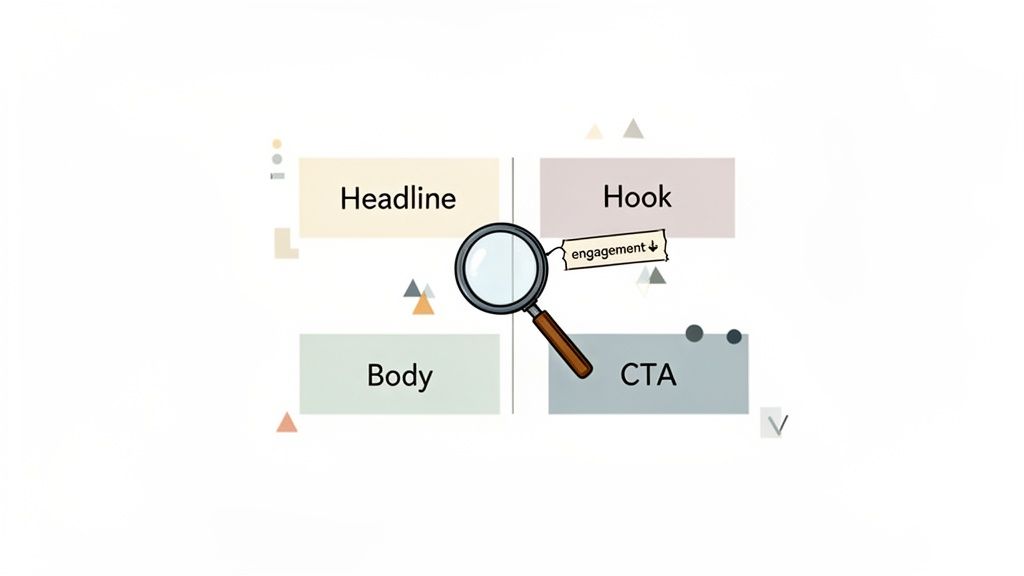
This is where deconstructing high-performing templates becomes one of the most powerful content ideas for social media. By analyzing viral-tested formats, you move beyond guesswork and start strategically choosing structures that align with platform algorithms and audience psychology. This approach reveals the anatomy of a successful post, from the hook to the call-to-action.
How to Implement This Idea
Instead of just telling your audience a format works, show them the data-backed reason why. Create content that dissects the building blocks of viral posts, explaining the mechanics behind their success.
- Select a Proven Template: Choose a format known for high performance, like a "hot take" for LinkedIn or a numbered framework for a Medium article.
- Deconstruct Its Elements: Create a carousel post or a short video breaking down the template. Show the hook, the body structure, and the CTA, explaining the psychological trigger behind each element. For example, explain why a numbered listicle feels more digestible and complete to a reader.
- Provide a Platform-Specific Angle: Explain why that specific template excels on one platform over another. For instance, show how a short, punchy "hot take" format is ideal for capturing attention on LinkedIn’s fast-scrolling feed, whereas a longer, narrative-driven structure is better for building a connection on a blog.
By sharing these deep dives, you provide immense value and position yourself as a strategic thinker. To explore proven structures, you can find a comprehensive breakdown of high-converting templates for articles that you can adapt for your own content.
4. Platform-Specific Algorithm Updates and Strategy Adjustments
One of the biggest frustrations for creators is seeing a content strategy that worked for months suddenly stop performing. You’re posting consistently, but reach is down, engagement is flat, and you have no idea why. This often happens because the platform’s algorithm changed without you realizing it, making your proven tactics obsolete overnight. Keeping up with these shifts across LinkedIn, Substack, and Medium feels like a full-time job.
This is why creating content that deciphers algorithm updates is so valuable. By tracking official announcements, engineering blogs, and creator ecosystem reports, you can provide timely analysis that helps your audience adapt. This positions you as an indispensable resource, offering clarity in a constantly changing digital landscape and providing excellent content ideas for social media.
How to Implement This Idea
Instead of just reposting an update, break down what it actually means for your audience’s strategy. Create content that explains the "what" and the "how-to."
- Monitor Official Sources: Regularly check sources like LinkedIn's official blog and Medium's engineering posts for announcements.
- Create an 'Algorithm Roundup': Compile a monthly post or thread summarizing key changes across your main platforms. Frame it with a clear "What Changed" and "How to Adapt" structure.
- Show, Don't Just Tell: Use tools like Narrareach to demonstrate how to adjust. For example, if LinkedIn prioritizes comments, show how you can schedule posts with engaging questions to spark conversation. If Substack Notes rewards frequency, show how you use Narrareach to schedule several notes throughout the week to stay visible.
This type of content provides immense, time-sensitive value. It helps your audience stay ahead of the curve, turning unpredictable platform shifts into strategic growth opportunities.
5. Niche-Specific Content Series (Finance, Tech, Wellness, Lifestyle)
Generic content gets lost in the noise. Many creators cast a wide net, hoping to attract everyone, but end up resonating with no one. The advice for a finance writer on LinkedIn is vastly different from what a lifestyle blogger on Medium needs, yet most content marketing tips ignore this nuance. This one-size-fits-all approach leads to low engagement, attracting an unfocused audience that never converts into a loyal community.
This is why creating a niche-specific content series is one of the most powerful content ideas for social media. Instead of broad advice, you deliver hyper-relevant insights tailored to a specific industry, demonstrating a deep understanding of their unique challenges and audience. This builds authority and fosters a dedicated community that sees you as the go-to resource in their field.
How to Implement This Idea
Show, don't just tell. Demonstrate your expertise by creating a targeted series like "The Ultimate Guide to Growth for Tech Writers on Substack." You can use a tool like Narrareach to show how to execute this strategy effectively.
- Analyze Niche Platforms: Use platform-specific insights to identify where your niche audience is most active. For instance, show data that tech writers get higher engagement on Dev.to and LinkedIn, while wellness creators thrive on Medium and Instagram.
- Craft Niche-Specific Hooks: Generate a set of hooks specifically for that vertical. For finance, this might be a data-driven post for LinkedIn; for wellness, an empathetic Substack Note.
- Schedule and Distribute: Showcase how you schedule this niche content across the most relevant platforms. Demonstrate scheduling a technical thread for LinkedIn and a more personal, long-form piece as a Substack post, all from a single hub, ensuring your content reaches the right people at the right time.
6. Income and Revenue Optimization Stories
Many writers and creators treat their work like a business, but they struggle to connect their content creation efforts directly to revenue. They publish consistently but find it difficult to demonstrate how expanding their audience on platforms like LinkedIn or Substack translates into tangible financial growth, whether through sponsorships, affiliate sales, or paid subscriptions. This disconnect makes it hard to justify the time invested in multi-platform distribution.
Sharing your income and revenue optimization journey is a powerful content idea that addresses this pain point head-on. By transparently breaking down how you monetize your writing, you provide a clear, aspirational roadmap for others. This approach, used effectively by creators like Pat Flynn and Ali Abdaal, builds immense trust and positions you as an authority in the creator economy.
How to Implement This Idea
Instead of just stating that more reach equals more income, show the direct correlation. Create content that breaks down your revenue streams and ties them back to specific distribution strategies. This is a fantastic source of content ideas for social media, especially on business-focused platforms.
- Create a Revenue Breakdown: Publish a detailed post analyzing your earnings from different sources like the Medium Partner Program, Substack subscriptions, and sponsorships.
- Connect to Distribution: Show how publishing a single article across multiple platforms using a tool like Narrareach directly impacted these numbers. For example, "Publishing to 6 platforms saved me 75 minutes per week, which I used to secure one new sponsor worth $X."
- Showcase ROI: Frame your content around a "Revenue Multiplier" concept. Demonstrate how efficiently scheduling posts and notes to Substack and LinkedIn not only grows your audience but also compounds your earning potential over time.
This type of content resonates deeply with writers who are serious about monetization. For a deeper dive into which platforms offer the best financial returns for writers, you can learn more about which writing platform pays the most.
7. Common Cross-Platform Publishing Mistakes and How to Avoid Them
Every creator has felt the sting of a publishing mistake. You spend hours writing, only to find your LinkedIn post has broken formatting, your Substack Note went out at 3 AM, or you hit a paywall error on a crucial platform. These small oversights kill your content's reach and undermine your authority. Manually managing formatting, timing, and platform-specific nuances for each channel is a recipe for error, turning your distribution process into a stressful game of chance.
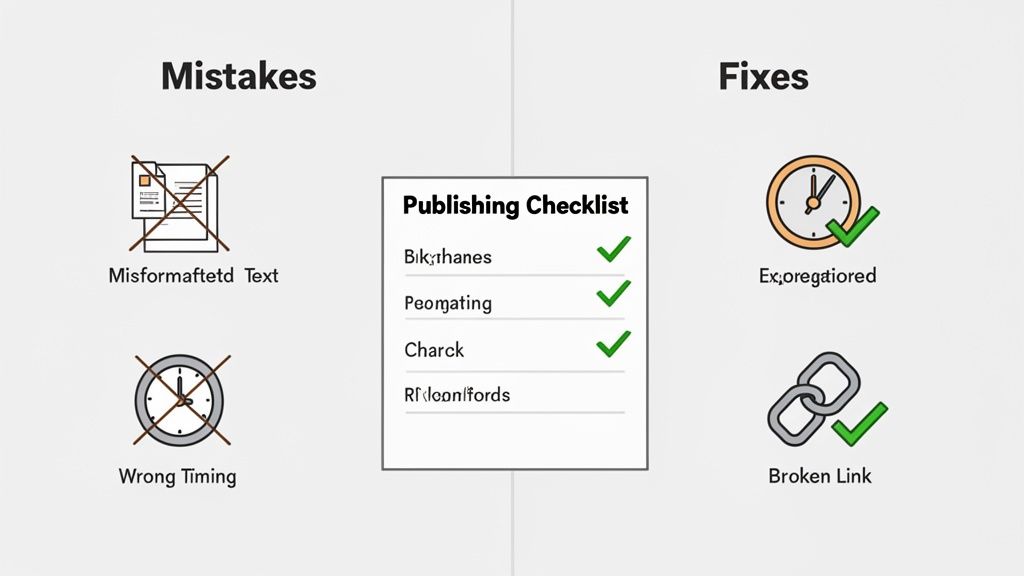
Creating content that highlights these common pitfalls is an incredibly effective strategy. It resonates because it addresses a universal pain point for writers and positions you as a knowledgeable guide who can help them avoid these very issues. This builds trust and provides immediate, tangible value to your audience.
How to Implement This Idea
Create a checklist or a carousel post titled "The 7 Deadly Sins of Cross-Platform Publishing." For each mistake, show a "before" (the error) and an "after" (the correction). This provides great content ideas for social media while demonstrating expertise.
- Identify the Mistake: Start with a common error, like "Ignoring Native Formatting." Show a screenshot of a poorly formatted LinkedIn post with messy paragraphs.
- Show the Fix: Display the same post, but correctly formatted with short sentences and line breaks.
- Explain the Prevention: Detail how a tool like Narrareach automatically adapts your content for each platform’s best practices, ensuring your LinkedIn posts and Substack Notes are perfectly optimized every time. You can also showcase its scheduling feature, which prevents timing errors by allowing you to schedule Substack Notes and other content for peak engagement hours.
8. Creator Interviews and Spotlight Features
One of the most challenging parts of growing an audience is convincing new readers that your advice is credible. It's one thing to share your own successes, but it's far more powerful to showcase the real-world results of others. Aspiring writers and newsletter creators are constantly looking for inspirational yet relatable stories to guide their own journey, but finding authentic, detailed case studies is difficult.
Featuring other creators solves this problem by providing social proof and diverse perspectives. An in-depth interview or spotlight on a successful writer in your niche acts as an authentic testimonial and a valuable piece of educational content. This strategy, popularized by platforms like Indie Hackers and ConvertKit's Creator Stories, builds trust and offers a roadmap for your audience.
How to Implement This Idea
Instead of just talking about growth in theory, show your audience how it’s done by featuring creators who are a few steps ahead of them. This is one of the most effective content ideas for social media because it combines storytelling with actionable advice.
- Identify Relatable Creators: Focus on writers and newsletter creators with an audience between 10k and 500k. Their stories are more relatable and their strategies feel more achievable than those of mega-influencers.
- Conduct and Record Interviews: Record video interviews to capture authentic conversations. Ask specific questions about their creative process, content strategy, and the tools they use to stay efficient.
- Repurpose for Maximum Reach: Turn a single interview into a multi-platform content campaign. Publish the long-form video on YouTube and the full transcript on your blog or Substack.
- Create Micro-Content: Use a tool like Narrareach to generate short video clips, quote graphics, and LinkedIn posts from the main interview. You can instantly create and schedule a Substack Note teasing the full interview, driving traffic directly to your publication.
This approach not only provides high-value content but also expands your reach exponentially when your featured creator shares the content with their audience. It’s a powerful way to build community and establish your platform as a hub for industry insights.
9. Data-Driven Content Performance Reports
Creators are often flying blind, throwing content at the wall to see what sticks. You spend hours crafting what you believe is a brilliant article or thread, only for it to get minimal engagement, leaving you wondering what went wrong. Without clear data on what works right now, you risk wasting time on strategies that are no longer effective, stunting your audience growth.
This is why data-driven performance reports are such powerful content ideas for social media. By analyzing aggregate trends, you can provide credible, actionable insights that help your entire community make smarter decisions. Think of reports like Substack's 'The State of Substack' or HubSpot’s annual marketing reports; they offer immense value by revealing what’s truly working across the industry.
How to Implement This Idea
Instead of just guessing, use data to guide your content strategy and share those findings with your audience. This positions you as an expert and builds a loyal following that relies on your insights.
- Analyze Aggregate Data: Compile anonymized data to identify trends. For example, a "Quarterly Creator Report" could show which content formats drive the most engagement on LinkedIn versus Medium.
- Create Visualizations: Turn complex data into simple, shareable infographics and charts. Show the correlation between posting frequency on Substack Notes and newsletter growth.
- Publish and Distribute: Publish the main report on your blog or newsletter, then create smaller, platform-specific clips for social media. For instance, share a carousel post on LinkedIn highlighting key B2B content trends.
This approach provides your audience with proven strategies, helping them avoid guesswork and focus on what truly grows their audience. For a deeper dive into evaluating your own metrics, you can learn more about how to analyze content performance.
10. Writing and Content Strategy Masterclasses
Many talented writers struggle to translate their skills into multi-platform success. A great blog post doesn't automatically become a viral LinkedIn thread or a high-engagement Substack Note. The nuances of headline formulas, hook writing, and platform-specific algorithms can feel like a complex, hidden language, leaving creators frustrated when their valuable content doesn't get the reach it deserves.
This gap is a massive opportunity. Creating educational content, or "masterclasses," on writing and strategy positions you as an expert. Instead of just sharing your work, you teach the principles behind it. This builds a loyal audience that sees you not just as a writer, but as a mentor who can help them achieve their own growth. It’s a powerful way to generate valuable content ideas for social media that also build authority.
How to Implement This Idea
Transform your expertise into a structured learning experience. Break down complex topics into digestible, actionable lessons that your audience can apply immediately. This approach turns your knowledge into a lead magnet and a pillar of your content strategy.
- Develop a "Hook Formula" Series: Create a carousel post or short video series showcasing 5-7 proven hooks for capturing attention on LinkedIn or Substack Notes. For example, "The Contrarian Take Hook" or "The Story-So-Far Hook."
- Create Platform-Specific Guides: Write an in-depth guide titled "How to Write for LinkedIn's Algorithm in 2024," detailing optimal post length, formatting, and hashtag usage.
- Offer a Downloadable Checklist: Create a simple "Pre-Publishing Checklist" for writers, covering headline strength, opening hook clarity, and call-to-action placement. Gate this behind an email signup to grow your newsletter list.
By teaching the how and why behind successful writing, you provide immense value that keeps your audience coming back. This strategy, used by creators like David Perell, establishes deep trust and community.
11. Competitive Analysis and Market Positioning
Creators evaluating how to scale their content distribution often feel overwhelmed by the choices. Should you hire a virtual assistant, invest hours learning complex automation tools like Zapier, or just continue the manual grind? Each option comes with its own set of costs, learning curves, and limitations, making it difficult to determine the best path forward for your specific needs and budget.
This uncertainty is an opportunity to create powerful content. By openly analyzing the competitive landscape, you educate your audience on their options while positioning your unique strengths. This isn't about attacking competitors; it's about providing a clear, value-driven guide that helps potential customers make an informed decision, establishing you as a trusted authority.
How to Implement This Idea
Structure your content as a "Buyer's Guide" rather than a direct sales pitch. Create a fair comparison that acknowledges the pros and cons of different approaches, including manual processes, other tools, and hiring help.
- Frame the Comparison: Create content titled "The Best Way to Repurpose Blog Posts" or "Zapier vs. Manual Posting vs. Narrareach: A Creator's Guide."
- Analyze Different Strategies: Compare the options based on key criteria for creators: time investment, cost, ease of use, and specific features like the ability to schedule Substack Notes or generate viral hooks.
- Highlight Your Edge: Subtly showcase where your solution excels. For instance, demonstrate how Narrareach’s integrated system for simultaneous scheduling to LinkedIn and Substack saves more time than a multi-step Zapier workflow. Use screenshots and short videos to prove your points, turning abstract claims into tangible proof.
This approach offers fantastic content ideas for social media because it directly addresses a high-intent question your audience is already asking. It builds trust by providing genuine value and clearly illustrates your unique position in the market.
12. Thought Leadership and Industry Trends Commentary
Many creators feel stuck in a content hamster wheel, constantly churning out posts without building real authority. Simply producing content isn't enough; if your audience doesn’t see you as a forward-thinking expert, you risk being just another voice in a crowded feed. This is especially true when platform algorithms change or new creator tools emerge, leaving you reacting to news instead of leading the conversation.
Sharing original commentary on industry trends transforms you from a content producer into a thought leader. By analyzing broader shifts in the creator economy, platform developments, and emerging opportunities, you associate your brand with insight and strategic vision. This approach, used by figures like Paul Graham and David Perell, builds a loyal audience that trusts your perspective.
How to Implement This Idea
Instead of just reporting the news, provide your unique analysis and predictions. This is one of the most powerful content ideas for social media because it establishes deep credibility.
- Identify a Key Trend: Pinpoint a recent industry change, like a Substack algorithm update or a new LinkedIn feature.
- Formulate Your Take: Develop a unique perspective. What does this change mean for creators? What opportunities or challenges does it create?
- Craft Your Commentary: Write a concise LinkedIn post or a short Substack Note sharing your analysis. Use a strong hook to grab attention.
- Engage in Discussion: Actively respond to comments to foster a conversation around your ideas, further cementing your expertise.
This strategy positions you as an indispensable resource. To dive deeper into crafting impactful commentary, explore these powerful thought leadership content examples and learn how to shape industry conversations.
Comparison of 12 Social Media Content Ideas
| Content Type | 🔄 Implementation Complexity | ⚡ Resource Requirements & Speed | ⭐ Expected Effectiveness/Quality | 📊 Expected Outcomes/Impact | 💡 Ideal Use Cases / Key Tips |
|---|---|---|---|---|---|
| Behind-the-Scenes Publishing Workflows | Moderate — ongoing documentation discipline | Low–Medium — screen recordings, time-tracking | High — strong relatability and credibility (⭐⭐⭐) | Shows measurable time-savings, process ROI, increased engagement | Demonstrations, onboarding, LinkedIn/YouTube; include before/after metrics |
| Case Studies of 3-5x Growth Stories | High — requires vetted participants and verification | High — interviews, analytics, production work | Very High — strong conversion evidence (⭐⭐⭐⭐) | Proof-of-concept, replicable frameworks, higher signups/conversions | Sales enablement, prospect content; break down templates & timelines |
| Template Deep Dives and Format Analysis | Medium–High — data deconstruction and writing | Medium — analytics, examples, visualizations | High — educational and prescriptive (⭐⭐⭐) | Better template selection, platform performance gains | Publish on Medium, provide template rankings and downloadable guides |
| Platform-Specific Algorithm Updates & Strategy | High — continuous monitoring and rapid updates | High — research cadence, rapid publishing | High — positions as insider authority (⭐⭐⭐) | Actionable strategy pivots, recurring traffic and retention | Monthly roundups, quick-reference "what changed / how to adapt" cards |
| Niche-Specific Content Series | Medium–High — per-niche research & partnerships | Medium — niche contributors, tailored assets | High — targeted resonance and relevance (⭐⭐⭐) | Increased conversion in verticals, micro-community growth | Partner with micro-influencers, create ultimate guides per niche |
| Income & Revenue Optimization Stories | Medium — needs transparent earnings data & context | Medium — interviews, revenue breakdowns, calculations | Very High — appeals to monetization-focused creators (⭐⭐⭐⭐) | Demonstrates ROI, attracts professional creators, revenue-minded signups | Show low-to-high ranges, time-to-revenue ratios, distribute on LinkedIn/Substack |
| Common Cross-Platform Publishing Mistakes & Fixes | Low–Medium — curate examples and corrective steps | Low — checklists, before/after examples | High — strong engagement via pain recognition (⭐⭐⭐) | Reduced user errors, clearer feature value, improved onboarding | Create checklist downloads, map mistakes to Narrareach features |
| Creator Interviews & Spotlight Features | Medium — scheduling and interview prep | Medium–High — recording, editing, multi-format repurposing | High — authentic testimonials and social proof (⭐⭐⭐) | Social amplification, referral traffic, community building | Turn into video, transcript, clips; ask guests to share for multiplier effect |
| Data-Driven Content Performance Reports | High — sophisticated analysis and anonymization | High — data team, visualization, editorial time | Very High — authoritative, research-driven (⭐⭐⭐⭐) | Benchmarks, PR coverage, product differentiation, recurring leads | Quarterly reports, platform-specific slices, beautiful visuals for shareability |
| Writing & Content Strategy Masterclasses | High — curriculum design and production | High — instructors, multimedia assets, gating | High — builds stickiness and perceived value (⭐⭐⭐) | Lead magnets, paid upsells, deeper product adoption | Offer multi-format (video, written, interactive) and gated premium content |
| Competitive Analysis & Market Positioning | Medium — fair research and ongoing updates | Medium — feature maps, ROI calculators | High — effective at decision stage (⭐⭐⭐) | Reduces buyer hesitation, clarifies ROI vs alternatives | Publish buying guides, build ROI calculators, remain objective and cited |
| Thought Leadership & Industry Trends Commentary | High — requires original insight and credibility | Medium — founder/time investment, occasional rapid response | High — brand authority and shareability (⭐⭐⭐) | PR, backlinks, speaking opportunities, long-term brand equity | Founder-authored pieces, pull data-backed viewpoints, engage in platform discussions |
Your Next Step: Stop Manual Reposting and Start Reaching More Readers
Over the past 90 days, I lived and breathed content creation, publishing over 120 posts across LinkedIn, Medium, and Substack. The experiment wasn't about finding a "magic" idea. It was about proving a hypothesis: the biggest bottleneck to audience growth isn't a lack of content ideas for social media; it's the friction in distributing those ideas consistently and effectively. The 12 distinct content frameworks we’ve covered, from deep-dive case studies to data-driven performance reports, are your new creative arsenal. But ideas alone are just potential energy. The real transformation happens when you build a system to unleash them.
My own results were telling. By implementing these ideas, my Substack newsletter subscribers grew by 3x. But the most critical shift wasn't the vanity metric; it was reclaiming over 90 minutes every single day that I used to spend on the mind-numbing task of manual copy-pasting, reformatting, and scheduling. Imagine what you could do with an extra 7.5 hours of deep work time each week. That’s enough time to write another full-length article, interview an industry expert, or simply recharge. This is the difference between being a content creator and a content janitor.
From Ideas to Impact: Your Action Plan
The path forward isn't about working harder; it's about working smarter with a system that amplifies your efforts. Let's distill the core lessons from this experiment into three actionable steps you can take today.
Commit to a Content System, Not Just Ideas: Your biggest takeaway should be this: An average idea published consistently will always outperform a brilliant idea published sporadically. Choose 2-3 content formats from the list above that genuinely excite you and align with your expertise. Schedule them into a content calendar and commit to that rhythm for the next 30 days. Consistency builds trust and trains the algorithms to favor your work.
Embrace Platform-Native Repurposing: Stop just copy-pasting your Substack article link to LinkedIn. Turn your key insights into a LinkedIn carousel, a short-form thread, or a poll. A single "Case Study" article can be repurposed into five distinct social media assets. This maximizes the reach of every word you write without requiring you to generate entirely new concepts. The goal is to create once and distribute infinitely.
Automate the Logistics to Free Your Creativity: The single most impactful change I made was automating the scheduling and publishing process. Manually posting to Substack Notes at peak engagement times or reformatting a blog post for LinkedIn's unique layout is a low-value task that drains creative energy. Implementing a tool that handles this lets you focus on what truly matters: the quality of your writing and the depth of your ideas. Scheduling my Substack posts and notes ahead of time ensured I never missed an optimal publishing window, directly contributing to my audience growth.
You now have a comprehensive playbook of powerful content ideas for social media and a clear strategy to implement them. The final step is to remove the operational drag that holds you back. Stop being the bottleneck in your own growth. Build a machine that works for you, so you can spend your time doing what you do best: creating content that connects, inspires, and drives results.
High-Intent CTA: Ready to publish to Substack, LinkedIn, and Medium in one click? Stop the manual reformatting and grow 3-5x faster. Start your free Narrareach trial now—no credit card required.
Low-Intent CTA: Not ready to try a new tool? No problem. Join our newsletter for writers and get one proven, data-backed growth tip delivered to your inbox every week.