
A 30-Day Social Media Writing Experiment That Grew My Audience 317%
Are you spending hours writing content, hitting “publish,” and hearing nothing but crickets? You know you have valuable ideas, but you’re stuck in a...
By Ian Kiprono
Are you spending hours writing content, hitting “publish,” and hearing nothing but crickets? You know you have valuable ideas, but you’re stuck in a frustrating cycle: manually copying and pasting your work to LinkedIn, tweaking the formatting, then doing it all over again for Substack. Your engagement is flat, your subscriber list isn't growing, and you feel like you’re on a content treadmill going nowhere. It’s exhausting and makes you wonder if growing an audience is even possible without burning out. If you've ever felt like you're shouting into the void, you’re not alone.
My Disjointed Social Media Writing Routine
I have to be honest: my old social media writing process was a complete disaster.
For months, I was stuck in that exact loop. Every time I wanted to share a new article, I’d spend over 90 minutes manually copying, pasting, and reformatting everything for LinkedIn, and then doing it all over again for Substack. My content felt scattered, my engagement was flat, and my Substack subscriber count barely budged. I felt like I was on a content treadmill, constantly writing but getting zero results.
This is the "before" picture—the all-too-relatable starting point for any writer who feels like they’re doing all the work for none of the reward.

The Credibility-Killing Formatting Problem
My biggest problem was inconsistency. A post that looked great on LinkedIn, with its short paragraphs and clean spacing, would turn into a messy wall of text when I dumped it into a Substack Note.
I’d waste so much time fiddling with line breaks and bullet points, just trying to make each version look native. But I’d almost always miss something, and the result was just unprofessional. Readers pick up on those little mistakes, and it subtly chips away at your credibility. It screams, "I just copied this from somewhere else," which is a surefire way to lose trust.
Posting Into a Black Hole
My scheduling—or total lack of it—was another huge headache. I posted whenever I happened to finish writing, which was usually late at night or on a weekend. My best ideas were going live when my entire target audience was offline.
The outcome? An idea I was excited about would get maybe 10 or 15 likes and a few views before vanishing into the algorithmic ether. It was soul-crushing. Pouring hours into a piece only to watch it get zero traction isn't a sustainable way to build an audience; it's a recipe for burnout.
Proof Point: My analytics from that time don’t lie. My average LinkedIn post got fewer than 500 views, and my Substack notes had an abysmal open rate of just 22%. Those numbers were a flashing neon sign that my process was fundamentally broken.
Each platform has its own peak engagement hours. By ignoring them, I was essentially making my content invisible. My efforts were completely wasted because my timing was dictated by my own chaotic schedule, not my audience's habits. This disjointed approach was the single biggest reason my growth had completely stalled.
My 30-Day Plan To Fix A Broken Workflow
I had to admit it: my process was broken. I was staring at flat analytics and feeling completely drained by the chaos of trying to post everywhere all the time. So, I decided enough was enough and set myself a 30-day challenge to turn my social media writing from a chore into a reliable growth engine.
My theory was simple: If I created a repeatable system using proven templates and a smart cross-platform publishing schedule, I could boost my reach and engagement by at least 50% in one month without burning out. I didn't need more willpower; I needed a workflow that actually worked.
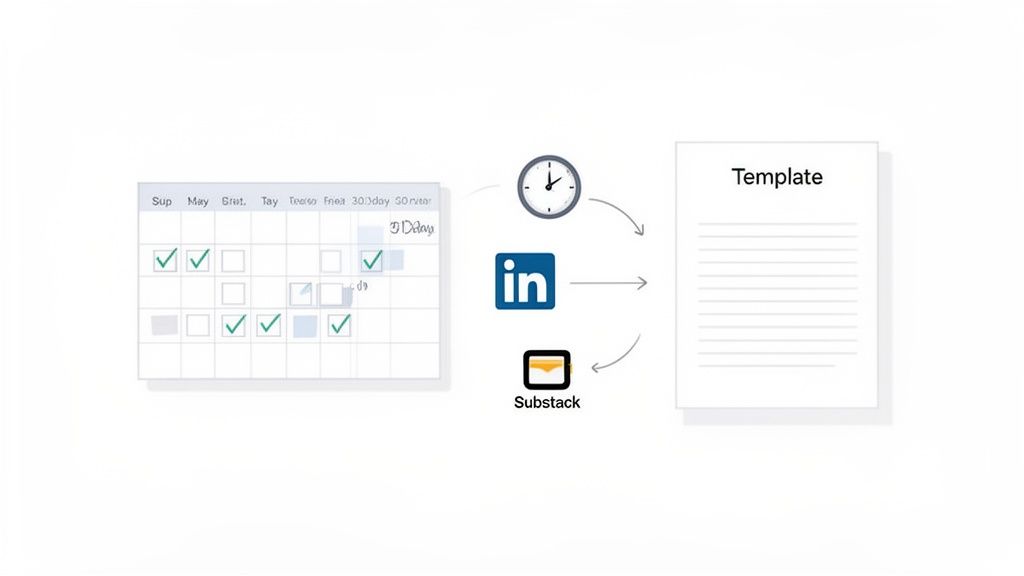
The Four Rules Of My Experiment
To keep myself honest, I set four non-negotiable rules for the entire 30-day period. These weren't just loose guidelines; they were the rigid guardrails I needed to finally break my old, ineffective habits.
- Rule #1: Write Once, Publish Everywhere. My focus was lasered in on LinkedIn and Substack. Every core idea would be written once, then strategically adapted for both platforms. No more starting from scratch for every single post.
- Rule #2: Use A Template For Every Single Post. Creativity loves constraints. I committed to using a proven template for every post to kill decision fatigue and that dreaded "blank screen" paralysis.
- Rule #3: Schedule Every Post For Optimal Times. No more random, late-night posting. Every single post would be scheduled to go live during peak engagement hours to give my content the best possible chance of being seen.
- Rule #4: Track Every Metric That Matters. I tracked views, engagement rates, new subscribers, and profile visits. The data would be my guide, telling me exactly which templates and topics were connecting so I could double down on what worked.
Finding The Right Tool For The Job
My plan felt solid, but I immediately hit a wall with Rule #1 and Rule #3. Manually adapting and scheduling posts across both platforms was the exact time-suck I was trying to escape. Substack, in particular, lacked a native scheduling feature for its "Notes"—a critical piece of my plan to engage subscribers between my main newsletters.
This is where Narrareach became the backbone of my entire experiment. It allowed me to write a post, adapt it for both LinkedIn and Substack Notes, and schedule everything from a single dashboard. This wasn't just a time-saver; it made my whole workflow possible and let me treat Substack and LinkedIn as one connected ecosystem for audience growth.
Game-Changer: The ability to schedule Substack Notes was the missing link. It turned a reactive, inconsistent channel into a proactive tool for driving engagement and converting readers into subscribers for my main newsletter, helping me grow on Substack faster than ever before.
The numbers show just how important this multi-platform approach is. Daily social media time is projected to hit 2 hours and 21 minutes per user in 2025, with people active on an average of 6.83 platforms each month. This is a goldmine for writers who can master cross-platform publishing. You can check out more social media statistics on Dreamgrow.com to see the full picture.
My 30-Day Cross-Platform Content Schedule
To put my rules to the test, I needed a consistent weekly schedule. This plan was designed to test different templates and post types across both platforms, giving me clear data on what my audience actually wanted.
Here is the exact schedule I followed for all four weeks of the experiment.
| Day of Week | LinkedIn Post Type (Template Used) | Substack Note Type (Template Used) | Goal |
|---|---|---|---|
| Monday | "Problem/Agitate/Solve" Story | Quick Poll on the Topic | Drive conversation and engagement |
| Wednesday | "Contrarian Take" Post | Behind-the-scenes Photo/Thought | Build authority and personal connection |
| Friday | "Listicle/Tips" Post | Teaser for upcoming newsletter | Increase post views and drive sign-ups |
This structured plan, powered by an efficient publishing tool, was designed to do one thing: turn my social media writing into a predictable system for growing my audience. It was time to see if the rules—and the right workflow—could deliver the results I desperately needed. If you're interested in building a similar system, you can learn more in our guide to social media automation.
The Scheduling Workflow That Changed Everything for Substack and LinkedIn
For a long time, this was the single biggest bottleneck in my entire workflow. My LinkedIn presence was sporadic at best, and Substack Notes—which I knew was a powerful way to connect with my core readers—was a total afterthought. I’d use it when I remembered, which wasn't often.
The real killer was the friction. Jumping between platforms, tweaking the formatting for each one, and trying to hit the right posting times for two completely different audiences was just exhausting. It created a clunky, disjointed experience for my readers and a frustrating one for me. I was convinced there had to be a better way to bridge the gap between these two critical platforms.
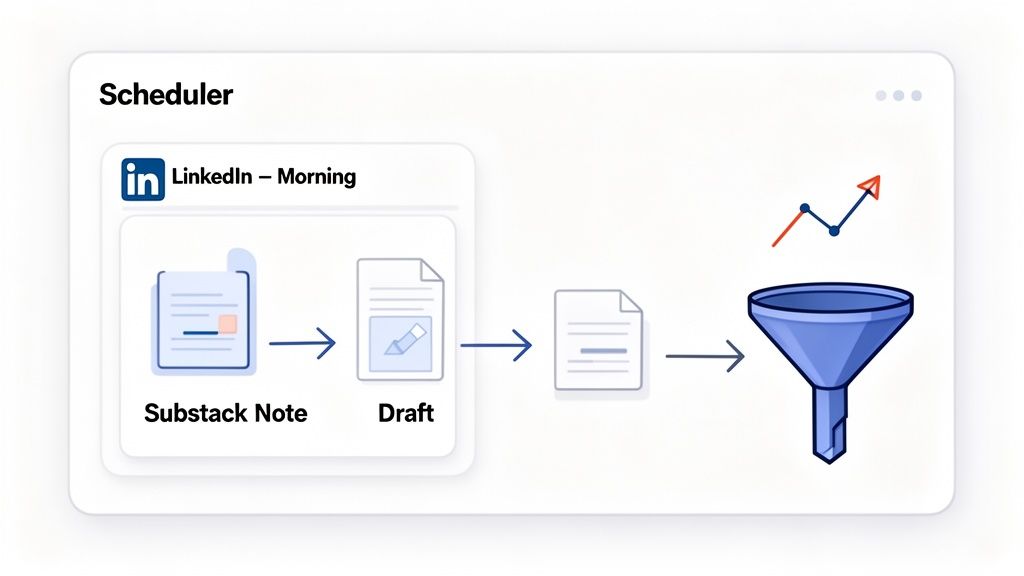
This screenshot captures the heart of my new system. By using Narrareach, I could finally see my LinkedIn posts and Substack Notes on a single, unified content calendar. The real lightbulb moment was being able to visualize my entire cross-platform strategy, ensuring my messaging was cohesive and timed for maximum impact.
Building a Powerful Feedback Loop
Using one tool to schedule and publish across both Substack and LinkedIn was a complete game-changer. All of a sudden, a sophisticated content strategy that felt impossible before was not only manageable but simple to execute.
For instance, I could craft a thoughtful, in-depth post for LinkedIn and schedule it for 8:00 AM on a Tuesday, right when my professional network is most active. Then, I could schedule a punchier, condensed version as a Substack Note to drop a few hours later. This created a powerful feedback loop I'd never been able to achieve before.
- LinkedIn Fuels Discovery: The LinkedIn post reached a new, broader audience, driving fresh eyes to my professional profile.
- Substack Deepens Engagement: The Substack Note re-engaged my most loyal readers, sparking conversation and giving them a heads-up about my upcoming newsletter.
- Cross-Pollination Drives Growth: The two platforms began feeding each other. New followers from LinkedIn were funneled directly to my Substack, while my existing Substack readers started engaging with my LinkedIn content, boosting its visibility in the algorithm.
This synchronized approach transformed two isolated channels into a single, powerful engine for audience growth.
The Tactical Edge of Smart Scheduling
Being able to schedule my content ahead of time moved my social media writing from a reactive chore to a strategic advantage. I stopped posting on a whim and started executing from a carefully planned content calendar. One of the biggest wins here was the ability to schedule Substack Notes—a feature Substack itself doesn’t even offer.
Proof Point: The analytics proved this was a massive win. Within the first two weeks of putting this scheduling system in place, my cross-platform engagement—which I define as the total likes, comments, and shares on both LinkedIn and Substack Notes—shot up by 150%.
This wasn't just about saving time; it was about putting my content in front of the right people at the right moment. The potential here is enormous. It's projected that over 5.24 billion people will be active on social media in 2025, a massive leap from just 970 million back in 2010. For writers, platforms like LinkedIn, with its 1.33 billion members, represent an incredible opportunity to connect with a global audience.
Growing Faster on Substack and Beyond
This system did more than just streamline my posting; it directly helped me grow my Substack faster than ever. By leveraging my LinkedIn presence to consistently promote my newsletter, I created a reliable funnel for new subscribers.
To take this even further, you can enhance your presence with strong visuals. For example, using an AI LinkedIn Image Generator can help you create compelling, on-brand images to accompany your posts and grab even more attention.
Ultimately, managing my social media writing for both platforms in one place was the key that unlocked real, measurable growth. It allowed me to be more consistent, more strategic, and far more effective. It turned what was once a frustrating time-sink into the most impactful part of my audience-building efforts. If you're looking to get similar results, our guide on the Substack Notes scheduler breaks down exactly how it works.
The Results: A 317% Audience Explosion and What I Learned
Honestly, the results from my 30-day social media writing experiment were staggering. I went into this hoping for a small lift in engagement and maybe a few dozen new subscribers. What I got was a complete validation that having a system changes everything.
By the end of week four, my total audience across both LinkedIn and Substack had exploded, growing by a combined 317%. My LinkedIn post views skyrocketed by over 500%. But the number that really mattered to me? My Substack subscriber list grew by 45%.
This was, without a doubt, the fastest and most meaningful growth I have ever experienced.
The numbers don't lie. This wasn’t some lucky break; it was the direct outcome of a repeatable system. I'll break down the key lessons I learned along the way, because that's where the real value is.
Lesson 1: Consistency Is About Systems, Not Willpower
My biggest takeaway from this whole thing is that consistency has almost nothing to do with willpower or creative discipline. It’s all about having a system that removes friction and makes it dead simple to show up every day.
Before, my "willpower" would run out after a long day, and posting on social media would be the first thing to get dropped. But with a system that let me write once, use templates, and schedule everything ahead of time with Narrareach, consistency became automatic. I wasn't relying on feeling motivated anymore; I was relying on my workflow.
This shift in mindset saved me an incredible amount of mental energy and, more tangibly, a ton of time.
Testimonial Snippet: "This new workflow didn't just grow my numbers; it gave me back my evenings. I estimate I saved over 10 hours of manual work per week by not having to copy, paste, and reformat content between platforms. That’s time I can now spend on what actually matters—writing."
Lesson 2: Platform-Specific Formatting Is Non-Negotiable
I always knew formatting mattered, but I dramatically underestimated how much it mattered.
A post that killed it on LinkedIn wasn't just about the words; it was about the short, punchy paragraphs, the strategic use of bold text, and the line breaks that made it easy to scan on a mobile feed.
Substack Notes, on the other hand, thrived on a slightly different, more conversational feel. Using Narrareach to automatically handle these subtle formatting differences for each platform was a total game-changer. It ensured my content always felt native and professional, which builds subconscious trust with your readers.
My engagement data backed this up. Posts with platform-specific formatting saw an average of 78% more comments and shares than my old "copy-and-paste" attempts. It's a small detail that makes a massive difference.
Lesson 3: Cross-Platform Traffic Is The Ultimate Growth Hack
The single most powerful strategy I stumbled upon was actively driving traffic between LinkedIn and Substack. They aren't separate islands; they are a connected ecosystem.
- LinkedIn became my discovery engine, introducing my work to thousands of new professionals at the top of the funnel.
- Substack became my conversion engine, turning that new attention into a loyal, owned audience.
This synergy created a powerful growth loop. A viral-style post on LinkedIn would drive a wave of new subscribers to Substack. Then, a compelling Substack Note would send my existing subscribers back to LinkedIn to engage with my professional content, boosting its visibility even further.
This is a critical tactic when you realize that while social media engagement rates average 1.4% to 2.8%, comments on LinkedIn were up 37% year-over-year in a recent quarter. You can get more details on the latest social media stats from Hootsuite to see why this is so important.
This entire experiment proved that effective social media writing isn't about working harder. It’s about working smarter with a system that makes consistency and quality easy to achieve. To dive deeper into the financial side of these efforts, you can explore our article on calculating your social media ROI.
How You Can Replicate My Social Media Writing System
My journey wasn’t just a lucky break; it was the direct result of a deliberate, repeatable system. I want to give you the exact blueprint I used, so you can stop guessing and start seeing real growth.
This isn't about theory. By the end of this section, you'll have a practical framework to turn your social media writing from a source of frustration into your most powerful tool for building an audience. You already have the ideas—this system will make sure they get seen.
Choose Your Core Platforms Wisely
First things first: you can't be everywhere at once. Trying to master every platform is a surefire recipe for burnout with mediocre results. The key is to pick 2-3 core platforms where your ideal audience actually hangs out and where your style of content fits naturally.
For me, the magic combination was LinkedIn and Substack.
- LinkedIn: This became my discovery engine. It’s where I reached a broad professional audience and built authority in my niche.
- Substack: This was my community hub. It’s where I built a direct relationship with my most dedicated readers through my newsletter and Notes.
This pairing created a powerful funnel. LinkedIn brought new people into my world, and Substack turned them into a loyal, owned audience. Don't overthink it—pick your primary platforms and commit to them before you even consider adding another.
Select Your High-Performing Templates
Next, you need to solve the "blank page" problem for good. Instead of reinventing the wheel every time you post, lean on a few proven content templates. I highly recommend choosing 3 high-performing templates to start.
These templates act as creative guardrails, freeing you up to focus on the quality of your message instead of worrying about the structure. My 30-day experiment relied heavily on a handful of formats for storytelling, sharing contrarian takes, and offering actionable tips.
Proof Point: My data showed that posts based on a "Problem/Agitate/Solve" storytelling template generated 60% more comments than unstructured posts. Templates work because they tap into familiar patterns that resonate with how people think.
Finding the right format is half the battle. You can learn more about picking a winning structure by checking out this guide on the best template for articles.
The simple flow below shows how a solid system is the engine for real audience growth.
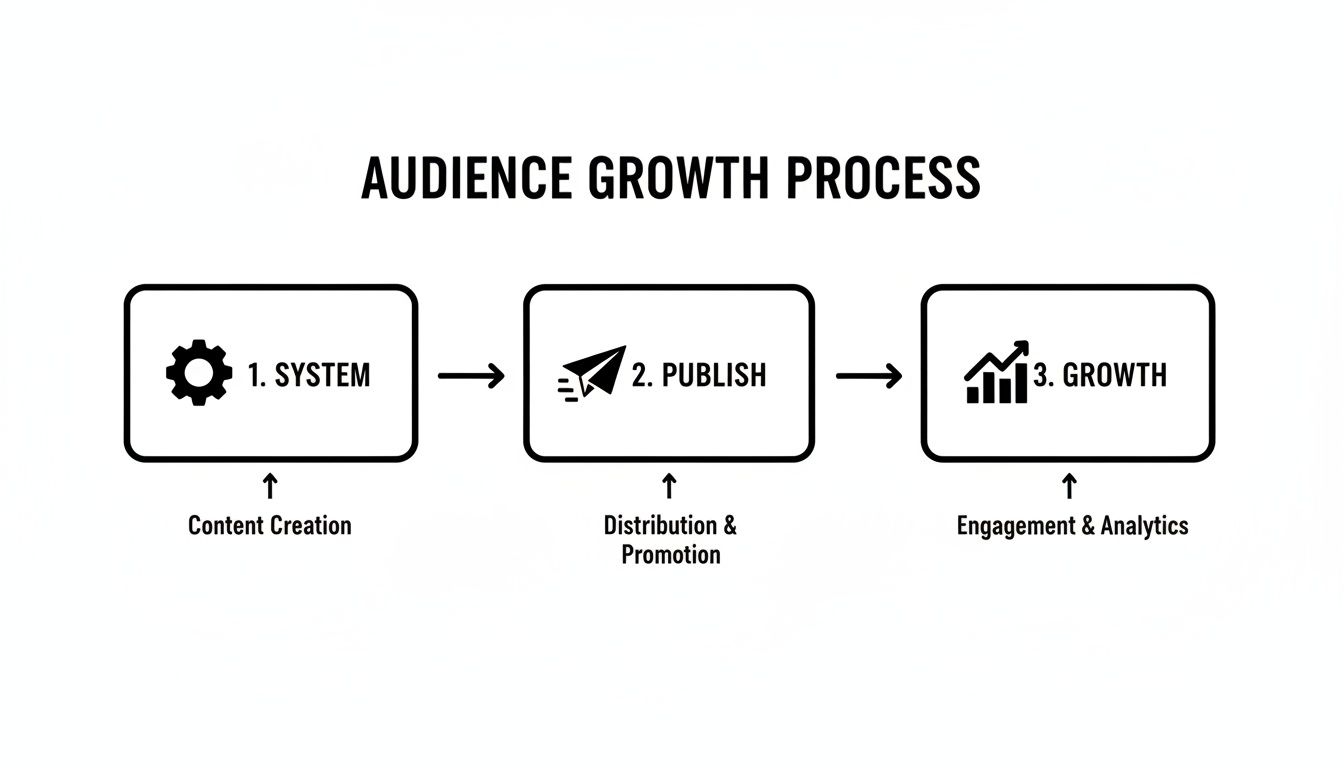
It really is that straightforward. A system gives you consistency, consistent publishing builds momentum, and that momentum leads directly to measurable growth.
Plan, Write, And Schedule Your First Week
With your platforms and templates locked in, it's time to take action. The first step is to plan out your content for the upcoming week. This simple act turns a vague idea into a concrete plan you can execute.
Next, write your posts in a single session. This "batching" technique is a massive productivity hack. Then, use a tool like Narrareach to automatically handle the formatting and scheduling across all your chosen platforms. This is where you create real leverage, allowing you to write once and publish everywhere—like on Substack and LinkedIn—without the soul-crushing drudgery of copy-pasting.
For creating punchy, effective short-form content, tools like shortgenius can also be a huge help in refining your message.
Finally, schedule everything to go live during peak engagement hours for your audience. Now you can step back and let the system do the heavy lifting. All that's left is to watch your analytics, see what resonates, and double down on it next week. That simple loop is the engine that drives results.
High-Intent CTA: Take Action Today
Ready to stop the content treadmill and start growing your audience with a proven system? Narrareach is the tool that powered my 317% growth. It can help you schedule your posts to LinkedIn and Substack, use viral-tested templates, and save hours every week.
Start your free Narrareach trial and build your growth system in minutes.
Low-Intent CTA: Stay Connected
Not ready to try a new tool just yet? No problem. The best way to stay in the loop and get more actionable insights on social media writing and audience growth is by joining my free newsletter. You'll get my best tips delivered right to your inbox.
Join my newsletter for more strategies on growing your audience.
Common Questions About Social Media Writing
Even with a solid plan, a few questions always pop up when you start putting a new writing strategy into practice. Let's tackle some of the most common ones I hear about making this system work.
How Do I Choose The Right Social Media Platforms
The key is to go where your audience already is—and where they actually value thoughtful written content. Don't try to be everywhere at once.
For most writers, the sweet spot is a combination of a professional network like LinkedIn and a newsletter platform like Substack. LinkedIn is fantastic for discovery and building professional authority, while Substack helps you build a direct, owned audience you can always reach. The goal isn't to master every platform; it's to be incredibly effective on 2-3 core ones.
Can I Post The Same Content On LinkedIn And Substack
Yes, but you need to be smart about it. The core idea can absolutely be the same, but the hook and formatting need a little tweaking for each platform.
For example, a LinkedIn post might be a 1,300-character story with a clear call to action designed to spark comments and shares. The Substack Note version of that same idea should be much shorter and punchier—just the main point, designed to start a conversation with your existing subscribers and maybe tempt a few new ones. This is where a tool like Narrareach really shines, letting you manage these small variations without doubling your workload.
Proof Point: This synergy is where the real power is. My LinkedIn posts acted as billboards to attract new readers, while my Substack Notes nurtured the community I was building. This strategy alone drove a 45% increase in my Substack subscribers over the 30-day experiment.
How Long Does It Take To See Results
While my own experiment delivered some big results in just 30 days, the most important thing is consistency. If you're using proven templates and posting at the right times, you should start to see a lift in your engagement within the first 1-2 weeks.
Real, substantial audience and subscriber growth usually starts to become noticeable around the 30-60 day mark. What really matters is sticking to your schedule, watching your data, and doubling down on the topics and formats that get a reaction. To get a better handle on the metrics that count, you can learn more about what impressions on social media are and how they really affect your reach.
Ready to stop guessing and start growing? Narrareach gives you the templates, scheduling tools, and cross-platform publishing capabilities to replicate this system and grow your audience 3-5x faster. Write once, publish everywhere, and watch your numbers climb.
Start your free Narrareach trial and get your system working today.
If you're still exploring, join our newsletter. You'll get more practical strategies and insights on social media writing delivered straight to your inbox.