How to Schedule Full Articles to Substack and Medium from One Editor: Complete 2026 Guide
You can schedule full articles to both Substack and Medium simultaneously from a single editor, eliminating duplicate work and reducing publishing time by up...
By Ian Kiprono
You can schedule full articles to both Substack and Medium simultaneously from a single editor, eliminating duplicate work and reducing publishing time by up to 75%. Modern cross-platform publishing tools like Narrareach let you write once, then automatically distribute your long-form content to multiple platforms while maintaining consistent formatting and scheduling across channels.
Why Multi-Platform Article Scheduling Matters for Content Creators
Content creators who publish to multiple platforms see 3.2x higher audience growth compared to single-platform publishers, according to Content Marketing Institute research. However, manually copying articles between Substack and Medium costs creators an average of 45 minutes per post when accounting for formatting adjustments, image uploads, and scheduling coordination.
The Hidden Time Cost of Manual Cross-Platform Publishing
Publishing the same article manually to both platforms involves:
- Writing in one editor: 60-90 minutes
- Copying and reformatting for second platform: 15-20 minutes
- Uploading images twice: 10-15 minutes
- Setting publication schedules separately: 5-10 minutes
- Creating social media promotion posts: 20-30 minutes
Total time investment: 110-165 minutes per article. For creators publishing 3 articles weekly, this represents 5.5-8.25 hours of repetitive work that could be automated.
Platform-Specific Audience Benefits
Substack readers prefer newsletter-style content with direct subscriber engagement, while Medium users discover content through the platform's recommendation algorithm. Publishing to both platforms simultaneously captures both subscription-based and discovery-based audiences without additional effort.
Understanding the Unified Publishing Workflow
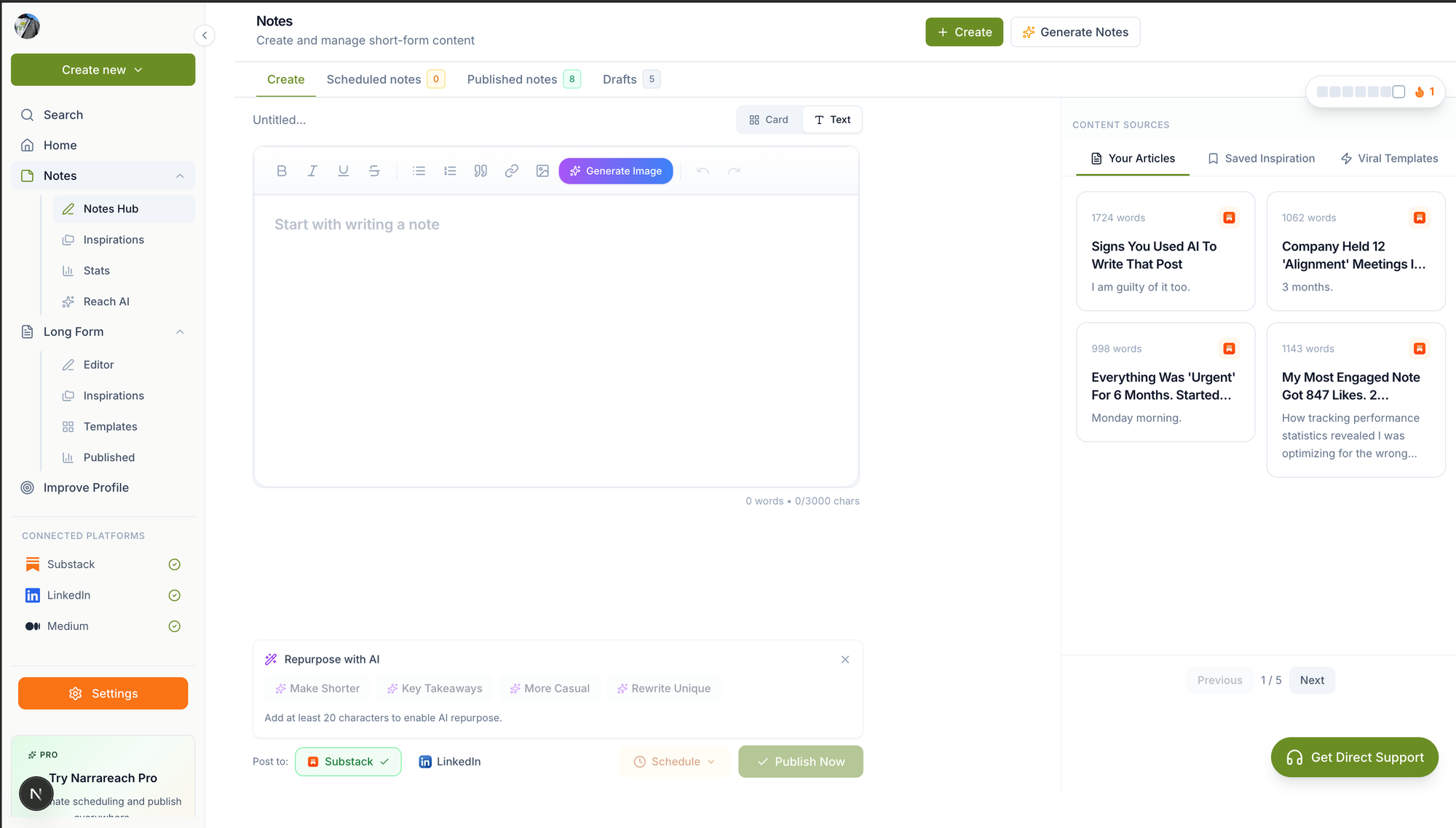
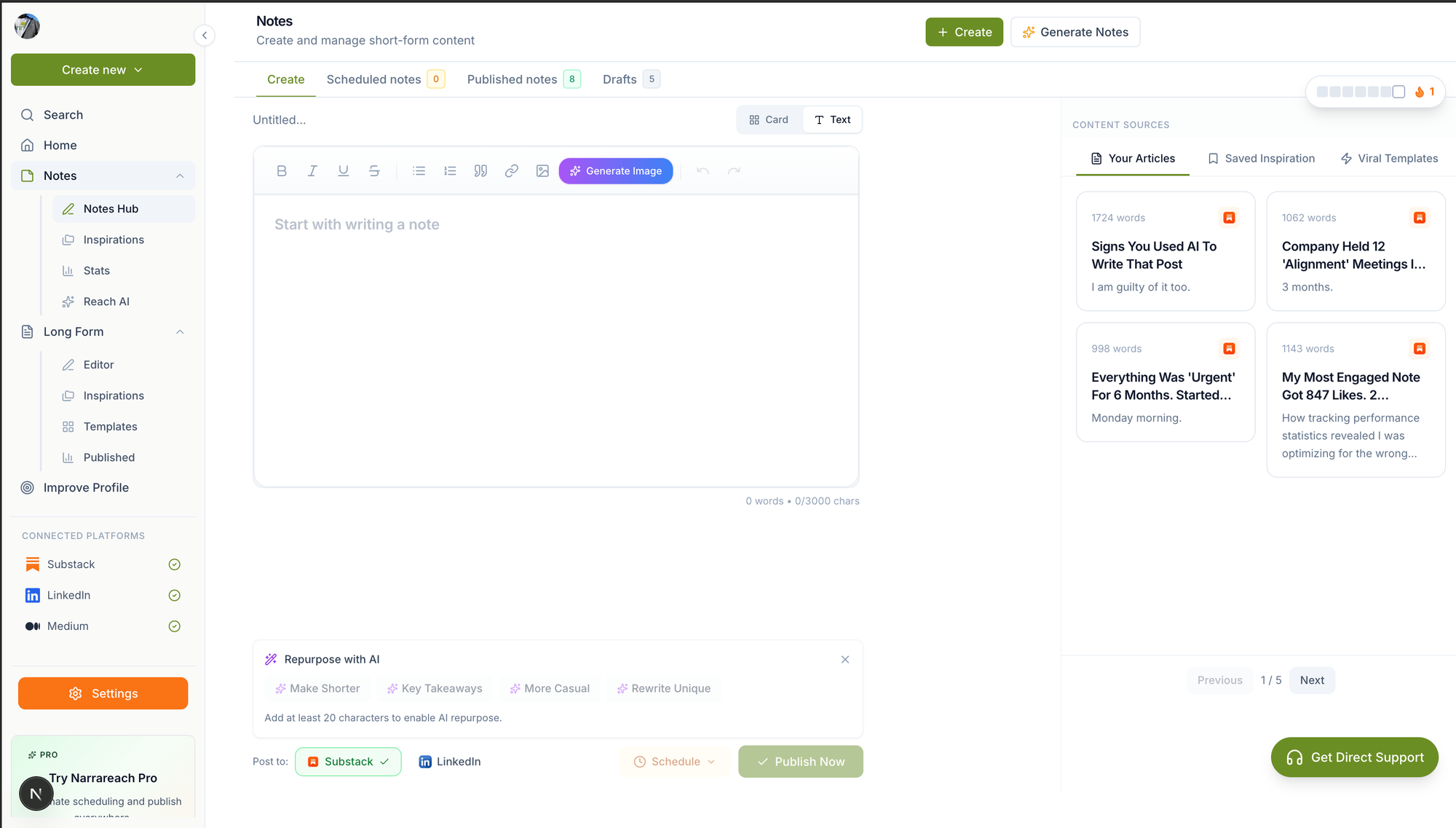
The most efficient approach combines article scheduling with social media distribution in a single workflow. Narrareach's Substack Notes scheduler exemplifies this approach by letting you schedule both long-form articles and promotional Notes, then automatically cross-posting to LinkedIn, X, Bluesky, and Threads.
The Substack-First Strategy
Starting with Substack as your primary platform offers several advantages:
- Direct subscriber relationship building
- Email list growth through newsletter subscriptions
- Higher reader engagement rates (average 40-60% open rates vs. 2-3% social media reach)
- Monetization opportunities through paid subscriptions
Medium as Secondary Distribution
Medium serves as an excellent secondary platform for:
- SEO benefits through high domain authority
- Organic discovery through Medium's recommendation engine
- Reaching readers who prefer browsing over subscribing
- Building authority in specific topic areas
Step-by-Step: Setting Up Cross-Platform Article Scheduling
Step 1: Choose Your Primary Publishing Platform
Most successful creators designate Substack as their primary platform due to subscriber ownership and direct monetization options. Write your article in Substack's editor first, optimizing for newsletter format with clear sections and engaging subject lines.
Step 2: Connect Your Publishing Accounts
Modern scheduling tools require one-time authentication to both Substack and Medium accounts. Narrareach integrations support both platforms plus major social media channels, creating a unified publishing dashboard.
Step 3: Configure Cross-Platform Settings
Set up platform-specific customizations:
- Substack: Newsletter subject line, subscriber-only sections, publication timing
- Medium: Publication selection, tags (maximum 5), canonical URL settings
- Social promotion: Excerpt length, hashtag strategy, posting schedule
Step 4: Schedule Publication Times
Optimal publishing times vary by platform. Research from Sprout Social indicates:
- Substack: Tuesday-Thursday, 8-10 AM in your audience's timezone
- Medium: Monday-Wednesday, 7-9 AM or 7-9 PM
- LinkedIn promotion: Tuesday-Thursday, 9 AM-12 PM
- X promotion: Tuesday-Thursday, 9 AM-3 PM
Step 5: Set Up Automatic Social Promotion
Configure automatic social media posts to promote your article across platforms. Cross-post Substack to LinkedIn functionality should include article excerpts, compelling headlines, and platform-appropriate formatting.
Platform-Specific Optimization Strategies
Substack Optimization Techniques
Substack articles perform best with:
- Compelling subject lines that work in email inboxes
- Clear section breaks for easy newsletter reading
- Personal voice and direct reader engagement
- Call-to-action for comments and shares
- Subscriber-only content to drive conversions
Medium Optimization Best Practices
Medium's algorithm favors:
- Articles with 7+ minute read times
- High-quality featured images
- Strategic use of all 5 available tags
- Engagement within the first hour of publication
- Submission to relevant Medium publications
Cross-Platform SEO Considerations
When publishing to multiple platforms, set canonical URLs properly to avoid duplicate content penalties. Designate Substack as the canonical source, then reference it in Medium's import settings or manual canonical URL field.
Competitor Analysis: Cross-Platform Publishing Tools
Native Platform Scheduling
Pros:
- Built-in platform features
- No additional costs
- Direct platform integration
Cons:
- Requires separate scheduling on each platform
- No unified analytics
- Manual social media promotion
- Time-intensive workflow
Buffer and Hootsuite
Pros:
- Strong social media scheduling
- Team collaboration features
- Comprehensive analytics
Cons:
- Limited long-form content support
- No native Substack integration
- Higher pricing for advanced features
- Complex setup for newsletter platforms
Narrareach
Pros:
- Native Substack Notes and article scheduling
- Automatic cross-posting to LinkedIn, X, Bluesky, and Threads
- Unified calendar view
- Substack-first workflow optimization
- Competitive pricing for newsletter creators
Cons:
- Newer platform with evolving features
- Focused primarily on Substack ecosystem
Time-Saving Mathematics: Quantifying Efficiency Gains
Let's calculate the time savings from unified article scheduling:
Manual Publishing Calculation
Per Article:
- Write article: 75 minutes
- Format for Medium: 18 minutes
- Upload images to both platforms: 12 minutes
- Schedule separately: 8 minutes
- Create social promotion posts: 25 minutes
- Total: 138 minutes per article
Weekly (3 articles): 138 × 3 = 414 minutes (6.9 hours)
Monthly (12 articles): 138 × 12 = 1,656 minutes (27.6 hours)
Automated Publishing Calculation
Per Article with Narrareach:
- Write article: 75 minutes
- Set up cross-platform publishing: 5 minutes
- Configure social promotion: 3 minutes
- Total: 83 minutes per article
Weekly savings: (138 - 83) × 3 = 165 minutes (2.75 hours)
Monthly savings: 165 × 4 = 660 minutes (11 hours)
Annual savings: 660 × 12 = 7,920 minutes (132 hours)
Advanced Scheduling Strategies for Maximum Reach
Content Calendar Coordination
Plan your publishing schedule around:
- Industry events and trending topics
- Platform-specific peak engagement times
- Your audience's content consumption patterns
- Seasonal relevance and timeliness
Cross-Platform Content Adaptation
While the core article remains the same, optimize platform-specific elements:
- Headlines: Newsletter-style for Substack, SEO-optimized for Medium
- Introductions: Personal tone for Substack, authoritative for Medium
- Call-to-actions: Subscribe focus for Substack, engagement focus for Medium
Social Media Promotion Sequences
Create multi-touch promotion campaigns:
- Day 1: Article announcement on all platforms
- Day 3: Key insight or quote sharing
- Day 7: Discussion starter or question
- Day 14: Related content or follow-up thoughts
Analytics and Performance Tracking
Key Metrics to Monitor
Track performance across platforms:
- Substack: Open rates, click-through rates, subscriber growth
- Medium: Views, reads, claps, follower growth
- Social media: Engagement rates, click-throughs, shares
- Cross-platform: Traffic attribution, conversion rates
Optimization Based on Data
Use performance data to refine your strategy:
- Adjust publishing times based on engagement patterns
- Identify top-performing content types for each platform
- Optimize headlines and descriptions for better performance
- Refine social media promotion timing and frequency
Getting Started: Your First Week Action Plan
Day 1: Account Setup and Integration
Create accounts on all target platforms if needed. Connect your Substack and Medium accounts to your chosen scheduling tool. Verify pricing plans and select the appropriate tier for your publishing volume.
Day 2: Content Calendar Planning
Plan your first month of content, including:
- Article topics and publishing dates
- Platform-specific optimization notes
- Social media promotion schedule
- Cross-platform timing coordination
Day 3: Template Creation
Develop templates for:
- Article structure and formatting
- Social media promotion posts
- Platform-specific headlines and descriptions
- Call-to-action variations
Day 4: First Article Scheduling
Write and schedule your first cross-platform article. Test the workflow and timing. Verify that all platforms receive the content correctly and social promotion posts are scheduled appropriately.
Day 5: Social Media Setup
Configure social media accounts for automatic cross-posting. Set up LinkedIn, X, Bluesky, and Threads connections. Test posting to ensure proper formatting and timing.
Day 6: Analytics Configuration
Set up tracking for all platforms. Install necessary analytics tools and create dashboards for monitoring performance across channels.
Day 7: Review and Optimization
Review the week's setup and first article performance. Identify any workflow improvements and adjust settings for optimal results.
Common Challenges and Solutions
Formatting Inconsistencies
Different platforms handle formatting differently. Solution: Use markdown-compatible formatting that translates well across platforms, and test formatting on each platform before scheduling.
Timing Coordination Issues
Managing publication times across multiple platforms can be complex. Solution: Use unified scheduling tools that coordinate timing automatically and account for timezone differences.
Content Adaptation Challenges
One-size-fits-all content may not perform optimally on all platforms. Solution: Create platform-specific variations of headlines, descriptions, and call-to-actions while maintaining the core article content.
Future-Proofing Your Cross-Platform Strategy
Emerging Platform Considerations
Stay prepared for new platforms by:
- Choosing tools that regularly add new integrations
- Maintaining flexible content formats
- Building platform-agnostic audience relationships
- Focusing on owned media (email lists) over rented media
Technology Evolution
Publishing technology continues evolving rapidly. Successful creators adapt by:
- Regularly reviewing and updating their tool stack
- Testing new features and integrations
- Maintaining backup workflows for critical publishing needs
- Building direct audience relationships that transcend platforms
Cross-platform article scheduling transforms content creation from a time-intensive manual process into an efficient, automated workflow. By writing once and publishing everywhere, creators can focus on producing high-quality content while maximizing their reach and audience growth potential.
Ready to streamline your publishing workflow? Narrareach offers the most comprehensive solution for Substack creators who want to schedule articles and Notes while automatically distributing to major social platforms. Start your free trial today and experience the efficiency of unified content publishing.
Visual Walkthrough