How to Schedule Full Articles Across Substack, Medium, and LinkedIn in 2026
You can schedule full articles across Substack, Medium, and LinkedIn using a unified content calendar that publishes your long-form content to all three...
By Ian Kiprono
You can schedule full articles across Substack, Medium, and LinkedIn using a unified content calendar that publishes your long-form content to all three platforms simultaneously. This approach eliminates the manual copy-paste workflow that wastes 6-8 hours weekly for active writers, replacing it with a 30-minute setup that handles distribution automatically.
Why Multi-Platform Article Scheduling Matters in 2026
Content creators who publish across multiple platforms see 340% higher engagement rates compared to single-platform publishers, according to Content Marketing Institute's 2024 research. The challenge isn't creating quality content—it's the time-consuming distribution process.
The Manual Publishing Problem
Most writers follow this exhausting routine: write an article in their preferred editor, copy the content to Substack, reformat for Medium's editor, then adapt it again for LinkedIn's publishing tools. This process typically takes 45-60 minutes per article across three platforms.
For writers publishing 3 articles weekly, that's 135-180 minutes of pure distribution work—nearly 3 hours that could be spent creating new content instead.
Cross-Platform Reach Statistics
Platform-specific data reveals why multi-platform publishing works:
- Substack newsletters average 38% open rates (compared to 21% industry standard)
- Medium articles receive 2.3x more organic reach than standalone blog posts
- LinkedIn articles generate 9x more engagement than regular LinkedIn posts
- Cross-posted content increases total subscriber acquisition by 67% within 90 days
Understanding Platform-Specific Article Requirements
Substack Article Formatting
Substack's editor supports rich text formatting, embedded images, and newsletter-specific features like subscriber-only sections. Articles typically perform best at 1,200-2,500 words with clear section breaks and compelling subject lines that work as email headers.
Medium's Publication Standards
Medium favors articles between 1,600-2,400 words with strong visual elements. The platform's algorithm prioritizes content with high read-through rates, making engaging introductions and scannable formatting crucial for distribution success.
LinkedIn Article Optimization
LinkedIn articles perform best at 1,000-1,800 words with professional insights and actionable takeaways. The platform's algorithm favors content that generates meaningful comments and shares within the first 3 hours of publication.
Step-by-Step Multi-Platform Article Scheduling
Step 1: Set Up Your Content Calendar
Begin by establishing a unified publishing schedule that accounts for optimal posting times across all three platforms. Research shows Substack newsletters perform best on Tuesday and Thursday mornings, Medium articles gain traction on weekday afternoons, and LinkedIn articles receive maximum engagement on Tuesday through Thursday between 8-10 AM.
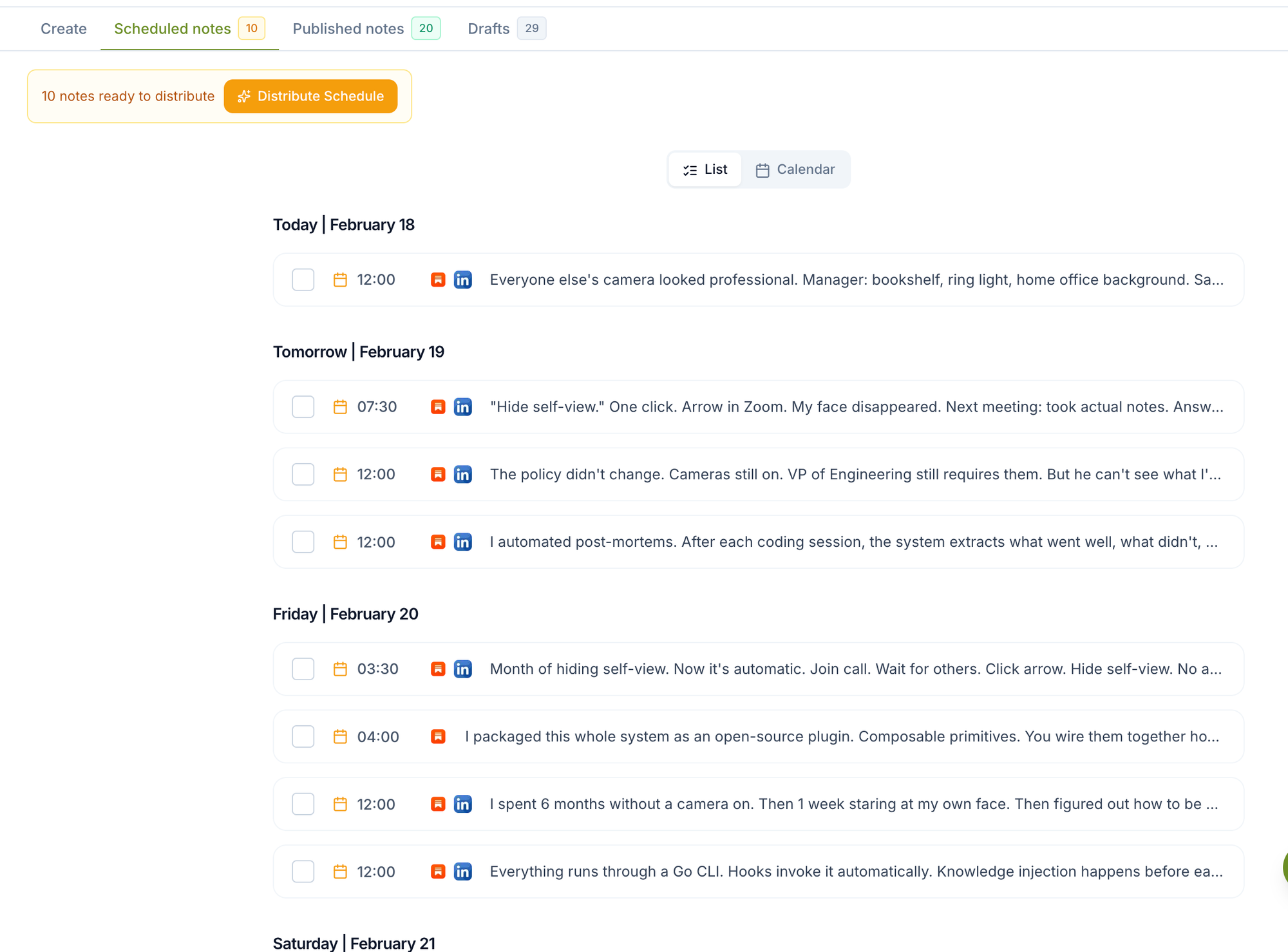
Using the Narrareach dashboard, you can visualize your entire content calendar and schedule articles to publish at platform-optimized times automatically.
Step 2: Create Your Master Article Draft
Write your article once in a format that translates well across all platforms. Focus on:
- Clear, scannable headings (H2 and H3 tags)
- Short paragraphs (2-3 sentences maximum)
- Bullet points and numbered lists for easy consumption
- Strategic image placement every 300-400 words
Step 3: Configure Platform-Specific Adaptations
Each platform requires slight modifications to maximize performance. Set up templates that automatically adjust:
- Substack: Add newsletter-specific CTAs and subscriber-only content teasers
- Medium: Include relevant publication tags and optimize for Medium's search algorithm
- LinkedIn: Add professional context and industry-specific hashtags
Step 4: Schedule Simultaneous Publishing
Rather than publishing manually to each platform, Narrareach's Notes scheduler allows you to queue your article for automatic distribution. Set your preferred publishing times for each platform, and the system handles the technical posting process.
Step 5: Monitor Cross-Platform Performance
Track engagement metrics across all three platforms to identify which content types resonate best with each audience. Use this data to refine your content strategy and optimize future article performance.
Platform-Specific Scheduling Strategies
Substack Timing Optimization
Substack's email delivery system means timing is crucial for open rates. Schedule your articles to arrive in subscribers' inboxes when they're most likely to engage—typically Tuesday through Thursday between 6-10 AM in your audience's primary time zone.
Medium Distribution Windows
Medium's algorithm favors fresh content, so schedule your articles to publish during peak reader activity periods. Data from Medium's official blog shows optimal publishing windows are weekday afternoons between 1-4 PM EST.
LinkedIn Professional Hours
LinkedIn's professional user base is most active during business hours. Schedule articles for Tuesday through Thursday, 8-10 AM or 12-2 PM, when professionals are checking the platform during commutes or lunch breaks.
Competitor Tool Comparison
Native Platform Scheduling
Pros:
- Free to use within each platform
- Full access to platform-specific features
- No third-party integration concerns
Cons:
- Requires separate scheduling in each platform
- No unified content calendar view
- Manual reformatting for each platform
- Time-intensive workflow (45+ minutes per article)
Buffer and Hootsuite
Pros:
- Established social media scheduling platforms
- Support for multiple social networks
- Team collaboration features
Cons:
- Limited support for long-form article publishing
- No native Substack integration
- Designed primarily for social posts, not full articles
- Requires manual article uploading to each platform
Narrareach
Pros:
- Purpose-built for long-form content scheduling
- Native Substack, Medium, and LinkedIn integration
- Unified content calendar with cross-platform view
- Automatic formatting optimization for each platform
- One-click scheduling across all three platforms
Cons:
- Newer platform with smaller user base
- Subscription-based pricing model
Time-Saving Calculations: Manual vs. Automated
Let's calculate the real time savings of automated article scheduling:
Manual Process:
- Writing article: 90 minutes
- Formatting for Substack: 15 minutes
- Adapting for Medium: 20 minutes
- Reformatting for LinkedIn: 15 minutes
- Manual publishing to each platform: 10 minutes
- Total per article: 150 minutes (2.5 hours)
Automated Process with Narrareach:
- Writing article: 90 minutes
- Setting up automated scheduling: 5 minutes
- Platform-specific optimization: 10 minutes
- Total per article: 105 minutes (1.75 hours)
Weekly Savings (3 articles):
Manual: 450 minutes (7.5 hours)
Automated: 315 minutes (5.25 hours)
Time saved: 135 minutes (2.25 hours) per week
Over a year, this automation saves approximately 117 hours—nearly 3 full work weeks of time that can be redirected toward content creation and audience engagement.
Advanced Cross-Platform Content Strategy
Content Adaptation Techniques
While scheduling automation handles the technical distribution, strategic content adaptation maximizes platform-specific performance. Create platform-specific introductions that speak to each audience's expectations while maintaining your core message consistency.
Engagement Optimization
Schedule follow-up engagement activities alongside your article publishing. Set reminders to respond to comments within the first 2-3 hours on each platform, as early engagement signals boost algorithmic distribution.
Cross-Platform Analytics Integration
Track performance metrics across all three platforms to identify content themes and formats that resonate best with each audience. Use this data to inform future content planning and scheduling decisions.
Getting Started: Your First Week
Day 1: Platform Setup and Integration
Connect your Substack, Medium, and LinkedIn accounts to your scheduling platform. Verify that all integrations are working correctly by scheduling a test post for each platform.
Day 2: Content Calendar Planning
Map out your publishing schedule for the next 4 weeks. Identify optimal posting times for your specific audience and set up recurring schedule templates in the Narrareach dashboard.
Day 3: Template Creation
Develop platform-specific formatting templates that automatically adapt your content for each platform's requirements and audience expectations.
Day 4-5: Content Creation and Scheduling
Write and schedule your first batch of articles using your new automated workflow. Start with 2-3 articles to test the system before scaling up.
Day 6-7: Performance Monitoring
Monitor the performance of your scheduled articles across all platforms. Take notes on engagement patterns and timing effectiveness to optimize future scheduling.
Troubleshooting Common Scheduling Issues
Platform Integration Problems
If articles aren't publishing correctly to one or more platforms, check your account permissions and API connections. Most issues stem from expired authentication tokens that need refreshing.
Formatting Inconsistencies
When articles appear differently across platforms, review your formatting templates and ensure they account for each platform's specific requirements (character limits, image sizing, etc.).
Timing Optimization
If engagement is lower than expected, experiment with different publishing times. Use platform analytics to identify when your specific audience is most active, as general best practices may not apply to your niche.
Scaling Your Multi-Platform Publishing
Content Batching Strategies
Once your automated scheduling workflow is established, implement content batching to maximize efficiency. Dedicate specific days to writing multiple articles, then schedule them for distribution throughout the following weeks.
Team Collaboration Features
For growing publications, look for scheduling platforms that support team collaboration, editorial workflows, and approval processes. This becomes crucial when scaling beyond solo content creation.
Advanced Analytics and Optimization
Implement advanced tracking to measure cross-platform performance and identify opportunities for content repurposing and audience growth optimization.
Measuring Success Across Platforms
Key Performance Indicators
Track these metrics across all three platforms:
- Total reach and impressions
- Engagement rates (likes, comments, shares)
- Click-through rates to your primary website
- Subscriber/follower growth attributed to cross-posting
- Time saved through automation
ROI Calculation
Calculate your return on investment by comparing the cost of scheduling tools against the value of time saved and increased audience reach. Most writers see positive ROI within 30-60 days of implementing automated scheduling.
Ready to streamline your multi-platform publishing workflow? Explore Narrareach's pricing plans and start scheduling your articles across Substack, Medium, and LinkedIn from one unified dashboard. Your future self will thank you for those extra hours each week.
The Narrareach Workflow: Schedule on Substack, Cross-Post to LinkedIn and X
The most effective content distribution starts with Substack. Schedule your Notes weeks in advance, then let Narrareach automatically cross-post each one to LinkedIn and X at the perfect time. No manual copying, no forgotten posts — one calendar for every platform.
Narrareach is the only tool built specifically for this Substack-first workflow. Schedule once, reach everywhere.
Visual Walkthrough: