How to Schedule Full Articles to Substack and Medium from One Editor in 2026
Scheduling full articles to both Substack and Medium from a single editor eliminates duplicate work while maximizing your content's reach across platforms...
By Ian Kiprono
Scheduling full articles to both Substack and Medium from a single editor eliminates duplicate work while maximizing your content's reach across platforms. Narrareach enables writers to compose once, then automatically schedule and distribute long-form content to Substack and Medium, plus cross-post promotional snippets to LinkedIn, X, Bluesky, and Threads from one unified calendar.
Why Multi-Platform Publishing Matters for Content Creators
Content creators who publish on multiple platforms see significantly higher engagement and subscriber growth. According to ConvertKit's 2024 State of Creator Economy report, newsletter creators who cross-post to 3+ platforms grow their audience 67% faster than single-platform publishers. Medium alone has 100+ million monthly readers, while Substack hosts over 35 million active subscriptions across its platform.
The challenge lies in manual republishing. The average content creator spends 4.2 hours per week reformatting and reposting the same article across platforms, according to Buffer's 2024 Social Media Trends report. This time drain forces many creators to abandon multi-platform strategies entirely, limiting their potential reach.
The Hidden Cost of Manual Cross-Posting
Consider a creator publishing 2 long-form articles weekly across Substack and Medium, then promoting each on 4 social platforms:
- 2 articles × 2 platforms × 15 minutes formatting = 60 minutes
- 8 social posts × 5 minutes each = 40 minutes
- Weekly total: 100 minutes of repetitive work
- Annual time cost: 86+ hours of pure republishing
Automated scheduling and cross-posting can reduce this to under 20 minutes weekly—a 80% time savings that creators can reinvest in content creation.
Platform-Specific Optimization Requirements
Each platform has distinct formatting and engagement patterns. Substack readers expect newsletter-style formatting with clear sections and personal voice. Medium audiences prefer clean, minimalist layouts with strategic use of headers and bullet points. Social platforms require condensed, hook-driven snippets that drive traffic back to the full article.
Smart scheduling tools handle these platform differences automatically, ensuring your content appears native to each environment without manual reformatting.
Step-by-Step Workflow: Write Once, Publish Everywhere
The most efficient approach starts with a single editor that can format and schedule to multiple destinations simultaneously. Here's the complete workflow:
Step 1: Set Up Your Multi-Platform Publishing Hub
Connect your Substack and Medium accounts to Narrareach integrations. The platform authenticates with both services using OAuth, ensuring secure access without storing passwords. This one-time setup takes approximately 3-4 minutes per platform.
During setup, configure your default publishing settings for each platform. Set your preferred publication time, timezone, and any platform-specific formatting preferences. Substack users can choose between sending immediately or scheduling for their optimal engagement windows.
Step 2: Compose Your Article in the Unified Editor
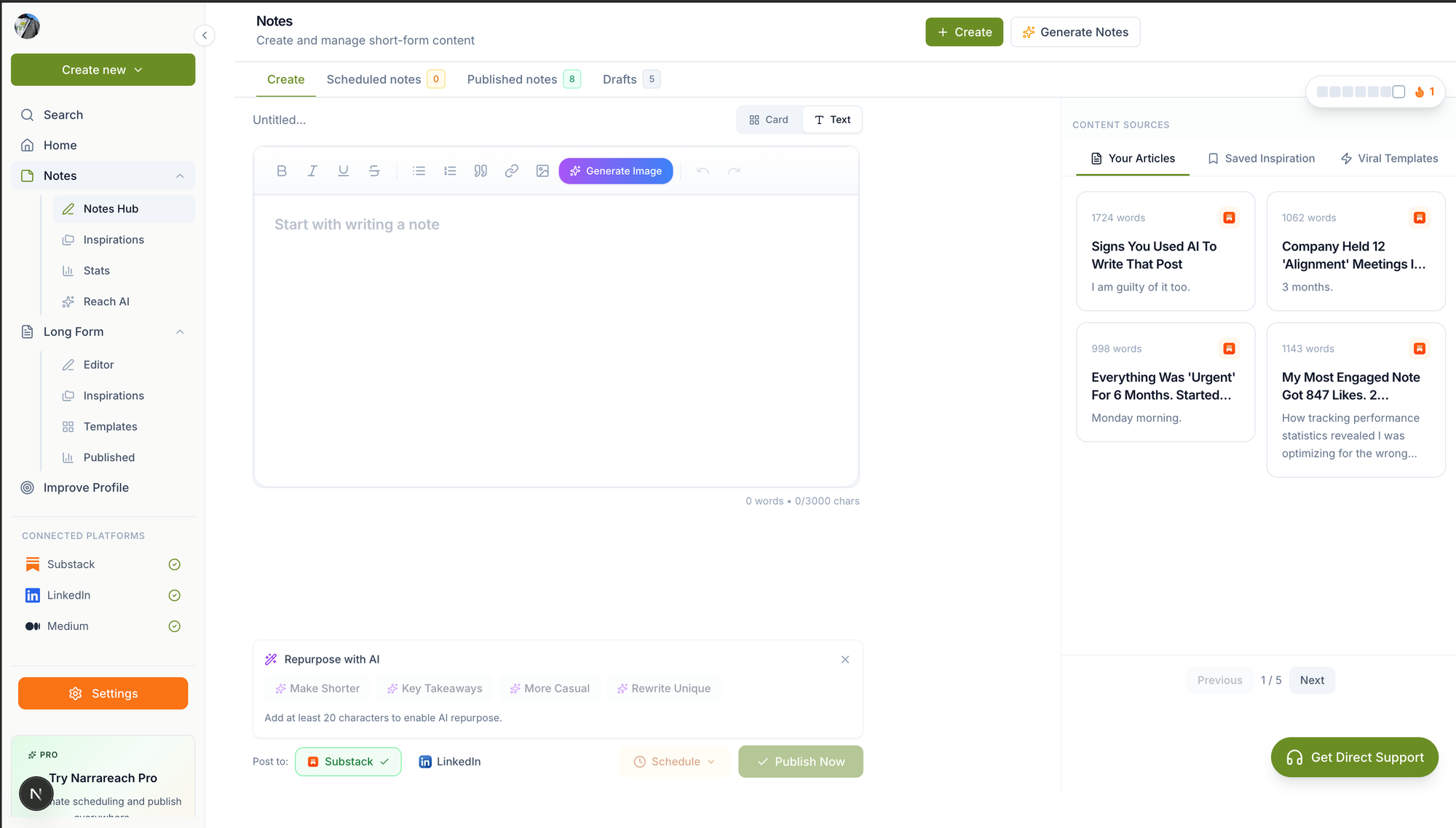
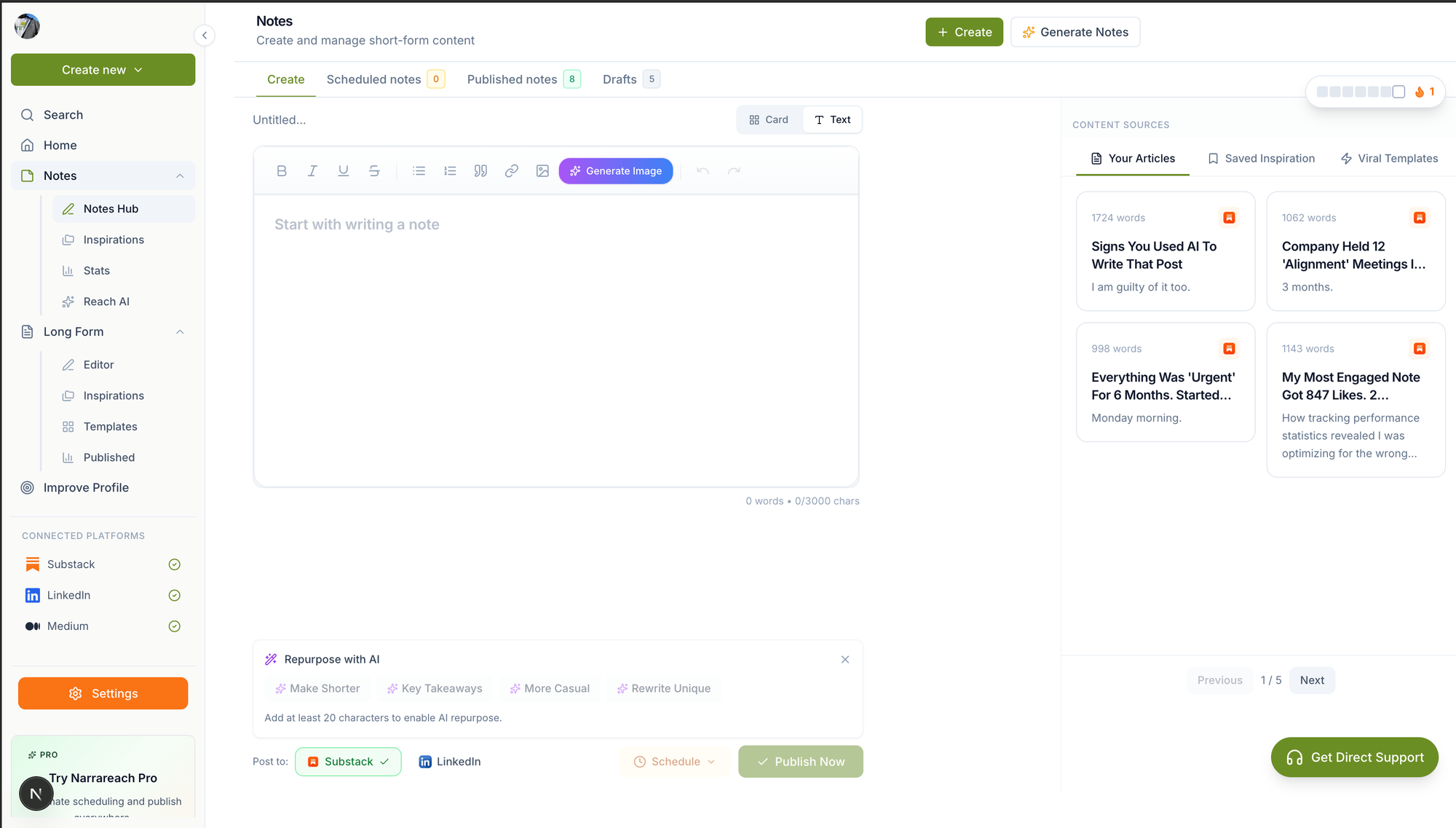
Write your article using the rich text editor, which supports markdown shortcuts and live preview for both Substack and Medium formatting. The editor automatically handles platform-specific elements like Substack's subscription buttons and Medium's highlight quotes.
Include platform-agnostic elements that work well everywhere: clear headings, numbered lists, and strategic paragraph breaks. Avoid platform-specific features like Substack polls or Medium's clap-to-highlight in your main content—save these for platform-specific customizations.
Step 3: Customize Platform-Specific Elements
Use the platform tabs to add unique elements for each destination. For Substack, add subscription CTAs and newsletter-specific introductions. For Medium, optimize your subtitle and tags for discoverability within Medium's algorithm.
The editor preserves your core content while allowing platform-specific customizations. This ensures each version feels native to its platform while maintaining your consistent voice and message across all channels.
Step 4: Schedule Simultaneous Publishing
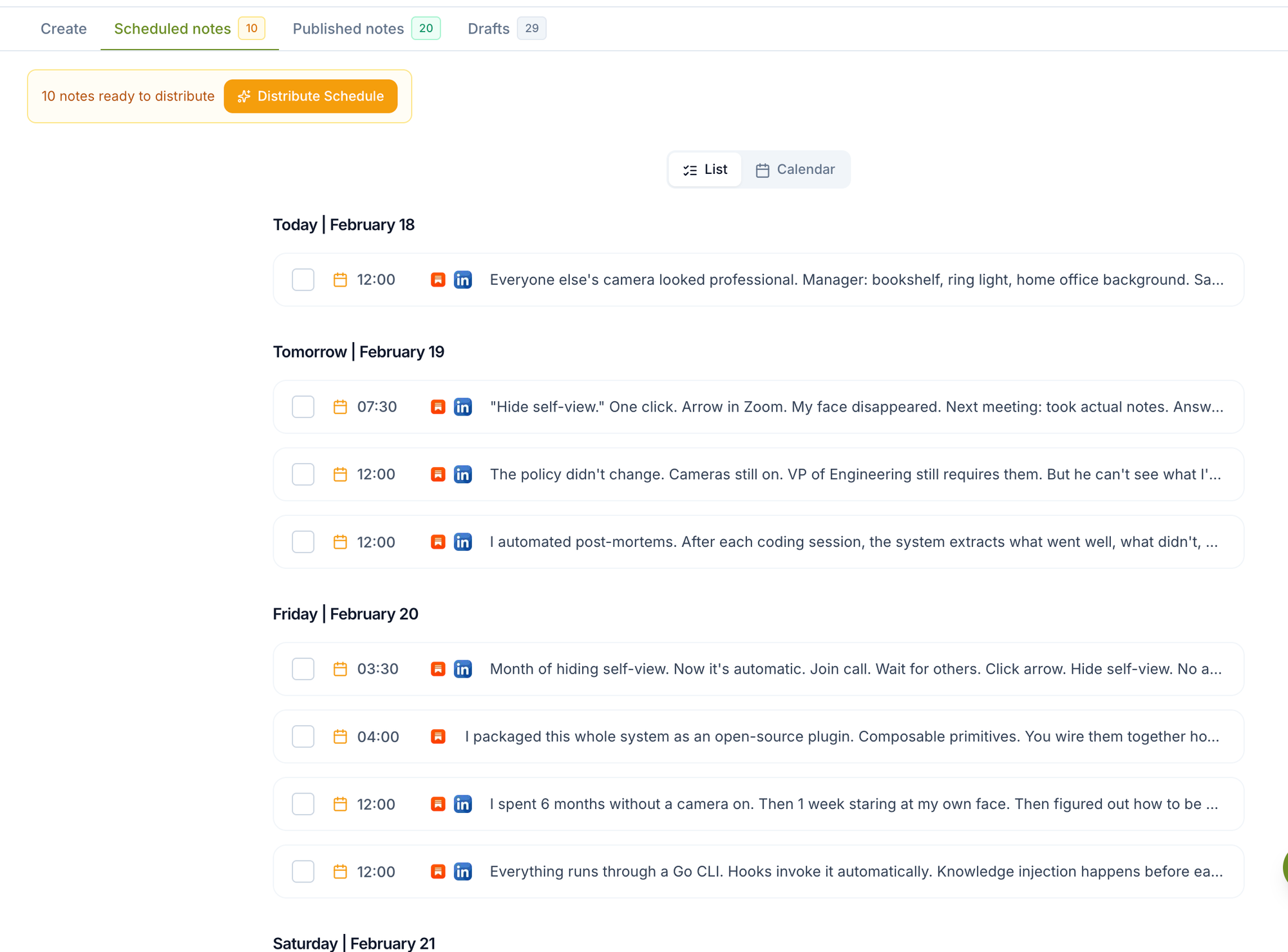
Set your publication schedule using the unified calendar. Most successful creators publish Substack newsletters on Tuesday-Thursday mornings (9-11 AM in their audience's timezone) and Medium articles on weekday afternoons when professional readers are most active.
The scheduler automatically handles timezone conversions and platform-specific timing. Substack articles can be set to send immediately to subscribers while also being published to your public archive, while Medium posts go live at your specified time.
Step 5: Configure Automatic Social Cross-Posting
Set up automatic promotional posts for LinkedIn, X, Bluesky, and Threads. Cross-post Substack to LinkedIn using professional-toned snippets, while X and Threads get more conversational hooks.
The system generates platform-appropriate snippets from your article's opening paragraphs, but you can customize each social post for maximum engagement. Include relevant hashtags and mentions automatically based on your content's topic and target audience.
Platform-Specific Strategy: Maximizing Each Channel
Substack Optimization Tactics
Substack's algorithm favors consistent publishing schedules and high open rates. Schedule your articles for the same day and time each week to build reader expectations. Use compelling subject lines that create curiosity without clickbait—Substack readers value authenticity over sensationalism.
Include a brief personal introduction at the top of each article. Substack readers subscribe for your unique perspective, so lead with your voice before diving into the main content. End with a clear call-to-action encouraging comments and shares.
Medium Distribution Strategy
Medium's Partner Program rewards articles that keep readers engaged on the platform. Structure your Medium versions with shorter paragraphs and more frequent subheadings to improve readability on mobile devices, where 60% of Medium reading happens.
Submit your best articles to relevant Medium publications after initial publishing. Publications can significantly amplify your reach—articles in top publications average 10x more views than standalone posts, according to Medium's creator insights.
Social Media Amplification
Each social platform requires different promotional approaches. LinkedIn posts should emphasize professional insights and industry relevance. X (Twitter) thrives on conversation-starters and controversial takes. Bluesky and Threads audiences prefer authentic, less polished content.
Schedule social posts 2-4 hours after your article goes live, giving initial subscribers time to engage before the broader social amplification begins. This creates social proof that improves click-through rates from social platforms.
Competitor Analysis: Scheduling Tools Comparison
Native Platform Scheduling
Substack Native Scheduling:
- Pros: Built-in analytics, seamless subscriber management, no third-party integrations needed
- Cons: Substack-only, no cross-posting capabilities, no social media integration
- Best for: Substack-exclusive creators who don't need multi-platform distribution
Medium Native Tools:
- Pros: Direct publication submission, built-in SEO optimization, native comment system
- Cons: No scheduling beyond immediate publishing, no automation features
- Best for: Occasional Medium publishers who manually manage their content calendar
Traditional Social Media Schedulers
Buffer/Hootsuite:
- Pros: Established platforms, extensive social media integrations, team collaboration features
- Cons: No Substack/Medium publishing, social-only focus, requires separate tools for long-form content
- Best for: Social media managers who handle publishing separately from content creation
Later/Sprout Social:
- Pros: Visual content calendars, Instagram-focused features, analytics dashboards
- Cons: Limited long-form publishing support, expensive for individual creators, complex setup
- Best for: Visual-first brands with dedicated social media teams
Narrareach: The Unified Solution
Narrareach Advantages:
- Pros: Single editor for Substack and Medium, automatic social cross-posting, Narrareach's Substack Notes scheduler, unified analytics
- Cons: Newer platform, focused specifically on newsletter creators rather than general social media management
- Best for: Newsletter creators and long-form content writers who want to maximize reach without multiplying workload
The key differentiator is Narrareach's newsletter-first approach. While traditional schedulers treat long-form content as an afterthought, Narrareach builds the entire workflow around article creation and distribution.
Time-Saving Math: Quantifying Your Efficiency Gains
Let's calculate the exact time savings for a typical content creator publishing 2 articles weekly:
Manual Multi-Platform Publishing
- Write article: 120 minutes
- Format for Substack: 8 minutes
- Format for Medium: 12 minutes
- Create 4 social media posts: 20 minutes (5 min each)
- Schedule/publish everything: 15 minutes
- Total per article: 175 minutes
- Weekly total (2 articles): 350 minutes (5.8 hours)
Automated Workflow with Narrareach
- Write article: 120 minutes
- Set up multi-platform publishing: 5 minutes
- Review and schedule: 3 minutes
- Total per article: 128 minutes
- Weekly total (2 articles): 256 minutes (4.3 hours)
Weekly Time Savings: 94 Minutes
This represents a 27% reduction in total content workflow time. Over a year, that's 81+ hours saved—equivalent to two full work weeks that can be reinvested in content creation, audience engagement, or business development.
For creators publishing daily content, the savings multiply dramatically. Daily publishers save approximately 6.5 hours weekly, or 338 hours annually—nearly two full months of 40-hour work weeks.
Advanced Scheduling Strategies for Maximum Reach
Optimal Timing Across Platforms
Different platforms have distinct peak engagement windows. Substack newsletters perform best Tuesday-Thursday, 9-11 AM in your audience's primary timezone. Medium articles get maximum visibility when published weekday afternoons, particularly Wednesday-Thursday, 2-4 PM EST.
Social media timing varies by platform: LinkedIn peaks Tuesday-Thursday 8-10 AM and 12-2 PM, X sees highest engagement during commute hours (7-9 AM, 5-7 PM), while Bluesky and Threads perform best during evening leisure hours (6-9 PM).
Advanced schedulers like Narrareach can automatically optimize timing based on your historical engagement data, learning when your specific audience is most active and adjusting schedules accordingly.
Content Versioning for Platform Optimization
While your core article remains consistent, subtle platform-specific optimizations can significantly improve performance. Substack versions should include more personal anecdotes and direct subscriber addresses. Medium articles benefit from data-driven insights and professional case studies.
Social media snippets should highlight different aspects of your article for each platform. LinkedIn posts might emphasize business implications, while X posts focus on surprising statistics or contrarian viewpoints that spark discussion.
Cross-Promotion Sequencing
Effective cross-promotion follows a strategic sequence. Start with your primary platform (usually Substack for newsletter creators), then cascade to secondary platforms 2-4 hours later. This creates momentum and social proof before broader distribution.
Social media promotion should begin after your article has been live long enough to generate initial engagement. Early comments and shares provide social validation that improves click-through rates from social platforms.
Analytics and Performance Tracking
Key Metrics to Monitor
Track performance across all platforms using unified analytics. Key metrics include open rates (Substack), read-through rates (Medium), click-through rates (social media), and cross-platform subscriber growth.
Pay particular attention to which topics perform best on each platform. Business strategy content might excel on LinkedIn while personal development articles perform better on Medium. Use these insights to optimize your content calendar and platform-specific customizations.
Attribution and Growth Tracking
Understanding which platforms drive the most valuable traffic helps optimize your content strategy. Substack subscribers typically have the highest lifetime value, while Medium readers often become long-term followers across multiple platforms.
Track subscriber sources using UTM parameters in your cross-platform links. This data reveals which promotional strategies generate the most valuable audience growth, allowing you to double down on effective approaches.
Getting Started: Your First Week Action Plan
Day 1-2: Platform Setup and Integration
Connect your Substack and Medium accounts to your chosen scheduling platform. If using Narrareach pricing plans, start with the free trial to test the workflow before committing to a paid plan.
Import your existing content calendar and identify 2-3 articles you can republish as tests. Choose evergreen content that performs well on one platform but hasn't been shared elsewhere.
Day 3-4: Content Preparation and Scheduling
Prepare your first multi-platform article using the unified editor. Focus on topics with broad appeal that work well across different audiences. Business insights, productivity tips, and industry analysis typically perform well on both Substack and Medium.
Schedule your article for publication during optimal timing windows. Set up automatic social media promotion for 3-4 hours after the article goes live, giving initial readers time to engage.
Day 5-7: Launch and Optimization
Monitor your first automated publication closely. Check that formatting appears correctly on each platform and that social media posts publish as scheduled. Make note of any platform-specific adjustments needed for future articles.
Analyze initial performance metrics and engagement patterns. Use this data to refine your timing, formatting, and promotional strategies for subsequent publications.
Common Pitfalls and How to Avoid Them
Over-Automation Without Personalization
While automation saves time, completely hands-off publishing can feel robotic to readers. Always review automated social media posts before they go live, and add platform-specific personal touches when possible.
Respond promptly to comments and engagement across all platforms. Automation should handle the distribution, but authentic human interaction drives long-term audience growth.
Ignoring Platform-Specific Best Practices
Each platform has distinct culture and expectations. Don't simply copy-paste identical content everywhere. Adapt your tone, formatting, and promotional approach for each audience while maintaining your core message.
Medium readers expect data-driven insights and professional presentation. Substack subscribers want personal connection and authentic voice. Social media audiences prefer conversational, accessible language.
Inconsistent Publishing Schedules
Automation makes consistency easier, but you still need to maintain regular publishing schedules. Set realistic goals—better to publish weekly consistently than to attempt daily publishing and burn out after a month.
Use your scheduling tool's calendar view to plan content weeks in advance. This prevents last-minute scrambling and ensures steady audience engagement across all platforms.
Advanced Features and Future-Proofing
AI-Powered Content Optimization
Modern scheduling platforms increasingly incorporate AI features that optimize headlines, suggest posting times, and even generate platform-specific variations of your content. These tools can significantly improve engagement rates when used thoughtfully.
However, maintain editorial control over AI suggestions. Use automation to enhance your content strategy, not replace your unique voice and perspective that readers subscribe to follow.
Integration with Email Marketing and CRM
Advanced workflows connect your publishing schedule with email marketing automation and customer relationship management. When someone subscribes via Medium, they can automatically be added to your Substack welcome sequence.
This creates a seamless funnel from casual readers to dedicated subscribers, maximizing the value of your multi-platform content strategy.
Conclusion: Streamlining Your Content Workflow
Scheduling full articles to Substack and Medium from one editor eliminates the time drain of manual cross-posting while maximizing your content's reach. The key is choosing a platform that understands newsletter creators' specific needs rather than treating long-form content as an afterthought.
Start with a simple workflow: write once, schedule to multiple platforms, and automatically cross-promote on social media. As you build confidence with the system, add advanced features like platform-specific customizations and AI-powered optimization.
The 80% time savings from automation can be reinvested in content creation, audience engagement, or business development. Most creators see measurable audience growth within 4-6 weeks of implementing a consistent multi-platform strategy.
Ready to streamline your content workflow? Narrareach offers a free trial that lets you test the complete workflow—from article scheduling to social media cross-posting—without any upfront commitment.
Visual Walkthrough