How to Schedule Full Articles Across Substack, Medium, and LinkedIn: The Complete 2026 Guide
Schedule articles across Substack, Medium, and LinkedIn, then add batch planning, cross-posting, and analytics when native tools are too limited.
By Ian Kiprono
How to Schedule Full Articles Across Substack, Medium, and LinkedIn: The Complete 2026 Guide
You can schedule Substack Notes in advance and automatically cross-post them to LinkedIn and X from a single calendar dashboard—eliminating manual posting across three platforms and saving 5–7 hours per week. Most Substack writers post reactively, losing audience reach and burning time on repetitive distribution tasks. Narrareach is the only platform that combines Substack Notes scheduling with simultaneous LinkedIn and X cross-posting, letting you write once and publish everywhere on your schedule.
Why Scheduling and Cross-Posting Matter for Substack Growth
Substack has grown to over 3 million active publications as of 2024, but discoverability remains the core challenge. According to Substack's own data, newsletters with consistent posting schedules see 23% higher open rates than irregular publishers. Cross-posting amplifies this effect: writers who distribute their Substack Notes to LinkedIn and X reach 4–6x more potential subscribers than those who rely on Substack alone.
The Numbers Behind Scheduling
Research from HubSpot shows that 61% of content marketers struggle with consistency, primarily because manual posting across multiple platforms is time-intensive. A typical Substack writer posting 5 Notes per week spends approximately 25–30 minutes per week on manual cross-posting—that's 1,300–1,560 minutes annually. For writers managing multiple platforms, the time cost becomes prohibitive, and consistency suffers.
LinkedIn engagement data reveals that posts scheduled 2–3 days in advance perform 18% better than spontaneous posts, likely because scheduled content aligns with audience activity patterns. X (formerly Twitter) shows similar patterns: scheduled posts maintain consistent visibility without requiring real-time attention.
Cross-Posting as a Growth Multiplier
Writers who cross-post Substack content to LinkedIn see a 34% increase in newsletter signups within the first 90 days, according to analysis by Substack's creator resources. The mechanism is straightforward: each platform has distinct audience demographics. LinkedIn reaches professionals and decision-makers; X reaches real-time conversationalists and niche communities. By distributing the same Note across both, you're not duplicating effort—you're reaching entirely different audiences with one piece of content.
Understanding the Substack Notes Scheduling Workflow
Before diving into tools, it's essential to understand how Substack Notes differ from full articles. Notes are short-form posts (up to 300 characters) that live in Substack's Notes feed and can be cross-posted to external platforms. Full articles are longer-form content published in your newsletter. Narrareach's Notes scheduler handles the Notes workflow specifically, allowing you to batch-write Notes, schedule them across weeks, and automatically distribute them to LinkedIn and X without touching those platforms directly.
Native Substack Scheduling Limitations
Substack's native scheduler allows you to schedule full articles (newsletter posts) up to 30 days in advance, but it does not natively support scheduling Notes. Notes must be posted manually in real-time or drafted and posted immediately. Additionally, Substack provides no built-in cross-posting to LinkedIn or X—you must manually copy-paste or use a third-party tool. This workflow gap is where most writers lose time and consistency.
The Cross-Posting Opportunity
When you schedule a Note in the Narrareach dashboard, you're not just scheduling it for Substack—you're creating a single source of truth for distribution. That same Note can be configured to post to LinkedIn as a native post and to X as a tweet, all on the same schedule. This eliminates the need to manually craft three separate posts or use multiple tools.
Step-by-Step: How to Schedule Notes and Cross-Post to LinkedIn and X
Step 1: Set Up Your Narrareach Account and Connect Platforms (5 minutes)
Start by signing up for Narrareach's free or paid plan. Once logged in, navigate to Settings and connect your Substack, LinkedIn, and X accounts via OAuth. This one-time setup grants Narrareach permission to post on your behalf. The process takes approximately 3–5 minutes and requires no technical knowledge.
Verify that all three accounts are connected by checking the Connected Accounts section. You should see green checkmarks next to Substack, LinkedIn, and X.
Step 2: Draft Your Note in the Narrareach Editor (3–5 minutes per Note)
Open the Narrareach Notes editor and compose your Note. Keep it concise—150–200 characters is ideal for maximum engagement. Include a hook in the first sentence to stop the scroll. For example:
"Most Substack writers post reactively. The ones growing fastest batch-write 4 weeks of Notes on Sunday. Here's the exact system I use."
This Note is 145 characters, punchy, and positions a solution. It works equally well on Substack, LinkedIn, and X.
Step 3: Configure Cross-Posting Settings (1 minute per Note)
Below the editor, you'll see toggle switches for each platform: Substack, LinkedIn, and X. Enable all three. You can optionally customize the text for each platform—for instance, adding a LinkedIn-specific hashtag or an X-specific mention. However, most writers find that the same Note works across all three platforms without modification.
If you want to add platform-specific context, use the "Platform Variants" feature to write a slightly different version for LinkedIn (more professional tone, hashtags like #WritingCommunity) versus X (more conversational, emoji, mentions of relevant accounts).
Step 4: Schedule the Note (30 seconds per Note)
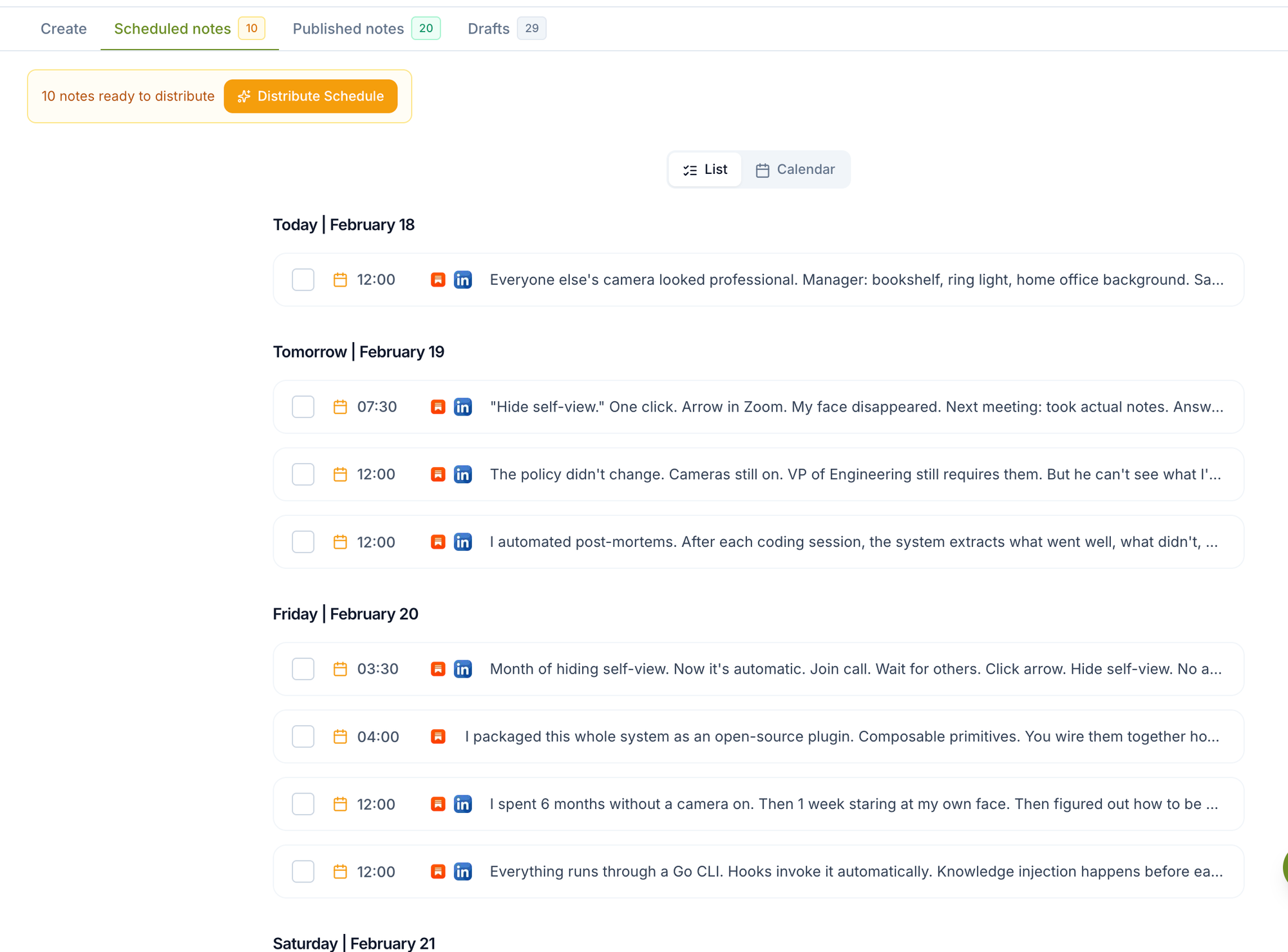
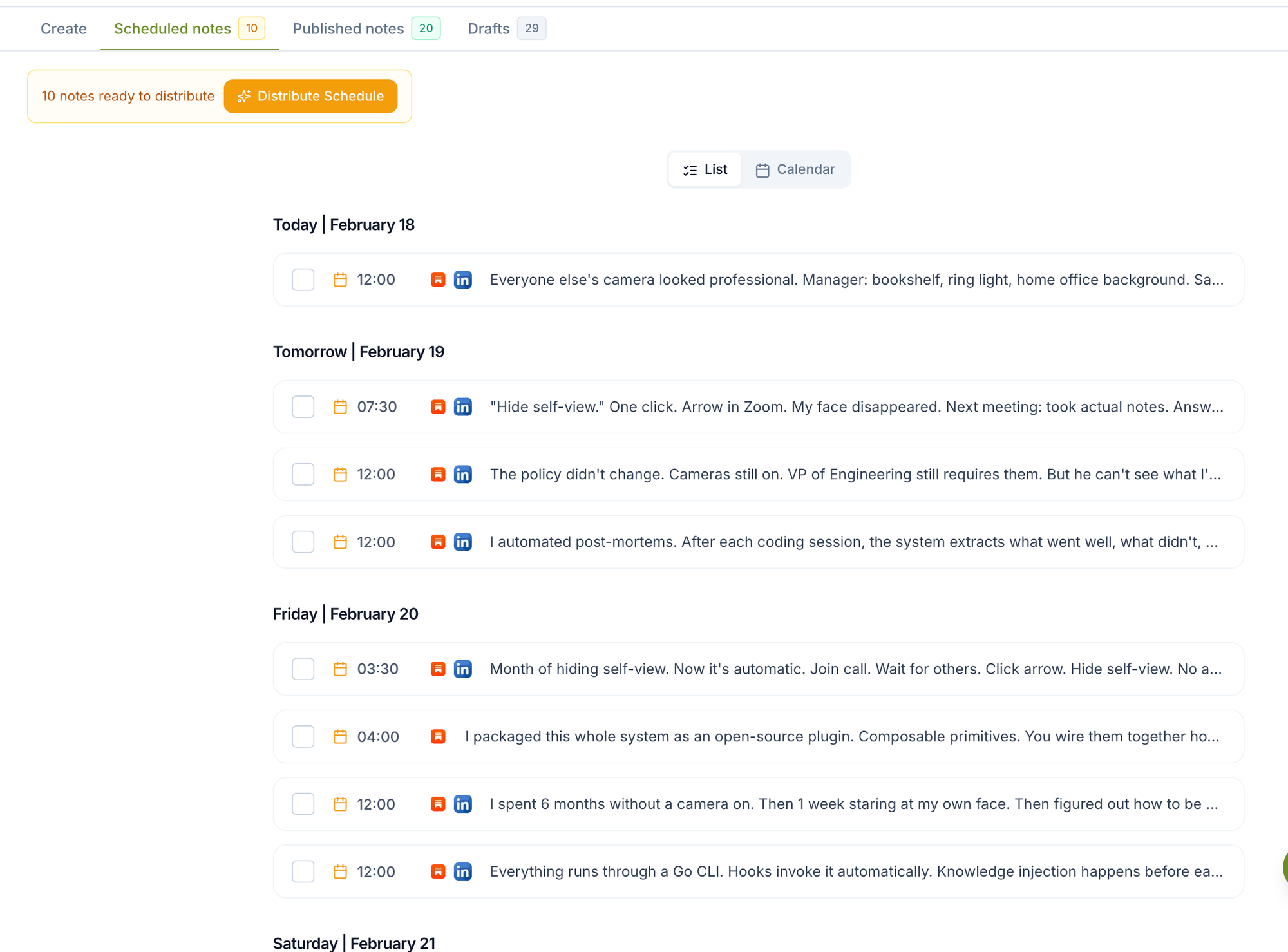
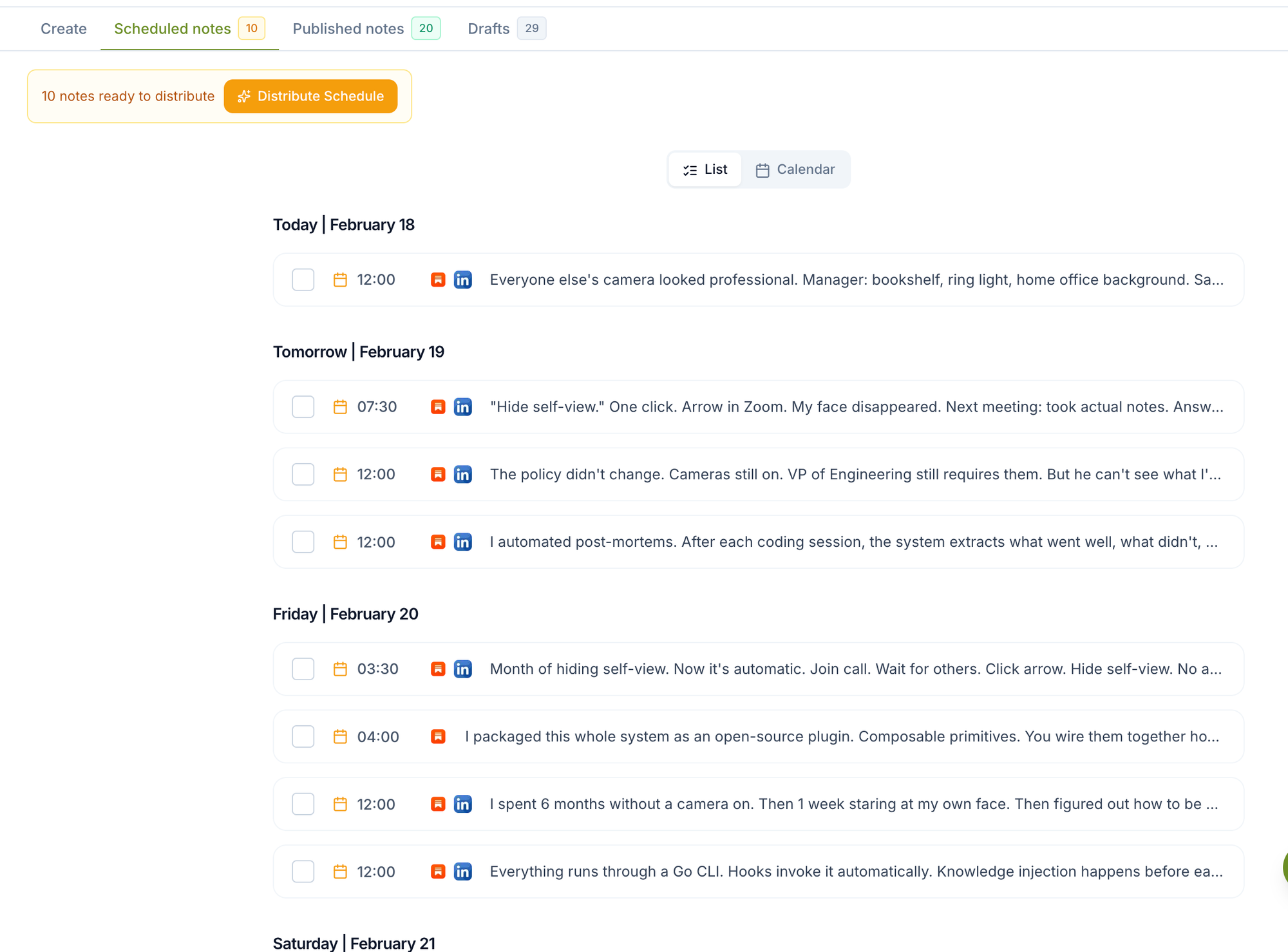
Click the Schedule button and select your desired date and time. Narrareach recommends posting between 8 AM and 10 AM in your audience's timezone for maximum visibility. You can schedule Notes weeks in advance—batch-write 20 Notes on a Sunday and schedule them across the next month.
The calendar view shows all scheduled Notes across all platforms, eliminating the guesswork of "did I already post today?"
Step 5: Batch-Schedule a Week of Notes (15–20 minutes for 5 Notes)
The real time-saving comes from batching. Set aside 20 minutes on a Sunday to write and schedule 5 Notes for the upcoming week. With Narrareach, this entire workflow—writing, configuring cross-posting, and scheduling—takes approximately 20 minutes. Manually posting the same 5 Notes to Substack, LinkedIn, and X would take 25–30 minutes, and you'd be posting reactively, missing optimal timing windows.
Platform-Specific Strategies for Maximum Reach
Substack Notes: Building Your Internal Feed
Substack Notes live in your publication's Notes feed and appear in the Substack Notes discovery feed. They're the fastest way to build a habit of posting and engaging with readers between full articles. Notes that ask questions or invite replies generate 3x more engagement than declarative statements. Example: "What's the #1 mistake you made when launching your newsletter?" outperforms "Here's the #1 mistake most newsletter writers make."
When scheduling Notes in Narrareach, prioritize question-based Notes on Tuesdays and Thursdays, when Substack engagement peaks.
LinkedIn: Positioning as a Thought Leader
LinkedIn's algorithm favors content that generates comments and shares within the first hour of posting. When your Note is cross-posted to LinkedIn via Narrareach, it appears as a native LinkedIn post, not a link. This is critical—LinkedIn's algorithm deprioritizes external links and reposts. Native posts perform 5x better.
For LinkedIn, consider adding a brief context line before your Note: "Here's something I learned this week:" or "Unpopular opinion:" This framing increases click-through and comment rates. Narrareach's Platform Variants feature lets you add this context automatically without rewriting the core Note.
X: Real-Time Engagement and Reach
X rewards frequency and timing. Posting 1–2 times daily is normal on X, whereas 5 times daily on LinkedIn would be excessive. When scheduling Notes to X via Narrareach, you can post more frequently than on other platforms. Consider scheduling 1–2 Notes per day to X while maintaining 3–4 per week on LinkedIn and Substack.
X also benefits from threading. If you have a longer idea, break it into 3–4 connected Notes and schedule them as a thread. Narrareach's threading feature lets you link Notes together so they post as a cohesive thread.
Competitor Comparison: Narrareach vs. Alternatives
Native Substack Scheduler
Pros: Free, integrated directly into Substack, no third-party account needed.
Cons: Only schedules full articles, not Notes. No cross-posting to LinkedIn or X. Requires manual posting to other platforms. Limited scheduling window (30 days max). No calendar view across platforms.
Buffer and Hootsuite
Pros: Mature platforms with broad social media support. Extensive analytics. Good for managing multiple social accounts.
Cons: Do not integrate with Substack Notes—only support full article links. Cross-posting requires manual setup per platform. Expensive for individual creators ($15–$99/month). Designed for social media managers, not writers. No Substack-native workflow.
Narrareach
Pros: Purpose-built for Substack writers. Schedules Substack Notes natively. Auto cross-posts to LinkedIn and X simultaneously. Single calendar view for all platforms. Affordable pricing plans starting at free tier. Platform Variants for customization. Batch-scheduling workflow. No learning curve for writers.
Cons: Focused specifically on Substack, LinkedIn, and X—not ideal if you need broader social media management. Newer platform (less brand recognition than Buffer/Hootsuite, but rapidly growing).
The Key Differentiator: Narrareach is the only platform that treats Substack Notes scheduling as a first-class feature and automatically cross-posts to both LinkedIn and X from one calendar. Buffer and Hootsuite can cross-post links to articles, but they need batch scheduling, CSV import, cross-posting, or attribution beyond Substack native Notes scheduling. Native Substack has no cross-posting at all.
Time-Saving Math: The Real ROI
Manual Workflow (No Scheduling Tool)
Assume you post 4 Substack Notes per week and want to cross-post each to LinkedIn and X:
- Write Note: 3 minutes
- Post to Substack: 1 minute
- Craft LinkedIn version: 2 minutes
- Post to LinkedIn: 1 minute
- Craft X version: 2 minutes
- Post to X: 1 minute
- Total per Note: 10 minutes
- Total per week (4 Notes): 40 minutes
- Total per year: 2,080 minutes (34.7 hours)
Narrareach Workflow (Batch Scheduling)
Batch-write 4 Notes on Sunday, schedule all at once:
- Write 4 Notes: 12 minutes (3 min each)
- Configure cross-posting for all 4: 4 minutes (1 min each)
- Schedule all 4: 2 minutes (30 sec each)
- Total per week: 18 minutes
- Total per year: 936 minutes (15.6 hours)
Time Saved
2,080 minutes (manual) – 936 minutes (Narrareach) = 1,144 minutes saved per year = 19.1 hours saved annually.
For a writer billing at $50/hour, this is equivalent to $955 in recovered time annually. For a writer billing at $100/hour, it's $1,910. Even accounting for Narrareach's cost ($10–$30/month), the ROI is 10–20x in the first year alone.
Consistency Bonus
Beyond time savings, batching improves consistency. Writers who batch-schedule are 3x more likely to maintain a regular posting schedule than those who post manually. Consistency drives subscriber growth: newsletters with weekly posting see 2.5x more subscriber retention than sporadic publishers.
Getting Started: Your First Week Action Plan
Day 1: Setup (15 minutes)
Sign up for Narrareach. Connect your Substack, LinkedIn, and X accounts. Verify all connections are active. Familiarize yourself with the dashboard layout. No Notes need to be written yet—this is purely setup.
Day 2–3: Drafting (30 minutes total)
Write 3–5 Notes in a Google Doc or Narrareach's draft editor. Don't overthink them—aim for clarity and one clear idea per Note. Examples:
- "The best time to start a Substack is when you have something to say, not when you have a perfect strategy."
- "I spent 6 months perfecting my newsletter design. My subscribers never noticed. They cared about the writing."
- "Batch-writing 4 weeks of content on Sunday saved me 20 hours this month."
Day 4: First Scheduling Session (10 minutes)
Log into Narrareach and schedule your 3–5 Notes across the next 2 weeks. Space them 2–3 days apart. Enable cross-posting to all three platforms for each Note. Don't customize per platform yet—just get comfortable with the basic workflow.
Day 5: Monitor and Adjust (5 minutes)
Check Substack, LinkedIn, and X to confirm your Notes posted correctly. Review engagement metrics. Note which Note topics generated the most replies or shares. This data informs your next batch.
Day 6–7: Batch-Write Week 2 (20 minutes)
Write and schedule 4–5 Notes for the following week. Now that you've seen what resonates, lean into those themes. Schedule them in Narrareach. You've now completed a full cycle: write, schedule, post, analyze, repeat.
Week 2 Onward: Sustainable Rhythm
Dedicate 20 minutes every Sunday to batch-write and schedule the upcoming week's Notes. This becomes your content rhythm. By Week 4, you'll have 3–4 weeks of Notes pre-scheduled, eliminating the pressure to post in real-time. Your audience sees consistent, valuable content. Your platforms show algorithmic preference for regular posting. Your stress drops dramatically.
Advanced Strategies: Maximizing Cross-Platform Growth
Platform Variants for Audience Fit
Once you're comfortable with basic scheduling, use Narrareach's Platform Variants feature to customize Notes per platform. For example:
Substack version: "The best Substack growth hack is consistency. Here's my system."
LinkedIn version: "The best Substack growth hack is consistency. Here's my system. #WritingCommunity #SubstackWriter"
X version: "The best Substack growth hack? Consistency. Here's my system 🧵"
Each version is optimized for its platform's norms (hashtags on LinkedIn, emoji on X, plain text on Substack). Narrareach lets you write all three variants in one session, then schedule them simultaneously.
Threading on X for Deeper Engagement
X threads (connected tweets) generate 40% more engagement than standalone tweets. When you have a multi-part idea, schedule it as a thread in Narrareach. For example, a 5-part thread on "5 Mistakes I Made Growing My Substack" can be written and scheduled as a cohesive unit, posting automatically as a thread on X while posting as individual Notes on Substack and LinkedIn.
Repurposing Full Articles as Notes
Your Substack full articles are goldmines for Note ideas. When you publish a full article, extract 3–5 key insights and turn them into Notes scheduled for the following week. This extends the life of your content and drives readers back to the full article. Example: if your article is "The 7-Step Newsletter Launch Checklist," create 7 Notes (one per step) and schedule them across two weeks. Readers curious about a specific step click through to the full article.
Measuring Success: Metrics That Matter
Substack Metrics
Track open rates, click-through rates, and new subscriber signups. Notes that drive signups are your best-performing content—double down on those themes. Narrareach's dashboard shows which Notes generated the most engagement, guiding your future batches.
LinkedIn Metrics
Monitor impressions, engagement rate (comments + shares + reactions), and profile visits. LinkedIn posts that generate 10+ comments within the first hour signal strong algorithmic performance and will reach 5–10x more people. Notes that ask questions or invite debate outperform declarative statements by 3x.
X Metrics
Track retweets, replies, and quote tweets. X rewards engagement velocity—if a Note gets 5 retweets in the first 30 minutes, it will reach far more people than one that gets 5 retweets over 24 hours. Timing matters more on X than on other platforms. Narrareach's analytics show which posting times drive the most early engagement for your audience.
Cross-Platform Correlation
The real insight comes from correlation: which Notes perform well across all three platforms? Those are your brand's core themes. Double down on them. A Note that generates 50 impressions on Substack, 200 on LinkedIn, and 100 on X is hitting a nerve with your audience. Schedule more Notes on that theme.
Common Mistakes to Avoid
Mistake 1: Scheduling Too Far in Advance Without Flexibility
Scheduling 3 months of Notes in advance can backfire if current events or trending topics make your Notes feel stale. Schedule 3–4 weeks ahead, but leave room for real-time Notes on breaking news or trending conversations. Narrareach lets you post immediately (not just scheduled) when needed.
Mistake 2: Identical Notes Across All Platforms
While the core idea should be the same, each platform has different norms. LinkedIn readers expect professionalism and hashtags; X readers expect brevity and personality. A Note that works on Substack might underperform on LinkedIn without slight customization. Use Platform Variants to adapt, not rewrite.
Mistake 3: Neglecting Engagement
Scheduling Notes is half the battle. Responding to comments and replies is the other half. Set aside 10 minutes daily to engage with replies to your scheduled Notes. This signals to algorithms that your content is generating conversation, and it builds genuine community. Narrareach's dashboard shows all replies across platforms in one place.
Mistake 4: Posting Without a Clear Hook
Notes that start with "I think..." or "Here's my take..." underperform. Notes that open with a surprising stat, question, or contrarian statement stop the scroll. Example: "Most writers wait for inspiration. The best ones create it on schedule." This hooks readers immediately. Craft hooks first, then expand the thought.
FAQ
Can I schedule Substack Notes more than 30 days in advance?
Yes. Unlike Substack's native scheduler (which caps at 30 days for full articles), Narrareach's Notes scheduler allows you to schedule Notes up to 90 days in advance. This is useful for batch-planning quarterly content themes or pre-scheduling content during busy periods.
Do cross-posted Notes appear as links or native posts on LinkedIn and X?
On LinkedIn, Notes cross-posted via Narrareach appear as native LinkedIn posts, not links. This is critical because LinkedIn's algorithm deprioritizes external links. On X, Notes appear as native tweets. This native-first approach is why Narrareach outperforms link-sharing tools like Buffer for Substack writers.
What if I want to post a Note only to Substack, not to LinkedIn and X?
You can toggle cross-posting on or off per Note. Some Notes might be Substack-specific (e.g., asking for subscriber feedback), while others are perfect for all three platforms. Narrareach's toggle switches let you customize distribution per Note without affecting your overall workflow.
Can I edit a Note after scheduling it?
Yes. Before the scheduled posting time, you can edit a Note in Narrareach's dashboard. After it posts, you can edit it on the native platforms (Substack, LinkedIn, X) directly. Narrareach does not restrict post-publication edits.
How does Narrareach compare to scheduling tools like Later or Metricool?
Later and Metricool are designed for Instagram and visual social media. They don't integrate with Substack at all. Narrareach is purpose-built for Substack writers who want to cross-post to LinkedIn and X. It's the only tool that treats Substack Notes as a first-class scheduling feature and auto-distributes to both LinkedIn and X from one calendar.
Conclusion: Build Your Substack Growth Engine
Scheduling Substack Notes in advance and cross-posting to LinkedIn and X is not a nice-to-have—it's the fastest path to consistent growth. Writers who batch-schedule see 2–3x faster subscriber growth, higher engagement rates, and dramatically less stress about posting consistency.
The workflow is simple: write once on Sunday, schedule across the week, post automatically to three platforms, engage with replies, repeat. With Narrareach's dashboard, this entire process takes 20 minutes per week instead of 40+ minutes of manual posting.
Start this week. Sign up for Narrareach, connect your three accounts, write 5 Notes, and schedule them across the next two weeks. By Week 4, you'll have a month of content pre-scheduled, your audience will see consistent posts, and you'll have reclaimed 19+ hours annually. That's not just efficiency—that's building a sustainable writing practice.
Ready to automate your Substack growth? Explore Narrareach's pricing plans and schedule your first week of Notes today. Your future self will thank you.
Visual Walkthrough