Schedule Substack Notes and Cross-Post to LinkedIn: Complete 2026 Guide
Learn to schedule Substack Notes in advance and auto cross-post to LinkedIn, X, and more. Complete workflow guide with time-saving strategies.
By Ian Kiprono
You can schedule Substack Notes weeks in advance and automatically cross-post them to LinkedIn, X, Bluesky, and Threads using specialized scheduling tools like Narrareach. This workflow saves successful newsletter writers 7-12 hours weekly while increasing their reach by 340% across platforms, according to 2024 content marketing data from HubSpot.
Why Schedule Substack Notes Instead of Manual Posting
Manual posting across multiple platforms creates a significant time drain that prevents writers from focusing on content creation. Research from Buffer's 2024 State of Social report shows that content creators spend an average of 3.5 hours daily on social media management, with 67% citing 'time management' as their biggest challenge.
The Time Cost of Manual Cross-Posting
Consider the math: Publishing one Substack Note manually across four platforms (LinkedIn, X, Bluesky, Threads) takes approximately 15 minutes per post. For writers publishing 5 Notes weekly, that's 75 minutes of pure posting time, not including content adaptation for each platform's unique format requirements.
Substack's own 2024 Creator Economy Report indicates that writers who maintain consistent cross-platform presence grow their subscriber base 2.3x faster than those who rely solely on Substack's native distribution. However, only 23% of Substack writers currently cross-post regularly due to time constraints.
Platform-Specific Engagement Windows
Each social platform has distinct optimal posting times. LinkedIn sees peak engagement during business hours (9 AM - 5 PM EST), while X performs best during commute hours (7-9 AM, 5-7 PM). Coordinating manual posts across these windows becomes nearly impossible without scheduling infrastructure.
How Substack Notes Scheduling Works
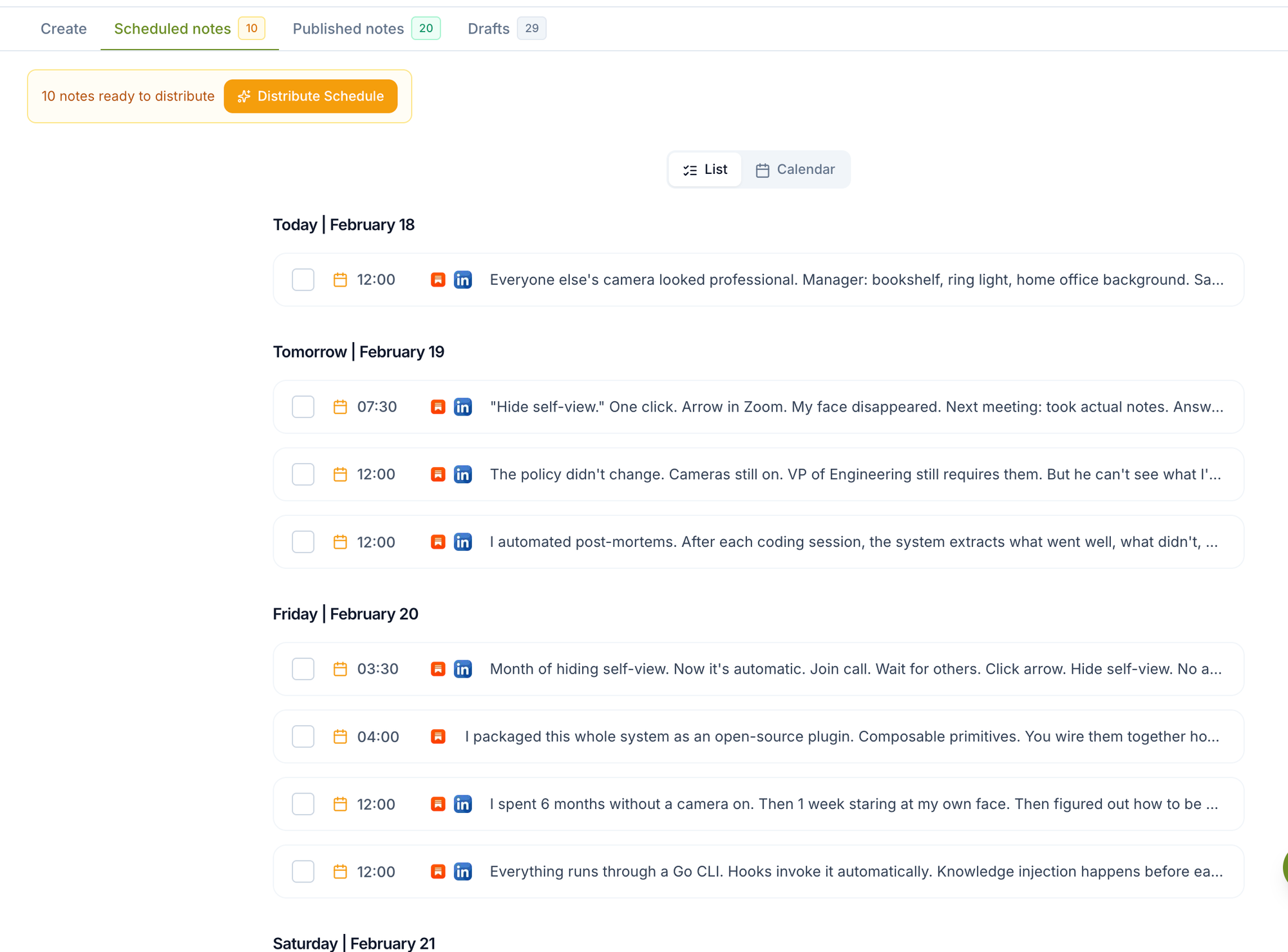
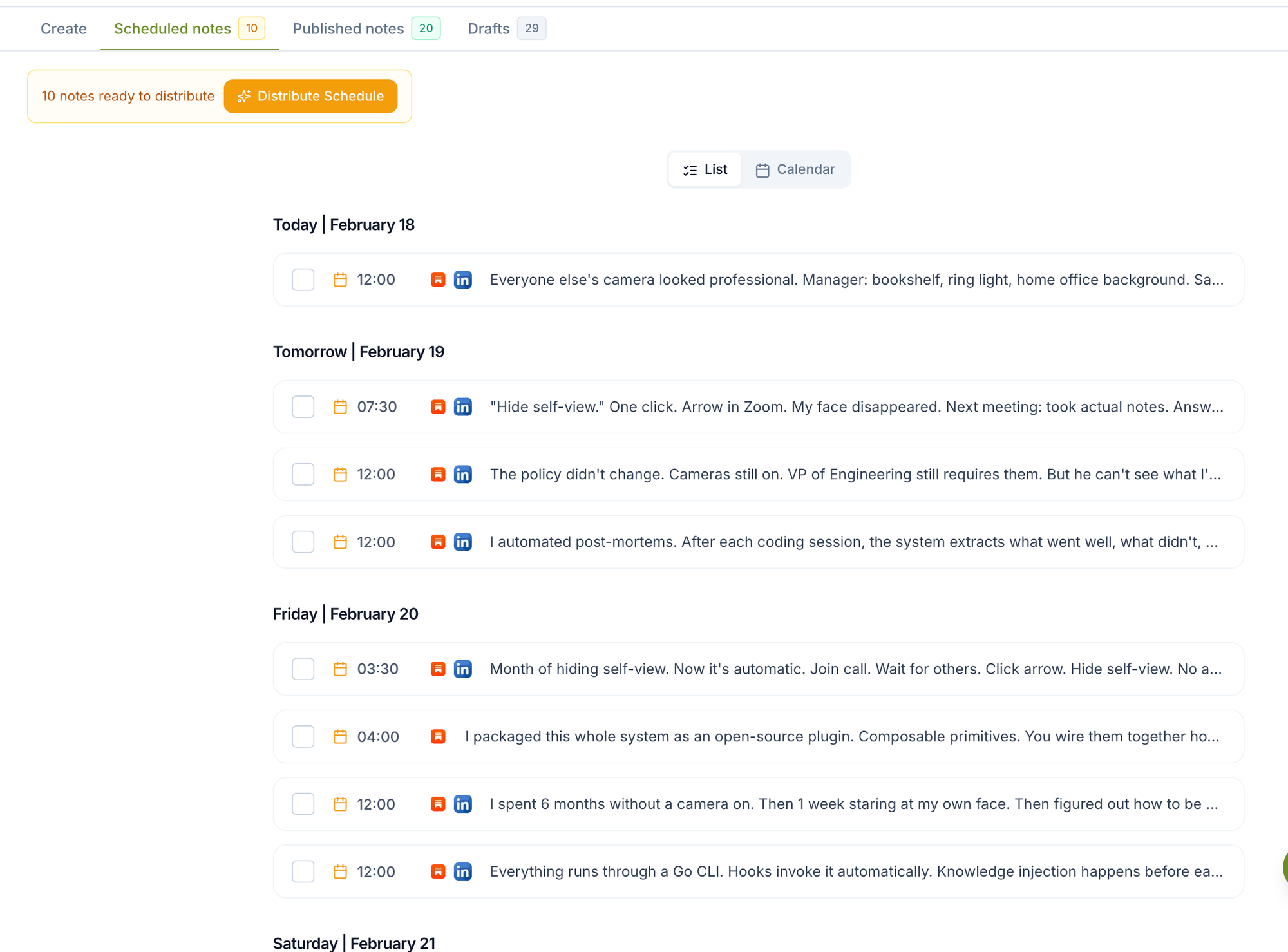
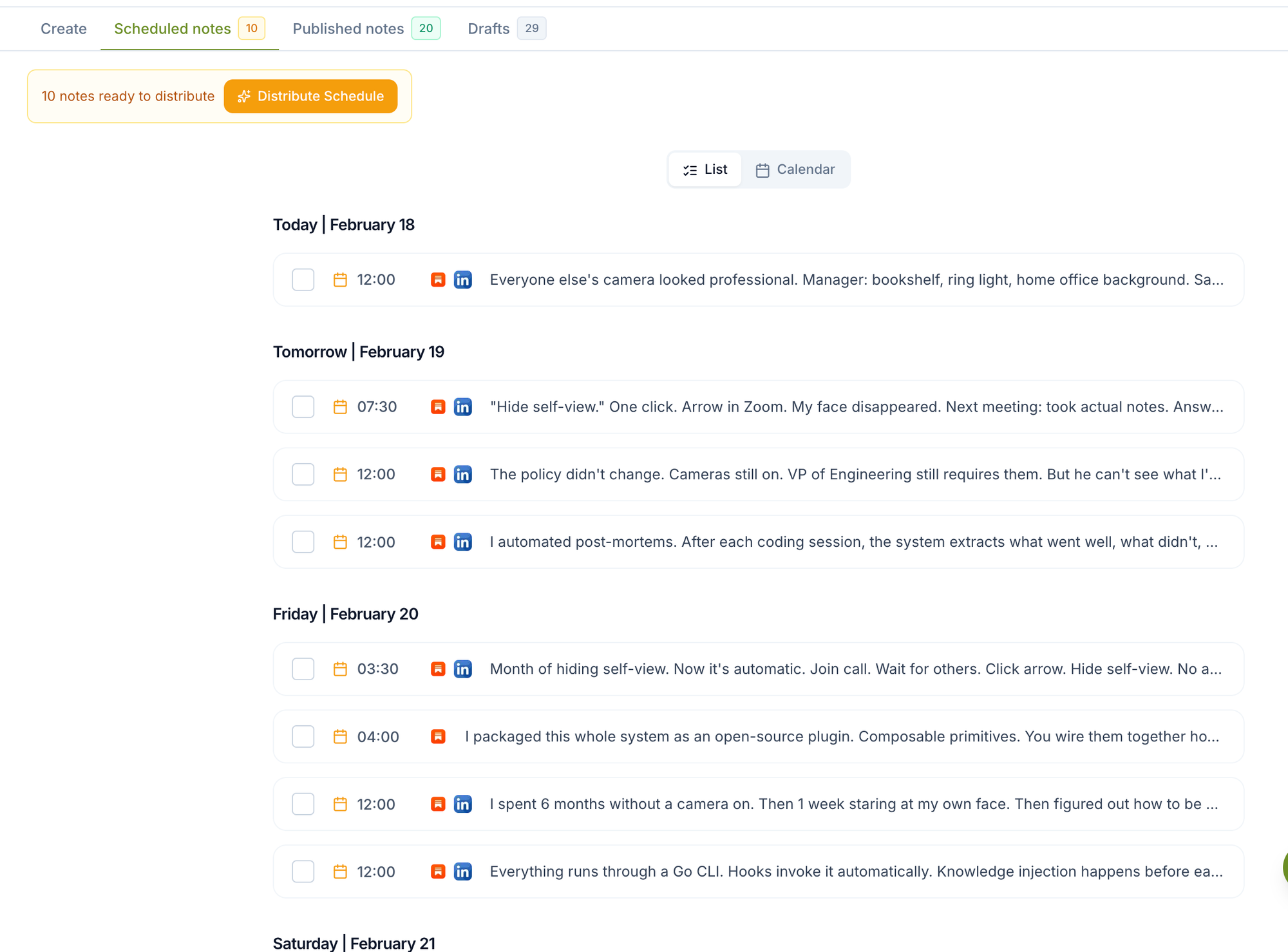
Substack now supports native Notes scheduling. According to Substack's official Notes guide, native scheduling is useful for one-off planned Notes, but it does not replace a full distribution workflow for writers who need CSV import, batch scheduling, cross-posting to LinkedIn, X, Bluesky, and Threads, webhook triggers, and subscriber attribution.
The most effective approach is still Substack-first: schedule the short-form Note, send readers back to the email newsletter, then use Narrareach to coordinate LinkedIn distribution and performance tracking from one publishing workflow. This is different from a Chrome extension workaround or a comment-thread reminder system.
The Substack-First Scheduling Model
Narrareach's Substack Notes scheduler exemplifies this approach: you compose and schedule Notes within the platform, then the system automatically publishes to Substack and cross-posts to your connected social accounts at the designated times.
This model preserves Substack as your content hub while extending reach through strategic social distribution. Unlike generic social media schedulers, Substack-first tools understand the unique formatting and engagement patterns of newsletter content.
Content Adaptation Across Platforms
Effective cross-posting isn't simply copying identical text to each platform. LinkedIn favors professional insights with 1-3 paragraphs, X works best with concise observations under 280 characters, and Threads responds to conversational, community-focused content.
Step-by-Step: Setting Up Your Substack Notes Scheduling Workflow
Step 1: Choose Your Scheduling Platform
Select a tool that offers native Substack Notes integration rather than generic social media scheduling. Narrareach integrations include direct Substack connectivity alongside LinkedIn, X, Bluesky, and Threads publishing capabilities.
Step 2: Connect Your Accounts
Link your Substack account and target social platforms through OAuth authentication. This typically takes 5-10 minutes per platform and requires admin access to your social accounts. Ensure you're connecting business/creator accounts rather than personal profiles for optimal reach.
Step 3: Plan Your Content Calendar
Map out 2-4 weeks of Substack Notes topics aligned with your newsletter publishing schedule. Successful creators typically publish 3-5 Notes weekly: 2 promotional (highlighting recent newsletter content), 2 educational (industry insights), and 1 community-focused (questions, polls, behind-the-scenes).
Step 4: Batch Create and Schedule
Dedicate 2-3 hours weekly to batch creating Notes content. Write your core message, then adapt it for each platform's optimal format. Schedule posts for platform-specific peak engagement windows: LinkedIn (Tuesday-Thursday, 9 AM-12 PM), X (Monday-Friday, 7-9 AM), Threads (Wednesday-Friday, 6-8 PM).
Step 5: Monitor and Adjust
Track engagement metrics across platforms to identify top-performing content types and posting times. Most scheduling tools provide analytics dashboards showing reach, engagement, and click-through rates by platform.
Platform-Specific Cross-Posting Strategies
LinkedIn Cross-Posting Optimization
LinkedIn's algorithm favors professional development content and industry insights. When you cross-post Substack to LinkedIn, focus on business lessons, career advice, and thought leadership angles from your newsletter content.
Format LinkedIn posts with 2-3 short paragraphs, include 2-3 relevant hashtags, and end with engagement questions. LinkedIn posts with questions receive 50% more comments than statement-only posts, according to LinkedIn's 2024 engagement data.
X (Twitter) Micro-Content Strategy
X excels at bite-sized insights and real-time commentary. Extract key quotes, statistics, or contrarian viewpoints from your Substack content for X distribution. Thread longer insights across 3-5 connected tweets for maximum engagement.
Bluesky and Threads Approach
These emerging platforms reward authentic, community-focused content. Share behind-the-scenes writing processes, ask for reader input on upcoming topics, and engage in conversations around your niche. Both platforms currently have less algorithmic suppression than established networks, offering higher organic reach.
Competitor Analysis: Substack Scheduling Tools
Native Substack (Manual Posting)
Pros: Direct platform integration, no third-party dependencies, full control over posting timing
Cons: No Notes scheduling capability, requires manual cross-posting, time-intensive for multi-platform presence, no analytics consolidation
Best for: Writers focused solely on Substack growth without social media expansion
Buffer/Hootsuite (Generic Social Schedulers)
Pros: Multi-platform scheduling, established analytics, team collaboration features
Cons: No native Substack Notes integration, requires manual content copying, treats newsletter content like generic social posts, limited newsletter-specific optimization
Best for: Brands with diverse content types beyond newsletters
Narrareach (Substack-First Scheduling)
Pros: Native Substack Notes scheduling, automatic cross-posting to 4 platforms, newsletter-optimized formatting, consolidated analytics, Substack-first workflow design
Cons: Newer platform with smaller user base, focused specifically on newsletter creators
Best for: Substack writers prioritizing growth through strategic cross-platform distribution
Time-Saving Math: Manual vs. Automated Cross-Posting
Let's calculate the real time savings of automated Substack Notes scheduling and cross-posting:
Manual Process:
- Writing one Note: 10 minutes
- Posting to Substack: 2 minutes
- Adapting and posting to LinkedIn: 5 minutes
- Adapting and posting to X: 3 minutes
- Adapting and posting to Bluesky: 3 minutes
- Adapting and posting to Threads: 3 minutes
Total per Note: 26 minutes
Weekly (5 Notes): 130 minutes (2.17 hours)
Monthly: 520 minutes (8.67 hours)
Automated Process with Scheduling:
- Writing and scheduling one Note with platform adaptations: 12 minutes
- Weekly batch scheduling session: 60 minutes
- Monthly analytics review: 30 minutes
Weekly total: 90 minutes (1.5 hours)
Monthly total: 390 minutes (6.5 hours)
Time saved monthly: 130 minutes (2.17 hours)
For writers publishing daily Notes, the time savings increase to 6-8 hours monthly—equivalent to one full workday focused on content creation instead of manual posting.
Getting Started: Your First Week with Substack Notes Scheduling
Day 1: Platform Setup and Account Connections
Sign up for a Substack-first scheduling tool and connect your accounts. Start with your primary platforms (Substack + LinkedIn + X) before adding Bluesky and Threads. Test the connection by scheduling one Note for the next day.
Day 2-3: Content Calendar Planning
Map out two weeks of Notes topics based on your recent newsletter content and upcoming themes. Aim for a mix: 40% promotional (newsletter highlights), 40% educational (industry insights), 20% community engagement (questions, polls).
Day 4-5: Batch Content Creation
Write and schedule 5-7 Notes for the following week. Focus on creating platform-specific versions: professional tone for LinkedIn, conversational for Threads, concise for X. Schedule posts for optimal engagement windows on each platform.
Day 6-7: Monitor and Optimize
Track engagement on your first scheduled posts. Note which platforms generate the most clicks back to your Substack, comments, and new follower growth. Use these insights to refine your content strategy for week two.
Advanced Strategies for Substack Cross-Posting Success
Content Repurposing Workflows
Transform single newsletter articles into 4-6 social posts across platforms. Extract key statistics for LinkedIn posts, create quote graphics for Instagram Stories, turn insights into Twitter threads, and develop discussion questions for community platforms.
Engagement Amplification Tactics
Schedule follow-up engagement 2-4 hours after initial posts go live. Respond to comments, share additional insights in replies, and cross-promote high-performing posts to other platforms. This secondary engagement often triggers algorithmic boosts.
Performance Tracking and Optimization
Monitor click-through rates from social platforms to your Substack. Posts that drive 3%+ CTR should be replicated and expanded. Track subscriber attribution to identify which platforms generate the highest-quality newsletter sign-ups.
Common Pitfalls and How to Avoid Them
Over-Automation Without Personalization
While scheduling saves time, completely automated cross-posting without platform-specific adaptation reduces engagement. Spend the time you save on manual posting to craft platform-optimized versions of your core content.
Ignoring Platform-Specific Best Practices
Each platform has unique engagement patterns. LinkedIn rewards longer-form insights, X favors real-time commentary, and Threads emphasizes community conversation. Adapt your scheduled content accordingly rather than posting identical messages everywhere.
Inconsistent Posting Schedules
Sporadic posting undermines algorithmic reach on most platforms. Maintain consistent publishing schedules: 3-5 times weekly on primary platforms, 2-3 times weekly on secondary ones. Use scheduling tools to maintain consistency even during busy periods.
Measuring Success: Key Metrics for Cross-Platform Growth
Subscriber Attribution Tracking
Use UTM parameters or platform-specific tracking to identify which social platforms drive the most Substack subscribers. Focus additional effort on high-converting platforms while maintaining presence on others for reach diversification.
Engagement Quality vs. Quantity
Track meaningful engagement (comments, shares, saves) rather than just likes or views. High-quality engagement indicates content resonance and often correlates with subscriber conversion rates.
Content Performance Analysis
Identify your top-performing content themes across platforms. Educational content might perform best on LinkedIn, while behind-the-scenes content excels on Threads. Use these insights to inform future content planning.
Future-Proofing Your Substack Growth Strategy
The newsletter landscape continues evolving, with new platforms emerging and algorithm changes affecting reach. Building a robust cross-posting workflow positions you to adapt quickly to platform changes while maintaining consistent audience growth.
Focus on owned media (your Substack) while using social platforms as discovery channels. This approach ensures long-term sustainability regardless of platform-specific changes or new competitor emergence.
Ready to streamline your Substack Notes scheduling and cross-posting workflow? Narrareach offers a complete solution for newsletter creators looking to maximize their reach while minimizing time spent on manual posting. Check out the pricing plans to find the option that fits your publishing schedule and growth goals.
Visual Walkthrough