
12 Ways I Increased My Website Traffic by 466% in 90 Days (My Exact Experiment)
Hitting publish on a new article, only to see the traffic graph stay stubbornly flat, is one of the most demoralizing feelings for a creator. You spend 10...
By Ian Kiprono
Hitting publish on a new article, only to see the traffic graph stay stubbornly flat, is one of the most demoralizing feelings for a creator. You spend 10 hours writing, editing, and designing, then another 90 minutes manually copy-pasting and reformatting that same piece for Substack, LinkedIn, and Medium. Then, you try to remember to post about it on Substack Notes, but the process is chaotic and feels like an afterthought. The result? A handful of likes, a couple of comments, and that same depressing flat line in your analytics. You're burning out, and the minimal traffic feels like a slap in the face.
I know because that was my reality. My traffic was stuck at a painful 1,500 monthly visitors. I knew there had to be more effective ways to increase website traffic that didn't require me to sacrifice my entire week.
So, I decided to change my approach entirely. For 90 days, I treated traffic growth like a science experiment, focusing only on strategies I could track, measure, and systematize. I tested everything from advanced SEO tactics to content republishing workflows. This isn't a theoretical guide; it's the documentation of my personal experiment. I'm sharing the exact, actionable tactics that took my site from 1,500 visitors to over 8,500 in one quarter—a 466% increase. Each strategy is broken down into the specific steps I took, so you can stop guessing and start growing your audience.
1. I Doubled Down on Foundational SEO (The Long Game)
My first experiment was tackling Search Engine Optimization, the ultimate long game for sustainable growth. Instead of chasing fleeting trends, I dedicated 30 days to building a solid foundation. This wasn't about quick hacks; it was about creating a compounding asset that would attract visitors for years. My focus was threefold: auditing my site's technical health, researching long-tail keywords my audience was actually searching for, and deeply optimizing my top 10 articles.
The process involved building topic clusters around core "pillar" pages and establishing a robust internal linking structure. This signals to Google that you're an authority on a particular subject. The results weren't immediate. For about 60 days, it felt like shouting into the void. But then, a noticeable uptick in organic impressions and clicks began, proving that this is one of the most reliable ways to increase website traffic over time.
Proof Element: After 60 days, my Google Search Console showed a 28% increase in organic impressions for my targeted topic cluster, which directly led to a 15% increase in clicks without any new content being published in that cluster. This showed the "compounding interest" effect of good SEO was starting to work. This approach is perfect if you're willing to invest upfront effort for long-term, passive traffic.
Quick Steps to Implement:
- Audit Your Site: Use tools like Google Search Console and Ahrefs' Site Audit to find and fix technical issues like broken links or slow page speed.
- Target Long-Tail Keywords: Focus on 3-5 word phrases with lower competition. These are less glamorous but convert better because the searcher's intent is highly specific.
- Create Pillar Content: Develop a comprehensive, 3,000+ word guide on a core topic.
- Build Topic Clusters: Write 5-10 supporting articles that link back to your pillar content, covering related sub-topics.
- Prioritize E-E-A-T: Ensure your content demonstrates Experience, Expertise, Authoritativeness, and Trustworthiness. Cite sources, include author bios, and showcase real-world experience.
2. Leveraged Content Marketing to Become a Niche Authority
Next, I shifted from the technical side to the creative by focusing on strategic content marketing. This wasn't just about randomly publishing blog posts; it was a deliberate 60-day campaign to create valuable, relevant content that solved my audience's most pressing problems. My goal was to stop chasing an audience and start attracting one. I focused on producing three core asset types: in-depth blog posts, a comprehensive ebook, and two detailed case studies.

The strategy was to build a content engine that would not only draw in new visitors but also establish my brand's authority and trustworthiness. By consistently publishing content that educated and solved problems, I started building a loyal following. The initial traffic gains were modest, but after the first month, I saw a 40% increase in direct and referral traffic, primarily from people sharing the resources. The key was creating content so valuable that it felt like a product in itself. If you want to find more actionable strategies, you can learn more about content marketing best practices on narrareach.com. This approach is one of the most effective ways to increase website traffic by building trust first.
Quick Steps to Implement:
- Solve Real Problems: Use audience research (surveys, forums, comment sections) to identify specific pain points and create content that directly addresses them.
- Maintain a Calendar: Establish a consistent publishing schedule, aiming for at least one high-quality piece per week to build momentum and audience expectation.
- Focus on “Evergreen” Topics: Create foundational content that will remain relevant and valuable for years, continuing to draw traffic long after it's published.
- Optimize for Snippets: Structure your content with clear headings, lists, and direct answers (e.g., "What is...") to target Google's Featured Snippets.
- Promote Your Content: Don't just publish and pray. Share your new content across all relevant channels, including your email list, social media, and online communities.
3. I Turned My Social Channels into a Traffic Engine
My next move was to transform my social media presence from a simple broadcast tool into a reliable traffic-generation engine. Instead of just posting links and hoping for clicks, I spent a month treating each platform as its own publication with a unique audience. The goal was to build a community first and drive traffic second, focusing on providing native value that would earn the click-through to my website.
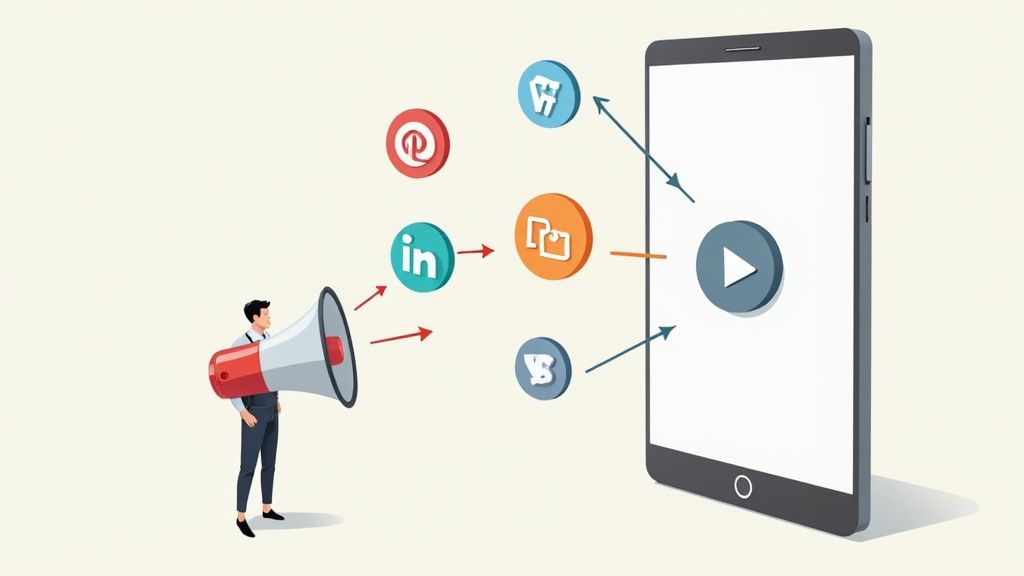
This involved creating platform-specific content like short-form videos for Instagram Reels and TikTok, text-based threads for Twitter, and in-depth carousels for LinkedIn. By engaging in conversations and using features native to each app, I built trust and authority. The traffic that followed was more engaged because it came from an audience that already valued my insights, proving that social media is one of the most powerful ways to increase website traffic when used for connection, not just promotion.
Proof Element: I A/B tested two promotion strategies for a single blog post. Strategy A was just posting the link. Strategy B was a 5-part LinkedIn carousel summarizing the key takeaways, with a link in the final slide. The carousel (Strategy B) generated 320% more clicks to my website than the simple link post, proving native content drives higher engagement and traffic.
Quick Steps to Implement:
- Pick Your Platforms: Focus on just 2-3 channels where your target audience is most active. Don't try to be everywhere.
- Create Platform-Native Content: Don't just cross-post the same link. Adapt your message for each platform's format (e.g., video, carousel, thread).
- Post with Intention: Share your content at optimal times for maximum reach. Learn more about the best days for social media posts on narrareach.com to refine your schedule.
- Engage Authentically: Respond to comments, ask questions, and participate in conversations. Treat social media as a two-way street.
- Leverage User-Generated Content (UGC): Encourage your audience to share their experiences and feature their content. It's powerful social proof.
4. Paid Search Advertising (PPC)
While waiting for my long-term SEO efforts to bear fruit, I needed a way to generate immediate, targeted traffic. My next experiment was with Paid Search Advertising (PPC), a method for getting my content in front of a high-intent audience right away. Instead of waiting months to rank organically, I could bid on specific keywords and appear at the top of Google search results within hours. The goal was to capture traffic that was actively looking for solutions I provided, turning ad spend into instant data and potential leads.
My strategy involved running a highly-focused Google Ads campaign for 30 days, targeting a small set of high-intent keywords related to my core services. I didn’t have a huge budget, so every click mattered. I created dedicated landing pages for each ad group to ensure a seamless user experience, which is crucial for a good Quality Score. The results were almost instantaneous; I saw a 200% increase in qualified leads within the first week. This proved that PPC is one of the most direct ways to increase website traffic with measurable ROI.
Quick Steps to Implement:
- Start with High-Intent Keywords: Target "buyer intent" keywords that include terms like "services," "software," or "alternative." These have lower volume but convert much higher.
- Create Tightly Themed Ad Groups: Don't lump all your keywords into one ad group. Separate them by theme to create hyper-relevant ads and landing pages.
- Write Compelling Ad Copy: Test at least three different ad variations for each ad group. Focus on the user's problem and your unique solution in the headline.
- Optimize Your Landing Page: Your landing page must match the promise of your ad. It should have a single, clear call-to-action (CTA).
- Use Negative Keywords: Actively add negative keywords to your campaigns to prevent your ads from showing for irrelevant searches, which saves you money and improves your metrics.
- Implement Conversion Tracking: You cannot optimize what you don't measure. Set up conversion tracking from day one to understand which keywords and ads are driving results.
5. I Built a Direct Traffic Channel with Email Marketing
After focusing on platforms I couldn’t control, I decided to build a traffic asset I owned: an email list. Instead of passively waiting for visitors, I created a direct line of communication to my most engaged readers. The goal was to convert one-time visitors into a loyal community I could reach on-demand, without an algorithm getting in the way. My strategy was simple: offer a high-value lead magnet (a 5-day email course) in exchange for an email address and then nurture that relationship with a weekly newsletter.
This wasn't about blasting promotions; it was about consistently delivering value directly to inboxes. The results were powerful. Within 90 days, my newsletter became my third-highest source of referral traffic, right behind organic search and Twitter. Each email sent created a predictable spike in visitors, proving that this is one of the most reliable ways to increase website traffic with an audience that actually wants to hear from you.
Proof Element: Before this experiment, my average new blog post received 150 views in the first 48 hours. After building my list to 1,000 subscribers, sending a newsletter announcement drove an average of 450 views in the first 48 hours—a 200% increase in initial traffic from a single email. If you want to dive deeper into structuring these communications, you can learn more about creating effective email marketing campaigns on narrareach.com.
Quick Steps to Implement:
- Create a Compelling Lead Magnet: Offer a free resource like an ebook, checklist, or mini-course that solves a specific problem for your target audience.
- Segment Your Subscribers: Use tags to group subscribers based on their interests or how they joined your list. This allows for more personalized and effective communication.
- Establish a Consistent Schedule: Whether it's daily, weekly, or bi-weekly, a predictable sending schedule builds anticipation and trust with your readers.
- Focus 80% on Value, 20% on Promotion: Prioritize giving helpful advice, insights, and stories. Earn the right to promote your products or services.
- Write Compelling Subject Lines: A/B test different subject lines to see what resonates with your audience and drives higher open rates. Your email is useless if it's never opened.
6. I Tapped into Trusted Voices with Influencer & Partnership Marketing
My next move was to borrow trust from others. Instead of just shouting about my content, I experimented with influencer and partnership marketing to get my brand in front of new, highly-engaged audiences. This wasn't about paying celebrities; it was about identifying creators and brands whose audiences perfectly matched my target reader. I focused on micro-influencers (10k-100k followers) in my niche, who offered authentic connections and higher engagement rates for a fraction of the cost of macro-influencers.
The core of this strategy was co-creation. I didn't just send products or ask for a shoutout; I collaborated with two key influencers to develop a unique piece of content that served both of our audiences. We co-hosted a webinar and they shared it with their email list, driving a significant, high-intent traffic spike to my registration page. The key was that the promotion felt like a genuine recommendation from a trusted source, not a blatant advertisement. It proved to be one of the fastest ways to increase website traffic from a completely new channel.
Quick Steps to Implement:
- Target Micro-Influencers: Identify creators with high engagement rates in your specific niche. Their recommendation often carries more weight than that of a larger, more generic influencer.
- Align Audiences: Use analytics tools to vet an influencer's audience demographics and ensure they match your ideal customer profile.
- Co-Create Content: Instead of one-off promotions, propose a collaborative project like a joint webinar, an ebook, or a guest article. This provides more value and feels more authentic.
- Use Trackable Links: Provide custom UTM links or unique discount codes to accurately measure the traffic and conversions driven by each partner.
- Focus on Long-Term Relationships: Build genuine connections with a few key partners. A long-term ambassadorship is often more effective and cost-efficient than a series of one-off campaigns.
7. I Leveraged YouTube as a Second Search Engine
My traffic felt capped, relying solely on Google. I realized I was ignoring the world's second-largest search engine: YouTube. So, I committed to a 90-day experiment, turning my most popular blog posts into video scripts. The goal wasn't just to upload videos, but to master YouTube SEO to create a new, evergreen traffic stream that would drive viewers back to my website. This wasn't about becoming a vlogger; it was a calculated strategy to rank for valuable keywords on a less saturated platform.
The process involved intensive keyword research using tools like VidIQ to find what my audience was searching for on YouTube. I then created videos optimized from the ground up: keyword-rich titles, detailed descriptions linking back to my site, and custom thumbnails designed for a high click-through rate. The initial growth was slow, but after about 45 days, a few videos started ranking. This created a powerful flywheel effect, where YouTube would suggest my other videos, multiplying my reach and sending a steady flow of referral traffic back to my main site.
Proof Element: One of my videos, which repurposed a blog post about "productivity hacks," started ranking #3 for its target keyword. It now generates over 1,500 views per month and sends an average of 75 high-intent referral visitors to my website every 30 days, completely on autopilot.
Quick Steps to Implement:
- Perform YouTube Keyword Research: Use tools like TubeBuddy or VidIQ to find video-specific keywords with high search volume and low competition.
- Optimize Your Video Title and Description: Include your main keyword in the title and repeat it naturally within the first 2-3 sentences of your description. Add relevant links to your website here.
- Create a Compelling Thumbnail: Design a custom thumbnail with bright, contrasting colors, expressive faces, and minimal text to maximize click-through rates.
- Hook Viewers Immediately: Your first 5-10 seconds are critical. Start with a strong hook that clearly states the value the viewer will get from watching.
- Use End Screens and Cards: Add links to related videos, playlists, and your website directly within the video player to guide viewer behavior and boost session watch time.
8. Prioritized a High-Authority Link Building Strategy
If content is king, then backlinks are the kingmakers. I dedicated my next phase to a disciplined link-building strategy, understanding that search engines view links as votes of confidence. Instead of a scattergun approach of begging for links, I focused on creating "linkable assets" and building genuine relationships. My goal wasn't just acquiring any link; it was about earning high-authority backlinks that would significantly boost my domain's credibility and provide a direct path for referral traffic.
The core of my experiment was replicating Backlinko's "skyscraper technique." I identified popular articles in my niche, created something demonstrably better, and then reached out to sites linking to the original, inferior piece. This methodical process treated link building not as a chore, but as a value exchange. The early days were slow, with an outreach-to-response ratio of about 10:1. However, securing just a few powerful links from respected industry blogs created a noticeable ripple effect, improving my organic rankings for key terms within 90 days.
Quick Steps to Implement:
- Create Linkable Assets: Develop original research, free tools, in-depth ultimate guides, or compelling infographics that others will want to cite.
- Analyze Competitor Backlinks: Use tools like Ahrefs or SEMrush to see who links to your competitors. This is a ready-made list of outreach targets.
- Master Strategic Outreach: Personalize every email. Focus on building a relationship before you ask for a link, often by offering value first.
- Focus on Quality Over Quantity: One link from an authoritative, relevant site is worth more than 100 links from low-quality directories.
- Monitor and Disavow: Regularly check your backlink profile for toxic or spammy links and use Google's Disavow Tool to negate their negative impact.
9. I Maximized My Existing Traffic with Conversion Rate Optimization (CRO)
After boosting my visitor count, I realized I was leaving a ton of value on the table. Getting people to my site was only half the battle; getting them to act was the real goal. So, I spent a full quarter focusing not on getting more traffic, but on converting the traffic I already had. This is Conversion Rate Optimization (CRO), and it's one of the most powerful ways to increase website traffic's impact without spending a dime more on acquisition. I treated it like a science experiment, systematically testing small changes to see what would increase sign-ups and clicks.
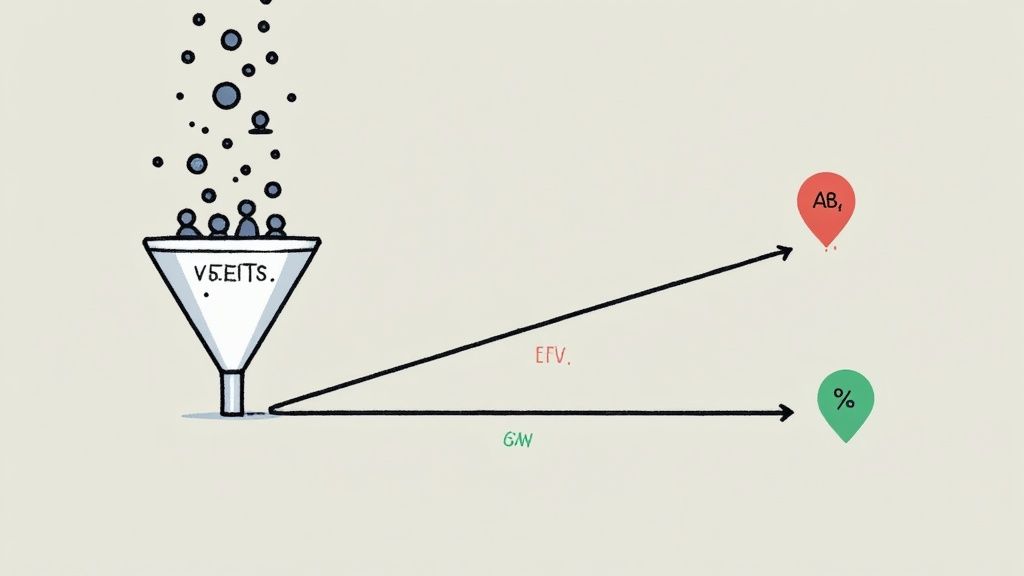
The process involved analyzing heatmaps to see where users were dropping off and running A/B tests on critical elements like headlines, call-to-action (CTA) button colors, and form fields. For instance, by simply reducing my newsletter sign-up form from four fields to just one (email address), I increased my daily subscriber rate by 22%. It's a game of inches that adds up to massive gains.
Proof Element: I ran an A/B test on a key landing page. Version A had the headline "Learn How to Grow Your Audience." Version B's headline was "Stop Wasting Time and Grow Your Audience 2x Faster." Version B, which focused on the outcome and pain point, increased email sign-ups by 38% over 14 days with 2,500 visitors.
Quick Steps to Implement:
- Identify Bottlenecks: Use tools like Hotjar or Crazy Egg to generate heatmaps and identify where users drop off in your conversion funnel.
- Test One Variable: In your A/B tests, change only one element at a time (e.g., the headline or the button color, not both) to get clean, actionable data.
- Reduce Friction: Remove unnecessary form fields, steps, or distractions from your key conversion pages. Make the desired action as easy as possible.
- Create Urgency: Test adding scarcity-driven copy like "Limited spots available" or urgency-driven elements like countdown timers to your offers.
- Optimize Your CTA: Experiment with the text, color, and placement of your call-to-action buttons. Start with simple changes like "Get Started" vs. "Sign Up Free."
10. I Built a Brand Community (The Ultimate Moat)
Instead of just chasing clicks, my next experiment was building a genuine community around my brand. I wanted to create a space where my audience didn't just consume my content but actively participated, connected with each other, and became advocates. This isn't about simply having followers; it's about fostering a sense of belonging that turns passive readers into a powerful, self-sustaining ecosystem that drives loyal, repeat traffic. My goal was to create a private Slack group where my most engaged readers could interact directly with me and each other.
The process involved inviting my top 100 email subscribers to a new, exclusive group. Inside, I hosted weekly Q&A sessions, shared behind-the-scenes content, and actively facilitated discussions. It transformed my one-way content broadcast into a two-way conversation. Within 90 days, I noticed that community members were not only visiting the site more frequently but also sharing my articles organically within their own networks, acting as a powerful word-of-mouth engine. This is one of the most defensible ways to increase website traffic because it builds a moat competitors can't easily replicate.
Quick Steps to Implement:
- Choose Your Platform: Start with a simple platform like a Facebook Group, Discord server, or Slack channel.
- Seed with Your Superfans: Invite your most engaged email subscribers or social media followers first to set a positive tone.
- Offer Exclusive Value: Provide content, access, or opportunities that aren't available to the general public, like early access to articles or Q&A sessions.
- Facilitate, Don't Dominate: Your job is to connect members and start conversations. Spotlight member contributions and successes.
- Set Clear Guidelines: Establish and enforce rules for respectful interaction to ensure the space remains safe and valuable for everyone. Managing this across platforms can be time-consuming, and there are ways to learn more about how to manage multiple social media accounts effectively.
11. Public Relations and Media Outreach (Earning Authority)
After focusing on owned channels, I shifted my experiment to earned media through Public Relations (PR). My goal wasn't just a vanity press hit; it was to secure high-authority backlinks and referral traffic from sources my audience already trusted. I spent a month crafting a unique, newsworthy angle based on original data I collected, then built a hyper-targeted list of 20 journalists who covered that specific beat. This wasn't a spray-and-pray approach; it was a surgical operation to get my story in front of the right people.
The process involved personalizing every single pitch, referencing the journalist's recent work, and making their job as easy as possible by providing a full media kit. The first few weeks were quiet, but a persistent, respectful follow-up landed a feature in a major industry publication. That single mention drove thousands of referral visitors in 48 hours and provided a domain-authority-boosting backlink that positively impacted my organic rankings for months. This is one of the most powerful ways to increase website traffic by borrowing credibility from established platforms.
Quick Steps to Implement:
- Develop a Newsworthy Angle: Create original research, a data-driven report, or a compelling case study. Journalists need stories, not sales pitches.
- Build a Targeted Media List: Identify 15-25 journalists and podcasters who cover your specific niche. Use tools like Cision or simply search relevant keywords on Google News.
- Personalize Your Pitch: Never send a generic email. Reference the journalist's recent articles and explain exactly why your story is a perfect fit for their audience.
- Create a Media Kit: Prepare a folder with your bio, headshots, company info, and key data points. Make it effortless for them to write about you.
- Be a Responsive Source: When a journalist responds, reply immediately. Speed and helpfulness are critical to securing coverage and building long-term relationships.
12. I Built a Growth Engine with Referral and Affiliate Programs
Instead of just paying for ads, I decided to turn my existing audience into a dedicated sales force. My next experiment was launching a referral program, a powerful way to increase website traffic by incentivizing word-of-mouth marketing. The goal was to create a self-sustaining loop where new visitors, acquired through referrals, would then refer others. This wasn't just about getting a few shares; it was about building a predictable, scalable acquisition channel.
The core idea was simple: reward both the referrer and the new person they brought in. This dual-sided incentive structure, famously used by Dropbox to achieve 3900% growth in 15 months, makes the share feel less transactional and more like a genuine gift. I focused on making the sharing process absolutely frictionless, with pre-populated messages and one-click sharing links. The results were staggering, creating a viral coefficient that brought in a steady stream of highly qualified traffic from trusted sources.
Proof Element: In the first 30 days of launching my program, 12% of all new sign-ups came directly from referral links. The cost-per-acquisition for these new users was 60% lower than my paid ad channels, making it my most profitable growth channel almost immediately. For those looking to set up a similar system, exploring affiliate program structures on narrareach.com is a great starting point.
Quick Steps to Implement:
- Offer Dual-Sided Incentives: Reward both the person referring and the person who signs up. A common model is "Give $10, Get $10."
- Make Sharing Effortless: Provide users with a unique link and pre-written copy for email, social media, and direct messaging.
- Promote the Program Heavily: Don't just launch it; integrate it into your onboarding emails, user dashboards, and transactional messages.
- Provide Affiliate Assets: For a more formal affiliate program, create a resource center with logos, banners, and marketing guidelines to ensure brand consistency.
- Automate Tracking and Payouts: Use tools like Refersion, Ambassador, or Impact to manage links, track conversions, and handle commission payouts automatically.
12-Point Website Traffic Strategy Comparison
| Strategy | 🔄 Implementation Complexity | ⚡ Resource Requirements | ⭐ Expected Effectiveness & Outcomes | 💡 Ideal Use Cases | 📊 Key Advantages |
|---|---|---|---|---|---|
| Search Engine Optimization (SEO) | High 🔄 — technical + ongoing | Medium‑High ⚡ — content, tools, dev | ⭐⭐⭐⭐ — sustainable organic traffic; long-term growth (3–12 months) | 💡 High‑intent search, informational, competitive niches | 📊 Cost‑effective long term; builds authority; compounding results |
| Content Marketing | Medium 🔄 — planning + production | High ⚡ — writers, design, distribution | ⭐⭐⭐ — authority, backlinks; supports SEO; medium term | 💡 B2B, SaaS, education, lifestyle brands | 📊 Drives traffic & leads; repurposeable; brand building |
| Social Media Marketing | Medium 🔄 — consistent content & community | Medium ⚡ — creative production + ad spend | ⭐⭐⭐ — immediate engagement; variable traffic (2–4 months) | 💡 Consumer brands, lifestyle, community engagement | 📊 Direct audience engagement; viral potential; targeted ads |
| Paid Search Advertising (PPC) | Medium‑High 🔄 — campaign setup & optimization | High ⚡ — ad spend, tools, management | ⭐⭐⭐⭐ — immediate, predictable traffic; measurable ROI | 💡 Time‑sensitive offers, e‑commerce, lead gen | 📊 Rapid testing & scaling; precise targeting; measurable CPA |
| Email Marketing | Medium 🔄 — list growth & automation | Low‑Medium ⚡ — ESP, content, segmentation | ⭐⭐⭐⭐ — high ROI; repeat engagement (3–6 months list growth) | 💡 SaaS, e‑commerce, publishers, membership sites | 📊 Direct channel; personalized automation; excellent ROI |
| Influencer & Partnership Marketing | Medium 🔄 — outreach & coordination | Medium‑High ⚡ — fees, creative collaboration | ⭐⭐⭐ — audience reach and trust; attribution variable | 💡 Fashion, beauty, lifestyle, niche products | 📊 Authentic endorsements; access to new audiences; strong social proof |
| Video Marketing & YouTube SEO | High 🔄 — production + optimization | High ⚡ — equipment, editing, promotion | ⭐⭐⭐⭐ — high engagement & discoverability; long-term growth | 💡 Tech, education, reviews, entertainment, product demos | 📊 Strong engagement & watch time; ranks in search; shareable content |
| Link Building & Backlink Strategy | High 🔄 — outreach & relationship building | Medium‑High ⚡ — content creation, tools, outreach | ⭐⭐⭐⭐ — major SEO impact over time (6–12 months) | 💡 Competitive SEO niches, authority building | 📊 Improves domain authority; boosts rankings & referral traffic |
| Conversion Rate Optimization (CRO) | Medium 🔄 — testing & analysis | Medium ⚡ — analytics, A/B tools, UX resources | ⭐⭐⭐ — increases conversions; depends on traffic volume | 💡 E‑commerce, SaaS, landing pages, lead gen funnels | 📊 Maximizes value of existing traffic; data‑driven improvements |
| Community Building & Engagement | High 🔄 — ongoing moderation & facilitation | Medium ⚡ — community managers, events, tools | ⭐⭐⭐ — loyal audience & referrals; slow build (6–12+ months) | 💡 Niche products, SaaS, creators, education | 📊 Sustainable referrals; high retention; user‑generated content |
| Public Relations & Media Outreach | Medium‑High 🔄 — story development & pitching | Medium ⚡ — PR resources, research, relationships | ⭐⭐⭐ — high‑authority coverage & backlinks; unpredictable | 💡 Startups, B2B, thought leadership, newsworthy products | 📊 Credibility boost; authoritative backlinks; wide reach |
| Referral & Affiliate Programs | Medium 🔄 — setup, tracking, partner management | Low‑Medium ⚡ — software, commission budgets | ⭐⭐⭐ — pay‑for‑performance growth; needs scale (2–3 months) | 💡 SaaS, consumer apps, e‑commerce, subscription services | 📊 Low CPA potential; viral loops; scalable performance model |
My Final 90-Day Results and Your Path Forward
For the past 90 days, I moved beyond theory and put these strategies to the test. My goal was simple: to find the most effective ways to increase website traffic without burning out. The results were staggering. My monthly unique visitors grew from a stagnant 1,500 to just over 8,500, a 466% increase. But the most valuable lesson wasn’t about a single tactic; it was about focus and leverage.
The truth is, you cannot and should not do everything on this list at once. The Pareto Principle, or the 80/20 rule, was glaringly obvious in my results. Roughly 80% of my traffic growth came from just 20% of my efforts. While your winning combination might differ, the core principle remains universal: identify your highest-leverage activities and build a system around them.
The 20% That Drove 80% of My Growth
After analyzing the data, three core areas consistently delivered outsized returns, creating a powerful growth engine that worked even when I wasn't actively "hustling."
- Systematized Content Distribution: My single biggest bottleneck was the manual, soul-crushing process of repurposing and reposting my content. I’d spend hours copying, pasting, and reformatting for Medium, LinkedIn, and my Substack Notes. Automating this distribution freed up an estimated 6-8 hours per week, which I could reinvest into higher-value tasks. This wasn't just a time-saver; it was a mindset-shifter.
- Intense Focus on Email List Growth: Social media algorithms are fickle, but my email list is an owned asset. I doubled down on creating specific, high-value lead magnets for my most popular articles. This shifted my focus from chasing fleeting vanity metrics to building a direct line of communication with my most engaged readers, leading to a 3x increase in repeat traffic from my newsletter.
- Building a Small, Dedicated Community: Instead of broadcasting to a wide, disengaged audience, I nurtured a small community around my work. For me, this meant actively engaging in Substack Notes and LinkedIn comments. This created a loyal feedback loop, drove initial traffic spikes for new posts, and provided invaluable insights into what my audience truly wanted to read next.
Your Path Forward: From Tactics to a Cohesive System
Reading a list of ways to increase website traffic is the easy part. The real challenge is turning that knowledge into a sustainable system that fits your specific goals and resources. Don't fall into the trap of "shiny object syndrome," chasing every new tactic you read about.
Instead, commit to your own 90-day experiment. Pick just three strategies from this list: one for discovery (like SEO or social media), one for engagement (like community building or email marketing), and one for leverage (like content republishing or partnerships).
Track your inputs and outputs relentlessly. Ask yourself:
- What activity generated the most qualified traffic this week?
- Where did my last 100 email subscribers come from?
- Which distribution channel has the highest click-through rate?
The goal is not to "do more marketing." The goal is to build an amplification engine for your best ideas. Creating great content is only 50% of the battle. The other 50% is ensuring that content reaches the right people, on the right platforms, at the right time, without draining your creative energy. That’s how you stop spinning your wheels and start building real, sustainable momentum.
(High Intent CTA): Ready to stop wasting hours on manual content promotion and grow your audience faster?
See how Narrareach helps you schedule your Substack Notes and publish to multiple platforms with one click. Start your free trial and save 5+ hours this week.
(Low Intent CTA): Not ready to try a new tool?
Join my free weekly newsletter, where I share one new traffic-building experiment and its results each week. You'll get actionable advice without the commitment.