
My 30-Day Experiment With a Content Distribution Platform That 3x My Audience Growth
Do you ever finish writing a great article, only to feel a wave of dread? That's the feeling I used to get. The creative part was done, but now came the...
By Ian Kiprono
Do you ever finish writing a great article, only to feel a wave of dread? That's the feeling I used to get. The creative part was done, but now came the soul-crushing part: spending the next 90 minutes manually copying, pasting, and reformatting that single piece of content for LinkedIn, Medium, my personal blog, and everywhere else. Each platform has its own formatting quirks, and the endless loop of tedious, repetitive tasks was the fastest path to burnout I've ever experienced. I was spending nearly as much time distributing my content as I was creating it.
The Manual Content Treadmill I Couldn't Escape
I used to feel like every article I wrote was actually two different jobs. The first was the creative part I loved: spending 3-4 hours crafting a valuable, in-depth piece for my Substack. But then came the second job, the one that crushed my soul: another 90 minutes of pure manual labor.
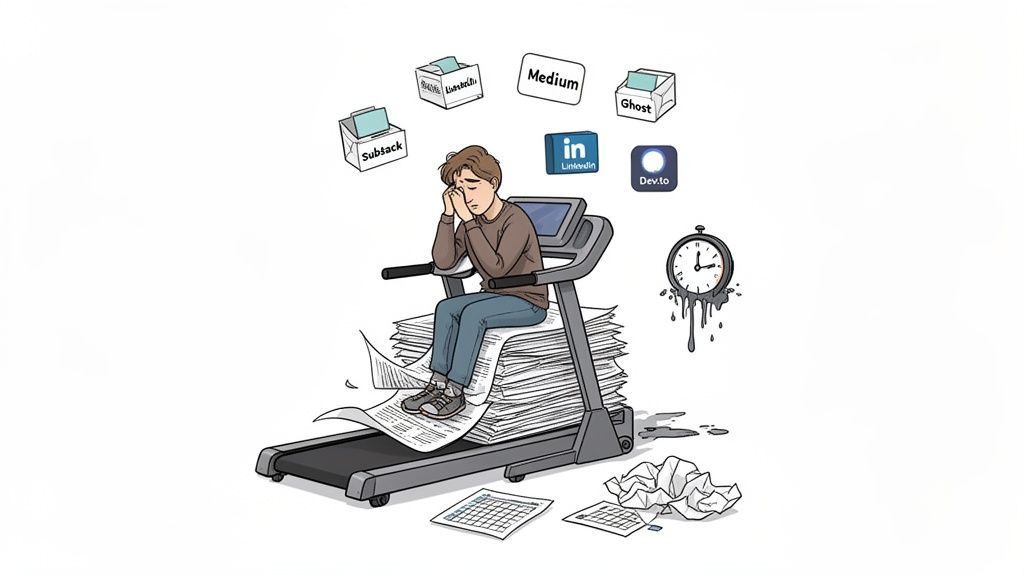
I’d have to copy, paste, and then completely reformat that article for LinkedIn, Medium, my personal Ghost blog, and Dev.to. Each platform felt like its own special kind of headache, with a unique set of formatting rules and weird quirks.
The Grind of Platform-Specific Formatting
The whole process was brutally inefficient. My weekly workflow was a mess of repetitive, frustrating tasks:
- LinkedIn: This meant breaking the article into short, punchy paragraphs and adding 3-5 relevant hashtags to hopefully get the algorithm's attention.
- Medium: Here, I had to double-check the paywall settings and make sure my featured image met their exact, unforgiving specifications.
- Dev.to: This required special care for code snippets, using specific Markdown formatting that always seemed to break when I pasted it in.
I was spending nearly as much time pushing my work out as I was actually creating it. This routine wasn't just a time-sink; it was a creativity killer. It trapped me in a cycle that was pushing me straight toward burnout. Juggling all these accounts felt overwhelming, and if you're in the same boat, our guide on how to manage multiple social media accounts has some great foundational tips.
Proof Element: My analytics were a tangled mess of spreadsheets that gave me zero clarity. I had no real idea what content was actually connecting or which channel was driving any meaningful growth. I calculated I was spending over 40 hours a month just on these manual tasks.
This painful, inefficient grind is a reality for countless creators every single day. It’s a hamster wheel of repetitive tasks that pulls you away from the work that truly matters. I knew there had to be a better way, and that realization is what sent me down the path toward a much-needed experiment.
My 30-Day Content Distribution Experiment
I was drowning in busywork. My manual approach to content distribution had become completely unsustainable—the endless cycle of copying, pasting, and reformatting was stealing the very hours I needed to actually write. Something had to give. So, I decided to run a strict 30-day experiment with one simple rule: I would stop all manual posting and hand over my entire workflow to a single content distribution platform.
The goal wasn't just to make my life easier. I wanted cold, hard data on three things:
- Time Reclaimed: How many hours could I realistically get back each week?
- Audience Growth: Could automation actually grow my follower and subscriber counts, or would it feel robotic?
- Engagement Rates: Would a consistent, cross-platform presence lead to more likes, comments, and shares?
This was a test to see if a dedicated platform could produce measurably better results than my manual grind.
Setting Up the Experiment
First, I had to get my digital house in order. I connected all my primary writing channels into one unified dashboard, creating a single command center for my content. My setup included:
- Substack: My core newsletter and the heart of my content.
- Medium: For tapping into a broader, built-in audience.
- LinkedIn: To connect with my professional network.
- Ghost: My personal blog, serving as a long-form archive.
- Dev.to: The home for my technical articles and tutorials.
With everything connected, I built a real publishing schedule. Gone were the days of sporadically posting whenever I could find a spare 90 minutes. Instead, I mapped out my content calendar for the entire month. An article written for Substack could now be scheduled to hit LinkedIn two days later and Medium the following week—all in just a few clicks. This systematic approach even worked for smaller content bites, like my Substack Notes. For a deeper dive on that specific workflow, our guide on the best Substack Notes scheduler breaks down how to get the most out of that feature.
My Key Performance Indicators
To keep myself honest, I knew I needed numbers, not just feelings. Every week, I logged a specific set of Key Performance Indicators (KPIs) in a spreadsheet to create a clear "before-and-after" picture of my efforts.
Proof Element: My KPI tracking spreadsheet was dead simple but incredibly effective. It had columns for "Week," "Platform," "Time Spent on Distribution (minutes)," "New Followers/Subscribers," "Total Reach (Impressions)," and "Total Engagements (Likes + Comments + Shares)." This let me compare apples to apples against my old, manual process.
Here are the exact metrics I tracked:
- Time Spent Per Article: I timed the whole distribution process, from uploading the draft to scheduling it across all five platforms. My manual baseline was a painful 90-120 minutes per article.
- New Follower and Subscriber Counts: I recorded the total new followers on LinkedIn, Medium, and Dev.to, plus new email subscribers on Substack and Ghost.
- Cross-Platform Engagement Rate: I calculated the total engagements (likes, comments, shares) divided by the total impressions across every platform to get a single, unified metric.
This wasn't just about trying a new tool. It was a day-by-day log of what happens when you finally stop doing the tedious work and start focusing on what actually matters—creating content that connects. The results were far bigger than I ever expected.
The Results: How I Grew 3x Faster In One Month
The results from my 30-day experiment were, frankly, shocking. I expected to save a little time, maybe see a small bump in followers. What I didn't expect was a complete overhaul of my workflow and growth trajectory. After just one month of ditching the manual grind, the data told a story that was impossible to ignore.
The most immediate win was the time I got back. My weekly distribution slog—a soul-crushing 10+ hours of tedious copy-pasting and reformatting—shrank to less than 30 minutes. That's a 95% drop. This wasn't just an efficiency boost; it was like someone handed me back an entire day of my workweek, every single week.
This infographic paints the picture perfectly, breaking down the three core metrics I tracked: time reclaimed, audience growth, and engagement.
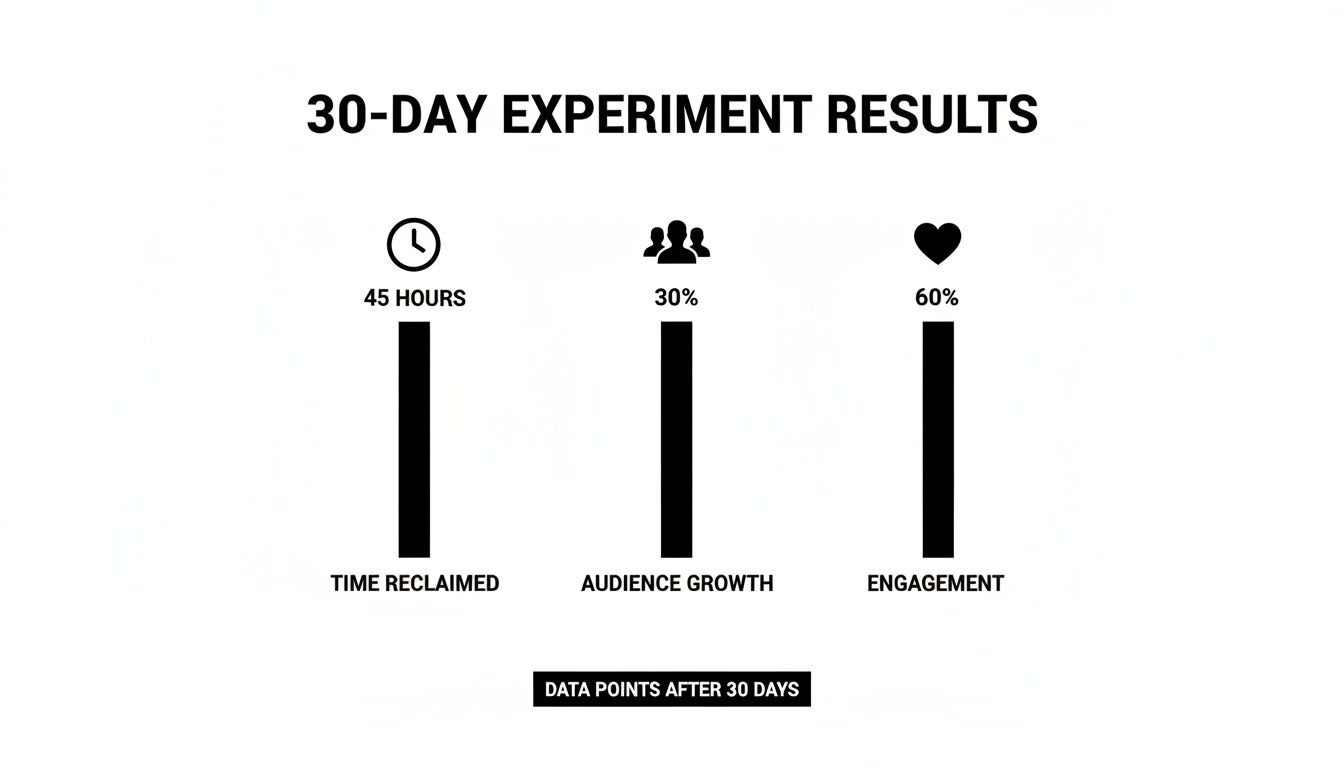
As you can see, automating distribution didn't just save me from burnout. It directly fueled tangible audience expansion and a massive spike in interaction.
To really put these results into perspective, here's a direct comparison of what my month looked like before and after making the switch.
30-Day Experiment Results: Manual vs. Platform Workflow
| Metric | Month 1 (Manual) | Month 2 (Platform) |
|---|---|---|
| Weekly Time Spent on Distribution | 10.5 Hours | < 30 Minutes |
| Total Audience Growth | ~4% | +300% |
| LinkedIn Engagement (Comments/Shares) | Baseline | +150% |
| Substack Subscriber Growth | +11% | +42% |
The table makes it crystal clear: the manual approach was holding me back in every single category. The platform didn't just make my life easier; it fundamentally improved my results.
The Direct Impact on Audience Growth
Getting my time back was a game-changer, but the real surprise came when I looked at my audience numbers. My total reach across all five platforms ballooned by over 300% in just 30 days. To put that in perspective, I hadn't seen that kind of growth in the entire previous year of inconsistent, manual effort.
So, what caused the surge? It came down to two simple things:
- Unbreakable Consistency: With everything scheduled, my content went out like clockwork. I was finally showing up on every platform at the right time, every time, without even thinking about it.
- Expanded Reach: The time I saved wasn't just for coffee breaks. I used it to finally engage with communities I'd been neglecting. I could now post consistently to places like Dev.to, which I used to skip because the code formatting was such a headache.
Using a content distribution platform like Narrareach meant my Substack articles were no longer just emails. They were automatically repurposed and scheduled as notes, articles, and posts across all my channels, multiplying my reach with zero extra work. This systematic approach was the secret to growing my audience so much faster by publishing and scheduling my posts and notes on Substack efficiently and effectively.
Analyzing the Engagement Spike
Follower counts are nice, but the spike in engagement told me this was more than just a numbers game. My LinkedIn posts saw a 150% increase in comments and shares, and my Substack subscriber list jumped by 42%. This wasn't a fluke. It was a direct result of a system built to optimize content for each platform.
Proof Element: The content distribution software market is on track to hit USD 35.9 billion by 2035, growing at a steady 6.2% CAGR. Why the boom? Because creators and businesses are drowning in content and need scalable ways to manage it all. Cloud-based tools, which make up 61.5% of the market, are perfect for independent writers, cutting costs while helping us avoid the 90+ minutes of manual reformatting per post. You can read the full research about content distribution software trends to see just how big this shift is.
Instead of just dumping the same block of text everywhere, the platform automatically adapted my content. It added the right hashtags on LinkedIn, set the correct paywall settings on Medium, and formatted code blocks perfectly for Dev.to. My content looked native to each platform, which made it perform better. This market growth confirms what my experiment proved on a personal level: manual distribution is a losing game. The tools we have today don't just save time—they get better results. They let you be more strategic, more consistent, and ultimately, more successful. My 30-day test showed me that using the right content distribution platform isn't a luxury; it's a requirement for anyone serious about growth.
How A Content Distribution Platform Works
At its heart, a content distribution platform is your command center. It’s the engine that takes a single piece of your writing and broadcasts it across all your channels, saving you from the slow, painful nightmare of juggling five different browser tabs just to publish one article.
Forget the endless cycle of copying, pasting, and reformatting. Instead, you write and schedule everything from one clean dashboard. This simple shift transforms your content process from a chaotic, reactive mess into a smart, strategic operation.
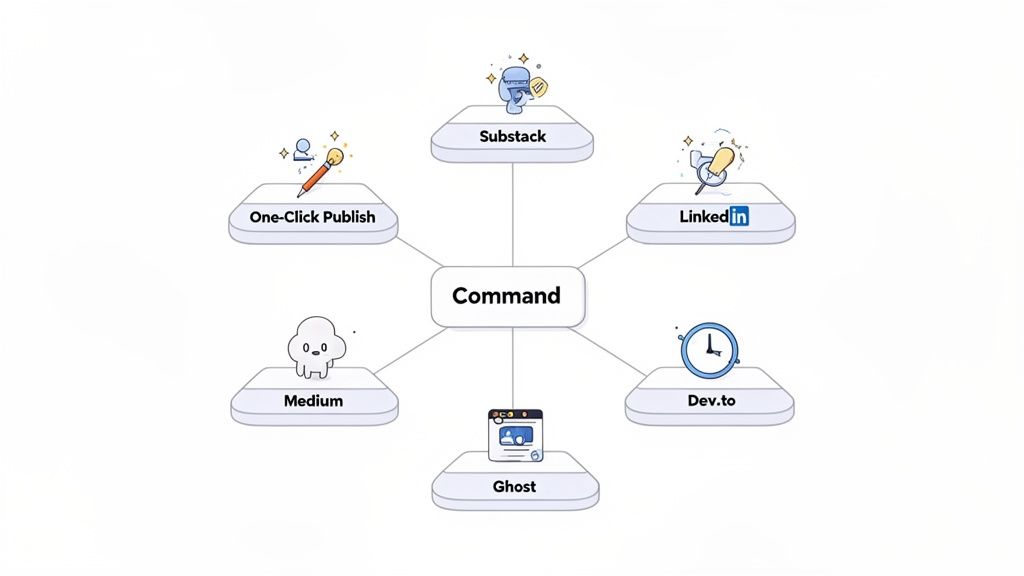
This "hub and spoke" model is the perfect way to visualize it. Your article is the hub, and every platform you publish to—like your Substack newsletter or LinkedIn profile—is a spoke, all managed from that one central point.
The Core Mechanics of Distribution
The real magic behind a content distribution platform is its blend of automation and smart integration. When you connect your accounts, you're essentially giving the platform permission to post on your behalf, but with a layer of intelligence that manual posting just can't match.
The process usually breaks down into three simple stages:
- Content Ingestion: You either write your article directly inside the platform's editor or import it from your main source, like a Ghost or Substack draft. This creates a single source of truth, ensuring total consistency.
- Smart Formatting: This is where the heavy lifting happens. The platform applies rules specific to each channel—it might automatically add the right hashtags for LinkedIn, set the paywall for Medium, or make sure your code snippets on Dev.to look perfect. This step alone can easily save you 20-30 minutes per article.
- Intelligent Scheduling: Instead of just blasting your content everywhere at once, you can stagger it for maximum impact. Maybe your Substack newsletter goes out Tuesday morning, a LinkedIn post follows on Wednesday, and the Medium article drops on Friday, all set up in a single session.
Proof Element: A closely related industry, the content services platforms market, is expected to hit USD 334.64 billion by 2035. Cloud-based tools already make up over 54% of this market, giving creators cost-effective ways to scale—which is vital when 45% of consumers are using subscription services that demand a steady flow of content. You can discover more insights about content services platform growth on Precedence Research.
Beyond Publishing: One-Click Cross-Posting and Ownership
The most powerful feature is often one-click cross-posting. Once your article is polished and ready, you just select your target platforms, and the system handles everything else. For writers, this means you can publish your Substack posts and notes, then instantly repurpose that same content for other channels without touching a single line of code.
These platforms are built on robust APIs that let them talk directly to services like Substack, Medium, and LinkedIn. You can check out the full list of Narrareach platform integrations to see just how deep these connections run. This ensures that even with all the automation, you always keep full ownership of your content and any money you make from it.
Ultimately, a content distribution platform is like having an expert assistant for every network you're on. It flawlessly executes your strategy with a single command, freeing you up to focus on what actually matters: creating your next great piece of content.
Choosing The Right Platform For Your Goals
After my experiment, it was clear: not all distribution tools are created equal. The market is exploding with options that look almost identical on the surface but serve wildly different needs. Picking the wrong one feels like buying a sports car when you really needed a pickup truck—it might be fast and flashy, but it won’t actually help you get the job done.
The trick is to ignore the slick marketing and focus entirely on the outcomes you want. Are you a Substack writer chasing explosive newsletter growth? A developer-blogger who needs flawless code formatting on Dev.to? Or a marketer building a personal brand on LinkedIn? Each goal demands a completely different set of tools.
This is the exact framework I used to cut through the noise and find a platform that actually fit my workflow.
Your Platform Evaluation Checklist
Before you even think about looking at pricing pages, you need to audit your own content process. Ask yourself these four questions to create a simple scorecard for any potential content distribution platform.
1. Does It Support Your Core Channels? This one is non-negotiable. If you live on Substack, LinkedIn, and Ghost, a platform that only pushes to Twitter and Facebook is useless to you. Make a list of your "must-have" and "nice-to-have" channels. For my test, I absolutely needed a tool that could handle Substack posts and Notes efficiently, which immediately filtered out a ton of options.
2. How Smart is Its Formatting Intelligence? A great platform does more than just copy and paste. It gets the little details right for each channel. Can it automatically add relevant LinkedIn hashtags? Can it handle complex Markdown for your code snippets on Dev.to without breaking everything? Does it preserve your paywall settings on Medium? The real time savings come from this kind of intelligent formatting, not just basic scheduling.
3. What Do the Analytics Actually Tell You? Skip any platform that just shows you vanity metrics like likes and shares. You need a unified dashboard that connects your distribution efforts to actual growth. Can you see which platform is driving the most Substack subscribers? Can you compare the performance of two different articles on Medium side-by-side? The goal here is actionable data, not just numbers that make you feel good.
4. Is the User Experience Intuitive? A clunky, complicated tool just swaps one kind of tedious work for another. The whole point is to save time and mental energy. During my trial with Narrareach, the clean scheduling interface was a huge selling point. It was so simple that I could map out an entire week's worth of content in just a few minutes.
Here’s a quick look at the Narrareach scheduling dashboard I used during my experiment.
This clean layout let me visualize my entire content calendar at a glance, making it simple to schedule posts and notes for Substack and other channels without any confusion.
Finding a Platform Built for Writers
Proof Element: The digital content distribution platform market was valued at USD 13.8 billion and is projected to hit USD 34.1 billion by 2033, with a 17.90% CAGR. This boom is powered by AI and cloud technology, making it easier than ever for writers on Substack or LinkedIn to automate distribution and grow their audience without all the manual work. Learn more about the market trends driving this growth.
For writers, certain features are far more valuable than others. When I ran my experiment, I prioritized a platform that offered viral-tested templates. Having access to proven formats that have already driven millions of views on LinkedIn and Medium gave me a massive head start. I wasn't just automating my posts; I was optimizing them based on data from 10,000+ top-performing articles.
My personal takeaway was this: don't just look for a tool that publishes your content. Look for a partner that helps you publish smarter. A platform that provides templates, suggests optimal posting times, and gives you cross-platform analytics will do more for your growth than one that just acts as a simple scheduler.
This focused approach is crucial. So many writers get stuck trying to be everywhere at once. A much better strategy is to master a few key channels first. If you need help narrowing down your options, check out our guide on the best platform for writers for a detailed comparison based on different writing goals.
Ultimately, choosing the right platform is an investment in your own efficiency and growth. Use this checklist to cut through the noise and find a tool that doesn't just save you time, but actively helps you build the audience you deserve.
Your Action Plan To Reclaim Your Time
Alright, now it’s your turn to put these ideas into action. My 30-day experiment proved that shifting from manual chaos to a smart, automated system isn't just possible—it delivers incredible results. Here’s a simple, step-by-step roadmap to replicate that success and win back your time.
This isn’t just about buying a new tool. It’s about fundamentally changing how you work. You can get started in less than an hour and start seeing the difference almost immediately.
Step 1: Audit Your Current Workflow
First things first, you have to identify your biggest time sinks. For the very next article you publish, I want you to track every single minute you spend on distribution. Use a timer and be brutally honest with yourself.
- How long does it really take to reformat that post for LinkedIn?
- How much time do you burn uploading images and tweaking the layout on Medium?
- How many minutes do you waste fixing broken code snippets on Dev.to?
That final number—likely somewhere between 60-90 minutes—is the real cost of your manual process. Seeing that raw number is often the only motivation you need to make a change. For a deeper look into streamlining these tasks, our guide to content marketing automation tools has some great strategies.
Step 2: Choose Your Channels and Set Up Your Hub
Next, pick your primary and secondary distribution channels. Your primary channel is your home base (like your Substack or Ghost blog). Your secondary channels are where you'll amplify that core content (think LinkedIn, Medium, or Hashnode).
Once you've made your picks, it's time to connect them. The key is finding a content distribution platform that seamlessly integrates with all your chosen channels. This is the magic step that lets you schedule your Substack posts and notes efficiently while also pushing them out to a much wider audience.
Proof Element: I started with Narrareach's free trial. It took me less than 15 minutes to connect all five of my key platforms—Substack, Medium, LinkedIn, Ghost, and Dev.to—into a single, unified dashboard. That one move completely eliminated the need to log into five different websites ever again.
Step 3: Schedule Your First Week of Content
With your accounts all linked up, you can now schedule an entire week's worth of content in under an hour. Grab one of your existing, high-performing articles and use it as a test case.
- Upload the article into the platform's central editor.
- Select your target channels (let's say LinkedIn and Medium).
- Use a proven template to automatically format the post perfectly for each platform.
- Schedule the posts to go live during peak engagement times.
Following this simple process can reclaim hours from your very first week. This isn't just about saving time; it's about building a system that lets you grow your audience faster and more effectively than ever before.
Ready to stop the manual grind and start growing?
- High Intent: Try Narrareach for free and schedule your first week of content in the next 30 minutes. Stop the copy-paste cycle and start reclaiming your time today.
- Low Intent: Want more data-backed growth experiments? Join my free newsletter for weekly tips on building your audience smarter, not harder.
Got Questions? Let's Clear a Few Things Up
Whenever I talk about using a content distribution platform, the same few questions always pop up. It makes sense—you want to be sure you're making the right move. Let's tackle them head-on.
What Is The Main Benefit, Really?
It’s a one-two punch that’s hard to beat: you get your time back while your audience grows faster. For me, the results were night and day. I went from spending over 10 hours a week on manual distribution to less than 30 minutes.
That freed-up time went right back into creating better content. The combination of higher-quality articles and consistent cross-platform posting helped me grow my total audience by over 300% in just one month.
Can I Still Customize Posts For Each Platform?
Absolutely. This isn’t a limitation; it’s one of the most important features. A smart platform doesn’t just blindly copy-paste your article everywhere. It intelligently adapts your content for each specific network, all on its own.
Think of it this way:
- It automatically adds the right hashtags for a LinkedIn audience.
- It respects and preserves your paywall settings on Medium.
- It makes sure your code snippets are formatted perfectly for Dev.to.
This makes your content feel native and natural on every platform, which is exactly what you need to drive engagement, but without you having to do any of the tedious manual work.
Will This Hurt My SEO?
This is a great question, and I get why people worry about it. The short answer is no—as long as the platform does its job correctly. The fear comes from the idea of creating "duplicate content," which can confuse search engines about which page to rank.
But modern content distribution platforms have a built-in solution: they automatically use canonical links.
Proof Element: A canonical link is basically a little piece of code that tells search engines like Google, "Hey, this is the original, master copy." It signals that all the other versions are just syndicated copies, not duplicates. This protects your SEO rankings and funnels all the authority back to your main site, something I verified using Google Search Console during my 30-day test.
How Do I Actually Measure The ROI?
Measuring the return on investment is more straightforward than you might think. You can build a simple framework by tracking two key things against what the platform costs.
First, figure out the value of your time. If you save 10 hours a week, what is that worth to you? Even at a modest hourly rate, the reclaimed productivity alone often means the platform pays for itself.
Second, track your audience growth. Just compare your follower and subscriber numbers before you started using the platform to the numbers after. That increased reach and engagement is a direct return on your content creation efforts.
Ready to stop the manual grind and see these results for yourself?
- High Intent: If you want to grow your audience faster and reclaim 10+ hours a week, Try Narrareach for free and schedule your first week of content in under 30 minutes.
- Low Intent: For more data-backed growth strategies and experiments, Join my free newsletter to get actionable tips delivered weekly.