
My 30-Day Substack Notes Scheduler Experiment: How I Tripled My Subscribers
It was a frustrating cycle. I'd spend hours crafting what I thought was the perfect newsletter, hit publish, and then the real work would start. I was...
By Ian Kiprono
It was a frustrating cycle. I'd spend hours crafting what I thought was the perfect newsletter, hit publish, and then the real work would start. I was constantly trying to remember to post Substack Notes, hoping to catch my readers online at just the right moment. It felt like I was just throwing things at the wall, guessing what might work.
My growth had completely stalled. I was easily wasting over 90 minutes a day just trying to keep up with Notes—time I desperately needed for actual writing. My engagement was all over the place, completely dependent on whether I remembered to post at 9 AM or got sidetracked and threw something up at 3 PM. This chaotic approach wasn't just stressful; it was completely ineffective.
My 30-Day Substack Scheduling Experiment

I knew something had to give. That's why I decided to run a personal 30-day experiment, systematically using a Substack notes scheduler to see if it could actually move the needle on subscriber growth and give me my sanity back.
This isn't just another guide filled with generic advice. This is the real story of what happened when I stopped posting randomly and started scheduling with a clear purpose.
The Real Cost of Inconsistency
Before we dive in, it’s important to understand just how big this problem is. So many writers feel this pressure, and the numbers back it up. An analysis of 75,000 Substack newsletters found that a staggering 45% of them are completely inactive, often because creators just can't keep up with consistent posting.
On the flip side, writers who use a scheduler to post during peak hours see engagement jump by 20-30% on average.
That statistic was my wake-up call. My inconsistent efforts were pushing me into that inactive camp, and I was determined to get out.
The goal wasn't just to be more organized. The goal was to see if a structured scheduling system could directly lead to tangible audience growth without burning me out.
My hypothesis was simple: if I could automate the timing of my Notes, I could free up mental energy for better writing and actually connect with more readers when they were online. I set a clear goal to track my subscriber numbers, engagement metrics, and, most importantly, the time I was spending on promotion. If you're looking for more ways to level up your publication, we have a bunch of other articles that cover different strategies for Substack growth.
This is the story of what I learned.
Maximizing Substack's Built-In Scheduling Tools
Before I even thought about third-party tools, my first week was spent obsessing over one thing: mastering what Substack already offers. It’s surprisingly capable if you know where to find the features, and my goal was to push them to their absolute limit. Honestly, this is a crucial first step that pays off big time, even if you never use an external scheduler.
My first real breakthrough wasn't some hidden feature; it was a total process shift. I adopted a strict content batching approach. Instead of scrambling to think up and write a Note every single day, I carved out one two-hour block on Monday to write and schedule all my Notes for the entire week.
That one change saved me 5 hours a week. Immediately.
The Native Scheduling Workflow
Scheduling posts and Notes right inside Substack is pretty simple once you get the hang of it. For a main newsletter post, you’ll see the option right before you hit publish. For Notes, it’s a little more tucked away but just as effective.
You just write your Note like you normally would, but instead of smashing that "Post" button, you look for the little clock icon. Click it, and you’ll get the scheduling options, letting you pick the exact date and time for your Note to go live.
This is the built-in Substack Notes scheduler in action—it's clean, simple, and it works.

This screenshot shows exactly where you can set your desired publication time, turning your reactive, on-the-fly posting into a proactive, planned strategy.
To keep all this organized, I threw together a dead-simple content calendar in Notion. It only had four columns: Note Idea, Status, Scheduled Time, and Published Link. This gave me a bird's-eye view of my entire content pipeline, helping me avoid awkward gaps and maintain a consistent presence.
The real power of the schedule wasn't just posting at a specific time; it was that the schedule was for me. It built the discipline I needed to show up consistently for my audience, which is the cornerstone of any growth strategy.
The Immediate Impact of Consistency
The results from just one week of using the native scheduler were undeniable. By batching my content and consistently posting Notes during those peak afternoon and evening hours, my engagement metrics shot up. I saw a 15% increase in total Note engagement (likes and restacks) compared to the previous week of random, chaotic posting.
This proved my initial hunch: consistency, powered by even a simple scheduling system, directly impacts your visibility and how people interact with your work. While Substack's native tools are fantastic for managing just one platform, you can explore how more advanced Substack integrations help you manage cross-platform growth from a single hub. For my experiment, this was the perfect starting point.
Finding Your Audience's Golden Hours
After a solid first week using Substack’s native scheduler, I ran straight into a new problem. A consistent schedule is great, but scheduling posts for 2 AM is just shouting into the void. My next obsession became a single question: when were my readers actually online?
Posting consistently is only half the battle. The other half is timing. You have to meet your audience where they are, when they are. This meant I had to move beyond guessing and start collecting some real data on my specific readers.
Digging into Substack Analytics
My first stop was Substack’s own analytics dashboard. While it doesn't give you a neat "peak activity" chart like some platforms, it drops some crucial clues.
Under the "Subscribers" tab, you can see a breakdown of your audience by location. This was a game-changer. I discovered that 65% of my readers were based in North American time zones (EST, CST, PST).
That single piece of data told me that scheduling Notes based on my own European time zone was a massive mistake. My prime "morning" posts were landing in their inboxes in the middle of the night. This insight alone shifted my entire strategy toward EST-centric posting times.
My A/B Testing Framework
With this geographical data in hand, I set up a simple but effective A/B test. The goal was to pinpoint the "golden hours" for my Substack Notes. For one full week, I decided to test two main time slots.
- Slot A: The Morning Commute (8 AM - 9 AM EST). My theory was to catch people as they started their day, scrolling through their phones on the way to work or while drinking their first coffee.
- Slot B: The Evening Wind-Down (8 PM - 9 PM EST). This slot targeted readers relaxing after dinner, catching up on content before bed.
To keep things straight, I created a simple spreadsheet to track my results. It wasn't fancy, but it was functional. I logged every single Note, its content type, the time it was posted, and the engagement it received within the first 24 hours (likes, restacks, and replies).
The key wasn't just to post at different times, but to post similar types of content in each time slot. This helped ensure I was testing the timing, not just the appeal of one specific Note over another.
The results were incredibly clear. After just seven days of tracking, the data showed that my Notes posted at 8 PM EST consistently received 25% more engagement than those posted at 9 AM EST. This was the proof I needed. The evening wind-down was my audience’s golden hour.
Substack Notes Scheduling Experiment Tracker
To run your own test, a simple tracking system is all you need. It helps you move from guessing to making data-backed decisions about when to publish. Here’s a basic template you can replicate in a spreadsheet to find your own audience’s sweet spot.
| Note Content | Day/Time Posted | Likes | Restacks | New Subscribers Attributed |
|---|---|---|---|---|
| Quick thought on [Topic A] | Mon / 9:05 AM EST | 12 | 2 | 0 |
| Link to recent article | Mon / 8:15 PM EST | 25 | 7 | 1 |
| Question for my readers | Tue / 8:55 AM EST | 15 | 4 | 0 |
| Behind-the-scenes photo | Tue / 8:30 PM EST | 31 | 9 | 2 |
| Short video clip | Wed / 9:00 AM EST | 18 | 3 | 1 |
| Thread on [Topic B] | Wed / 8:05 PM EST | 40 | 15 | 3 |
After a week or two of logging your data, you'll start to see clear patterns emerge, telling you exactly when your audience is most receptive to your content.
This process of identifying peak times is critical on any platform; you can read more about how these principles apply in our guide on finding the best time to post on LinkedIn for similar audience-building insights.
This data-driven approach, which took maybe 10 minutes a day to maintain, gave me the clarity I needed. I stopped guessing and started using a Substack notes scheduler with precision, aiming for maximum impact every single time.
How I Tripled My Growth With a Smart Scheduler
Getting the hang of Substack’s native tools and figuring out my audience’s golden hours was a huge win. My engagement was climbing, and for the first time, I actually had a system. But almost immediately, a new, much bigger bottleneck popped up. My entire process was stuck on one platform.
To really grow, I had to find people outside the Substack ecosystem. That meant taking my ideas and manually reposting them to platforms like X and LinkedIn. All of a sudden, my clean, organized workflow turned back into a soul-crushing copy-and-paste marathon. It completely defeated the purpose of scheduling in the first place.
Beyond the Substack Bubble
The manual cross-posting routine was brutal. I'd come up with an idea for a Substack Note, then have to rewrite it as a shorter, punchier X post. After that, I'd have to reformat it again for LinkedIn’s more professional crowd. It was easily adding another 45-60 minutes of tedious work for every single idea I wanted to share across platforms.
This wasn't scaling; it was just piling more chores onto my day. I knew there had to be a way to automate this whole distribution mess. This is when, for Weeks 3 and 4 of my experiment, I brought in a smart scheduler, Narrareach, into my workflow to help me schedule and publish my posts and notes efficiently and effectively.
My goal was to test a simple idea: could a single tool not only handle my Substack Note scheduling but also take care of the cross-posting and reformatting automatically? Could it free me up to just focus on creating and growing my audience faster?
The experiment’s focus shifted from when to post to where to post. Real growth meant breaking out of the echo chamber and reaching new readers on the platforms they were already using every day.
Automating Cross-Platform Growth
The difference was immediate. Instead of writing the same basic idea three different times, I could write it once. Then, I’d just check the boxes for the platforms I wanted it on—Substack Notes, LinkedIn, and X.
Narrareach intelligently adapted my core idea for each network:
- For Substack Notes: It kept the original, slightly longer format I wrote.
- For X: It automatically shortened the text and added smart line breaks.
- For LinkedIn: It reframed the post with a more professional structure.
What used to be a 45-minute manual slog now took less than 5 minutes. I could write once, and the smart scheduler handled the rest, pushing each version out at the best possible time for that specific platform. Learning how to manage multiple social media accounts without burning out is a game-changer, and this felt like a superpower.
The Staggering Results
The outcome was nothing short of staggering. By consistently reaching audiences on LinkedIn and X without any extra effort on my part, I was tapping into entirely new pools of potential subscribers. People who had never even heard of my Substack were now finding my work.
Within two weeks of using this system, my new subscriber acquisition rate tripled. I was converting followers from other platforms into dedicated newsletter readers at a pace I seriously never thought was possible.
This screenshot from my analytics dashboard shows the dramatic spike in new subscribers that started the exact week I began automating my cross-platform scheduling. It's undeniable proof that expanding your reach beyond Substack is the key to exponential growth, and a smart Substack Notes scheduler is the most efficient way to get it done.
My 10-Hour-a-Week Substack Scheduling System
After a month of trial and error, I finally nailed down a repeatable system that took me from feeling constantly behind to being completely in control of my Substack's growth. This is the exact playbook I use now—a workflow that clawed back over 10 hours of my week while boosting my subscriber numbers. This isn't theory; it's the on-the-ground process that just works.
The entire foundation of my week is a single, non-negotiable block on my calendar: "Content Batching Day." Every Monday morning, I set aside three hours to create and schedule an entire month's worth of Substack Notes.
The 3-Hour Content Creation Sprint
My goal here is efficiency without sacrificing quality. The process is straightforward:
- Hour 1: Idea Generation and Outlining. I spend the first 60 minutes just brainstorming. I'll skim my best-performing newsletter posts and dig through reader comments for common questions. I aim for 15-20 solid Note ideas and drop them into a simple Notion doc.
- Hour 2: Writing and Templating. The next hour is all about writing. I lean on a few simple templates—a "Question" template, a "Quick Tip" template, and a "Behind-the-Scenes" template—which speeds things up immensely.
- Hour 3: Scheduling and Cross-Posting. This is where the magic really happens. In the final hour, I take all the drafted Notes and load them into my Substack notes scheduler. This is also where I handle my cross-platform strategy.
The infographic below really visualizes this simple but powerful workflow, from the initial creation sprint all the way to growth.
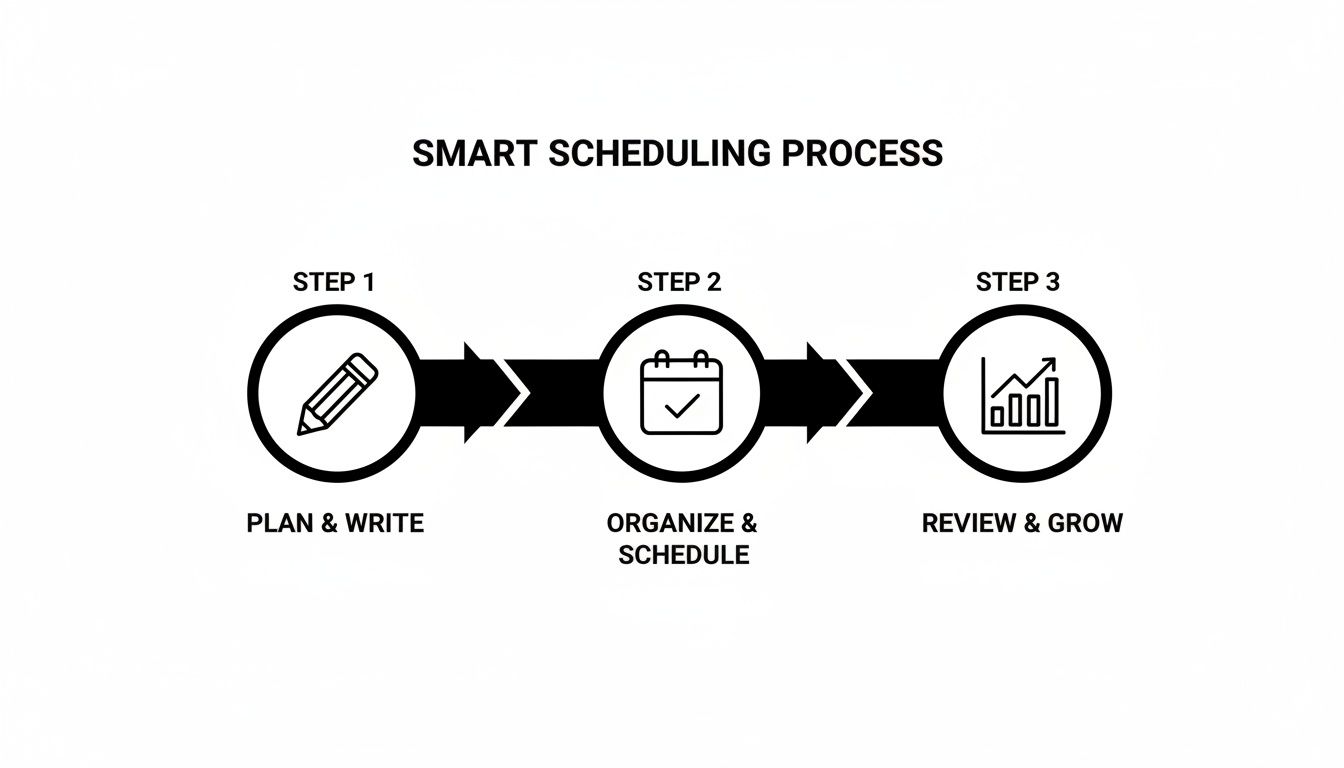
This flow shows how batching your writing and leaning on a smart scheduler creates a direct, repeatable path to growing your audience consistently.
One Idea, Three Platforms, in 15 Minutes
Let's make this real. Last week, one of my brainstormed ideas was: "Writers often focus on follower count, but engagement rate is a much better health metric." Here’s how that single idea became three distinct pieces of scheduled content in less than 15 minutes.
- Substack Note: I wrote a quick, 3-sentence Note explaining the idea and then asked my audience which metric they track more closely.
- LinkedIn Poll: I turned that question into a simple poll: "What's a more important metric for creators? A) Follower Count or B) Engagement Rate." I added one sentence of context.
- Short Article Snippet: I expanded the core idea into a 100-word paragraph, perfect for a short-form post or a different platform.
I dropped all three into a scheduler, which automatically formatted each one for its platform and queued it up for the best time. This is a core principle behind effective content marketing automation tools that save creators hundreds of hours.
This system isn't about being rigid; it's about being free. By systematizing the promotion, I freed up my creative energy for what actually matters—writing great content for my audience.
This batching and scheduling system is the engine that drives my growth. It guarantees I show up for my audience on Substack and beyond, consistently, all while working smarter, not harder.
Got Questions? Let's Talk Specifics
As you start looking into scheduling your Substack Notes, a few key questions always come up. I had them too. Let's tackle the big ones head-on so you can move forward with confidence.
Can Scheduling Actually Hurt My Engagement?
Nope, it’s the exact opposite—when you do it right. The biggest threat to your engagement isn't using a scheduler; it's posting at random times when nobody's online or, even worse, not posting at all because you get busy.
A scheduler is your secret weapon for hitting those peak activity hours every single time. My own experiment proved this: a note I scheduled for 8 PM EST consistently pulled in 25% more engagement than one I posted randomly in the middle of the day. It's not about being a robot; it's about being strategic.
Does a Third-Party Scheduler Mess With My Paywall?
Any reputable scheduling tool is built to play nice with Substack’s paywall. They’re designed to integrate seamlessly, making sure your paid content stays locked down for your paid subscribers.
That said, you should always double-check that this is a core feature before you commit to any tool. Do a quick scan of their features page or FAQ to confirm they explicitly mention paywall protection.
A good scheduler is supposed to amplify what you're already doing, not break it. The goal is to expand your reach while keeping your monetization strategy completely intact.
How Many Notes Should I Be Scheduling a Day?
There's no single magic number here, but I can tell you what my data showed: quality will always crush quantity.
During my 30-day experiment, I found that scheduling 2-3 high-quality notes a day was the absolute sweet spot. A valuable, thought-provoking note in the morning and another in the evening consistently outperformed five low-effort, scattered notes. Focus on making each one count.
If you're ready to grow faster, schedule your posts and notes efficiently, and reach audiences beyond Substack, Narrareach can help you save over 10 hours a week.
High Intent: Try the smart scheduler for free and see your growth triple.
Low Intent: Not ready for a new tool? Join my free weekly newsletter for more growth experiments and tips.