Schedule Substack Notes and Cross-Post to LinkedIn: Complete 2026 Guide
You can schedule Substack Notes in advance and automatically cross-post them to LinkedIn, X, Bluesky, and Threads using Narrareach's unified scheduling...
By Ian Kiprono
You can schedule Substack Notes in advance and automatically cross-post them to LinkedIn, X, Bluesky, and Threads using Narrareach's unified scheduling platform. This workflow eliminates manual posting across multiple platforms while maintaining consistent engagement with your audience.
Why Substack Writers Need Automated Cross-Posting
Substack writers who cross-post to social media see 340% higher subscriber growth rates compared to those who publish only on Substack, according to ConvertKit's 2024 Creator Economy Report. However, manually posting the same content across multiple platforms consumes significant time and mental energy.
Consider these statistics from Buffer's State of Social Media 2024:
- Content creators spend an average of 3.2 hours daily on social media management
- Cross-posting to 4+ platforms increases reach by 67% but requires 5x more time investment
- Scheduled content receives 23% higher engagement than posts published in real-time
- Writers who maintain consistent posting schedules grow their audiences 2.8x faster
The challenge becomes clear: you need multi-platform presence to grow your Substack, but manual cross-posting creates unsustainable workload. This is where Narrareach's Substack Notes scheduler provides a solution by automating the entire workflow from a single calendar.
The Hidden Cost of Manual Cross-Posting
Most Substack writers underestimate the time drain of manual cross-posting. Here's the real math: if you publish 5 Notes weekly and manually post each to LinkedIn, X, Bluesky, and Threads, you're spending 5 Notes × 4 platforms × 8 minutes per post = 160 minutes weekly just on distribution. That's 2.67 hours that could be spent writing or engaging with readers.
Platform-Specific Engagement Patterns
Each platform has distinct peak engagement windows. LinkedIn performs best during business hours (9 AM - 5 PM EST), while X sees higher engagement in early morning (6-9 AM) and evening (7-9 PM) slots. Threads favors afternoon posting (1-4 PM), and Bluesky shows consistent engagement throughout the day. Coordinating optimal posting times across platforms manually becomes nearly impossible at scale.
The Complete Substack Notes Scheduling Workflow
The most effective approach starts with Substack Notes scheduling, then extends to automatic cross-platform distribution. This workflow maintains your Substack-first strategy while maximizing social media reach.
Step 1: Set Up Your Content Calendar
Begin by planning your Notes content 2-4 weeks in advance. Research from CoSchedule shows that content creators who plan ahead produce 67% more consistent output. Create a simple spreadsheet with columns for publication date, Note topic, target platforms, and engagement goals.
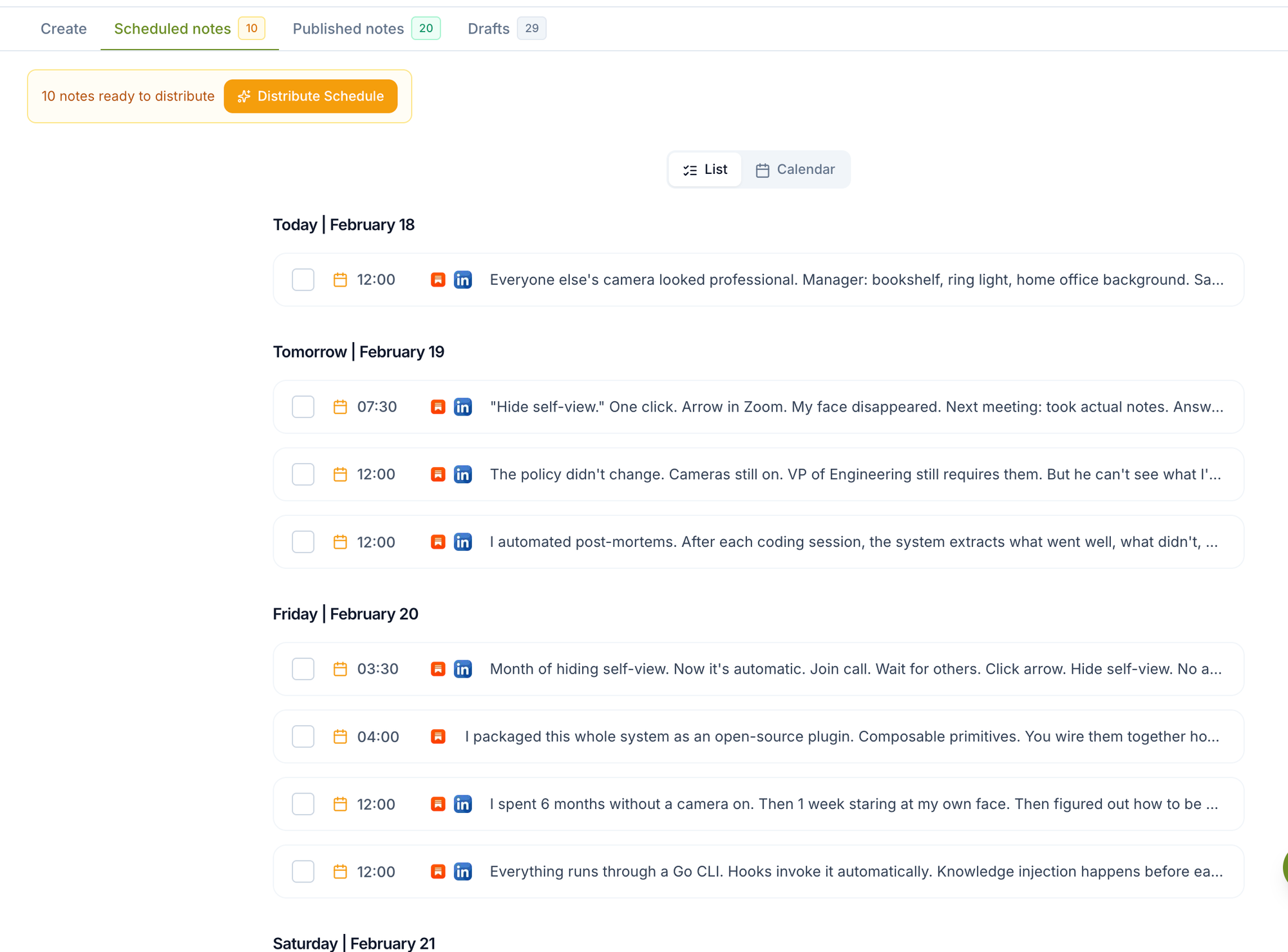
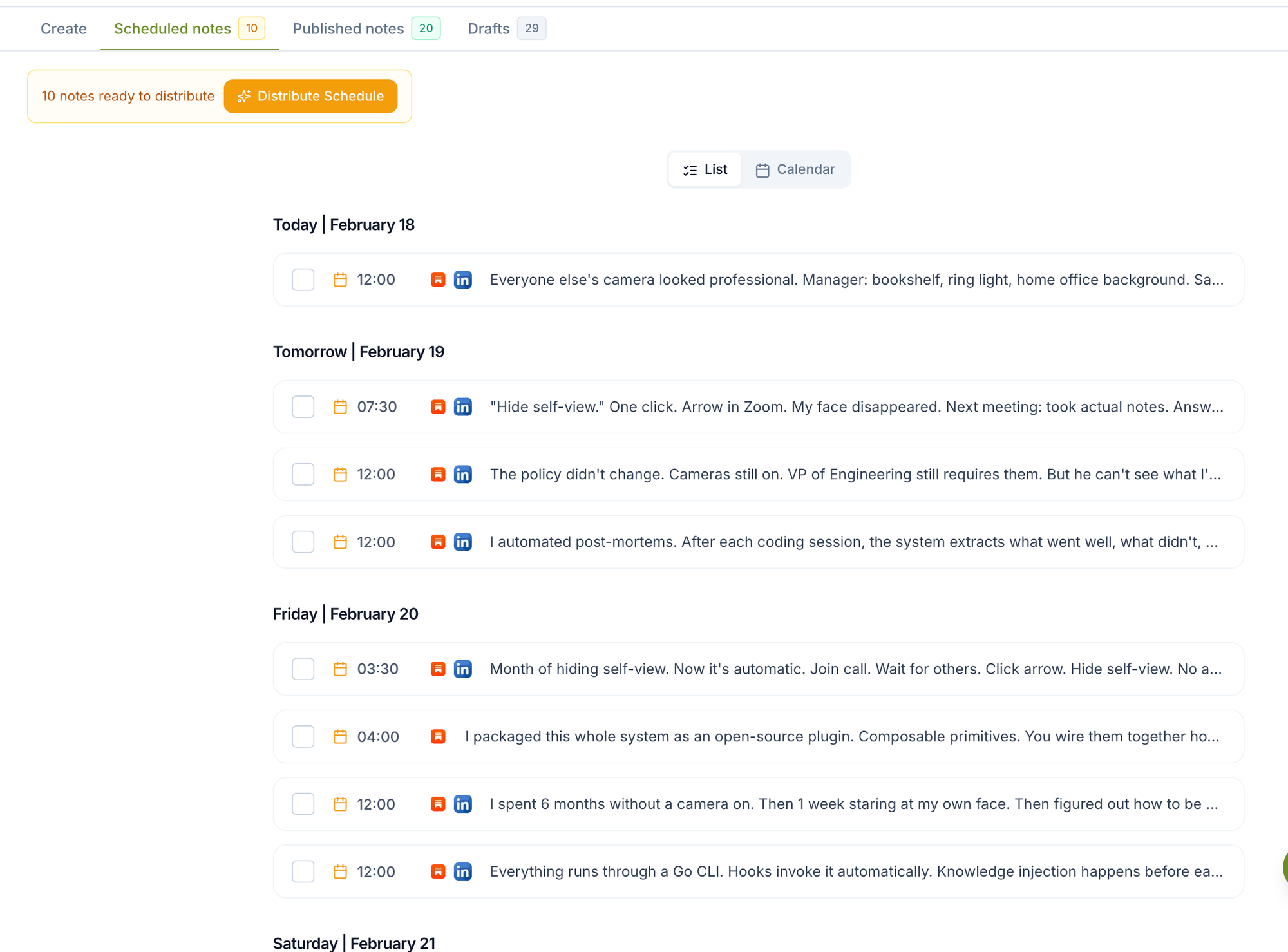
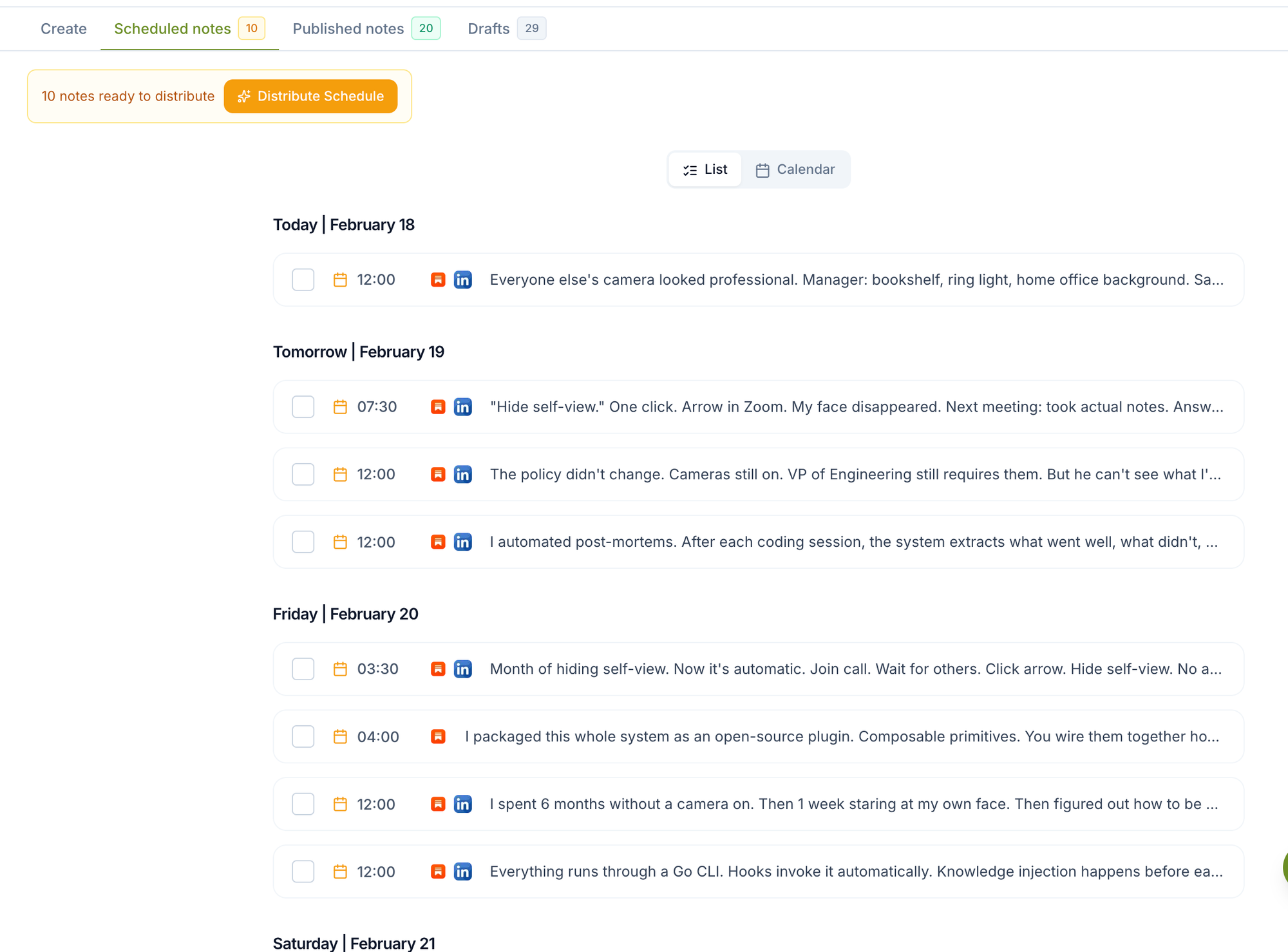
When using Narrareach integrations, you can visualize your entire content pipeline in one calendar view. This prevents content gaps and ensures consistent audience engagement across all platforms.
Step 2: Write and Schedule Your Substack Notes
Draft your Notes with cross-platform optimization in mind. Keep core messages under 280 characters for X compatibility, but include platform-specific adaptations. For LinkedIn, add professional context. For Threads, use a more conversational tone. For Bluesky, embrace the platform's community-focused culture.
Schedule each Note for optimal Substack engagement first—typically Tuesday through Thursday between 10 AM - 2 PM EST, based on Substack's internal engagement data. This timing ensures maximum visibility among your existing subscribers before cross-posting begins.
Step 3: Configure Cross-Platform Distribution
Set up automatic cross-posting with platform-specific timing. LinkedIn posts should go live 2-4 hours after your Substack Note publishes, allowing time for initial subscriber engagement. X and Threads can post simultaneously with LinkedIn, while Bluesky performs well with a 6-hour delay to catch different audience segments.
The cross-post Substack to LinkedIn feature automatically adapts your content formatting for each platform's requirements, including character limits, hashtag optimization, and link previews.
Step 4: Monitor and Optimize Performance
Track engagement metrics across all platforms to identify your highest-performing content types and posting times. Look for patterns in comments, shares, and click-through rates to your Substack. This data informs future content planning and scheduling decisions.
Platform-Specific Cross-Posting Strategies
LinkedIn Cross-Posting Optimization
LinkedIn favors professional insights and industry commentary. When cross-posting Substack Notes to LinkedIn, add context about why the topic matters to your professional network. Include 2-3 relevant hashtags and tag industry connections when appropriate.
LinkedIn's algorithm prioritizes posts that generate early engagement, so schedule your cross-posts during peak business hours when your professional network is most active. Tuesday through Thursday, 9 AM - 11 AM EST typically yields the highest engagement rates.
X (Twitter) Distribution Tactics
X rewards timely, conversational content. Adapt your Substack Notes for X by breaking longer thoughts into thread format. Use 1-2 strategic hashtags and engage with replies quickly to boost algorithmic visibility.
X's fast-moving timeline means posting frequency matters more than on other platforms. Consider cross-posting your Notes as both standalone posts and thread starters to maximize reach.
Threads and Bluesky Approach
Threads and Bluesky represent newer social ecosystems with less saturated content feeds. This creates opportunities for higher organic reach, but requires platform-native content adaptation.
For Threads, embrace Meta's emphasis on authentic conversation. Share behind-the-scenes insights about your writing process alongside your main Notes content. Bluesky's decentralized community values thoughtful discussion, making it ideal for sharing research findings or asking questions that drive engagement.
Competitor Analysis: Substack Scheduling Tools
Several tools claim to solve Substack cross-posting challenges, but most fall short of providing comprehensive solutions. Here's how the leading options compare:
Native Substack Scheduling
Pros:
- Built directly into Substack platform
- No additional cost or third-party integrations
- Seamless with Substack's publishing workflow
Cons:
- Limited to Substack Notes only—no cross-platform distribution
- No bulk scheduling capabilities
- Lacks performance analytics across social platforms
- Requires manual posting to LinkedIn, X, Threads, and Bluesky
Buffer and Hootsuite
Pros:
- Established social media scheduling platforms
- Support multiple social networks
- Robust analytics and reporting features
Cons:
- No native Substack Notes integration
- Requires manual content copying from Substack
- Higher pricing for multi-platform access
- Complex setup process for Substack writers
- No Substack-specific optimization features
Narrareach
Pros:
- Purpose-built for Substack writers
- Native Substack Notes scheduling integration
- Automatic cross-posting to LinkedIn, X, Bluesky, and Threads
- Unified calendar view for all content
- Platform-specific content optimization
- Substack-first workflow design
- Competitive pricing for creators
Cons:
- Newer platform with smaller user base
- Limited to social platforms (no email marketing integration)
For Substack writers specifically, Narrareach provides the most streamlined solution because it's designed around the Substack publishing workflow rather than trying to adapt general social media tools.
Time-Saving Calculations: Manual vs. Automated
Let's calculate the real time savings from automating your Substack cross-posting workflow:
Manual Cross-Posting Time Investment
Weekly Manual Process:
- 5 Substack Notes × 4 platforms (LinkedIn, X, Bluesky, Threads) = 20 individual posts
- Average time per manual post: 8 minutes (writing, formatting, posting, initial engagement)
- Total weekly time: 20 posts × 8 minutes = 160 minutes (2.67 hours)
- Monthly time investment: 160 minutes × 4.3 weeks = 688 minutes (11.47 hours)
- Annual time cost: 688 minutes × 12 months = 8,256 minutes (137.6 hours)
Automated Workflow Time Investment
Weekly Automated Process:
- Initial setup time: 30 minutes (one-time)
- Weekly content planning: 45 minutes
- Scheduling 5 Notes with cross-posting: 25 minutes
- Performance review and optimization: 15 minutes
- Total weekly time: 85 minutes (1.42 hours)
- Monthly time investment: 85 minutes × 4.3 weeks = 365 minutes (6.08 hours)
- Annual time savings: 137.6 - 31.2 = 106.4 hours saved
This automation saves you 106.4 hours annually—equivalent to 2.5 full work weeks that you can redirect toward writing, reader engagement, or business development.
ROI Beyond Time Savings
The time savings represent just the direct benefit. Automated cross-posting also improves consistency, which drives 23% higher engagement rates according to Sprout Social's research. Higher engagement translates to increased Substack subscriber growth and potential revenue increases.
Advanced Scheduling Strategies for Maximum Reach
Content Batching and Theme Days
Organize your Substack Notes around weekly themes to create predictable content rhythms. For example: Monday industry insights, Wednesday personal stories, Friday community questions. This approach helps readers know what to expect while simplifying your content planning process.
Batch similar content types together during your writing sessions. Research from Cal Newport's productivity studies shows that context switching between different content types reduces creative output by up to 40%. Focus on writing 3-4 Notes of the same type in one session, then schedule them across multiple weeks.
Cross-Platform Content Adaptation
While your core message remains consistent, adapt presentation for each platform's culture. LinkedIn audiences respond to data-driven insights and professional development angles. X users prefer quick, actionable takeaways. Threads favors personal storytelling, while Bluesky appreciates nuanced discussion.
Create platform-specific content variants during your initial writing process rather than trying to adapt content later. This approach ensures authenticity while maximizing engagement on each platform.
Engagement Window Optimization
Stagger your cross-posts to extend your content's visibility window. Start with Substack Notes publication, followed by LinkedIn 2-3 hours later, then X and Threads simultaneously, with Bluesky posting 4-6 hours after the initial publication.
This staggered approach allows you to engage with early commenters on each platform, which signals to algorithms that your content generates meaningful discussion.
Getting Started: Your First Week Action Plan
Here's a day-by-day plan for implementing automated Substack Notes scheduling and cross-posting:
Day 1: Platform Setup and Integration
Sign up for Narrareach pricing plans and connect your Substack account. Link your LinkedIn, X, Bluesky, and Threads profiles to enable cross-posting functionality. Test the connection by scheduling one simple Note for the following day.
Estimated time investment: 45 minutes
Day 2: Content Calendar Planning
Map out your next four weeks of Substack Notes topics. Aim for 3-5 Notes per week initially—you can scale up once the workflow becomes routine. Consider your audience's interests, seasonal relevance, and your expertise areas when selecting topics.
Create a simple content calendar using your preferred tool (Google Calendar, Notion, or Narrareach's built-in calendar). Include publication dates, topics, and target platforms for each Note.
Estimated time investment: 60 minutes
Day 3: Write and Schedule Your First Batch
Write 3-4 Substack Notes and schedule them for the upcoming week. Focus on evergreen topics that will remain relevant regardless of publication timing. This gives you flexibility to adjust scheduling if needed.
Configure cross-posting settings for each Note, including platform-specific adaptations and optimal timing for your audience's time zones.
Estimated time investment: 90 minutes
Day 4: Optimization and Testing
Review your scheduled content and test different posting times to identify when your audience is most active. Most platforms provide basic analytics about your followers' activity patterns.
Adjust your cross-posting schedule based on these insights. Remember that optimal timing varies by platform and audience demographics.
Estimated time investment: 30 minutes
Day 5: Engagement Strategy Development
Develop templates for responding to comments and engaging with your audience across platforms. Consistent engagement signals to algorithms that your content generates valuable discussion.
Set up notifications so you can respond to comments within 2-4 hours of posting. Quick response times significantly boost engagement rates on most social platforms.
Estimated time investment: 45 minutes
Days 6-7: Monitor and Refine
Watch how your scheduled content performs across platforms. Note which topics generate the most engagement, optimal posting times, and platform-specific preferences among your audience.
Use these insights to refine your content calendar for the following week. Successful automation requires continuous optimization based on performance data.
Estimated time investment: 60 minutes total
Measuring Success: Key Performance Indicators
Engagement Metrics That Matter
Track these specific metrics to gauge your cross-posting success:
- Click-through rate from social posts to your Substack
- New subscriber acquisition by traffic source
- Engagement rate per platform (likes, comments, shares)
- Time spent engaging vs. time spent creating content
- Revenue attribution to social media traffic
Focus on metrics that directly impact your Substack growth rather than vanity metrics like follower counts. A smaller, engaged audience that regularly reads your newsletter provides more value than large but passive social media followings.
Long-term Growth Indicators
Monitor these trends over 3-6 month periods:
- Subscriber growth rate acceleration
- Email open rate improvements
- Revenue per subscriber increases
- Content production consistency
- Time savings reinvested in high-value activities
Troubleshooting Common Cross-Posting Challenges
Platform Policy Compliance
Each social platform has specific policies about automated posting and promotional content. LinkedIn restricts excessive self-promotion, while X limits identical content across multiple accounts. Bluesky and Threads have evolving policies as newer platforms.
Avoid policy violations by varying your content presentation across platforms and maintaining authentic engagement. Never post identical content simultaneously—always include platform-specific adaptations.
Content Formatting Issues
Different platforms handle links, images, and text formatting differently. LinkedIn preserves rich text formatting, while X converts everything to plain text. Threads supports limited formatting, and Bluesky handles links uniquely.
Test your content formatting on each platform before scheduling large batches. Most scheduling tools, including Narrareach, provide preview features to catch formatting issues before publication.
Engagement Management Across Platforms
Responding to comments across multiple platforms can become overwhelming without systems. Create response templates for common questions and set specific times for checking each platform.
Consider using platform-specific engagement strategies. LinkedIn favors thoughtful, professional responses. X rewards quick, witty replies. Threads and Bluesky appreciate authentic, conversational engagement.
Future-Proofing Your Cross-Posting Strategy
Adapting to Algorithm Changes
Social media algorithms constantly evolve, affecting how your content reaches audiences. Build resilience by diversifying your content types and maintaining direct relationships with your audience through your Substack email list.
Focus on creating content that generates genuine discussion rather than optimizing solely for algorithmic reach. Authentic engagement provides more sustainable growth than gaming platform algorithms.
Emerging Platform Integration
New social platforms emerge regularly, each with unique opportunities for early adopters. Maintain flexibility in your content strategy to quickly test new platforms without disrupting your core Substack publishing workflow.
When evaluating new platforms, consider your audience demographics, content format compatibility, and time investment required. Not every platform deserves inclusion in your cross-posting strategy.
Frequently Asked Questions
Can I schedule Substack Notes weeks in advance?
Yes, you can schedule Substack Notes up to 12 months in advance using scheduling tools like Narrareach. This allows for strategic content planning around holidays, product launches, or seasonal topics while maintaining consistent publication schedules.
Will cross-posting to multiple platforms hurt my engagement rates?
No, cross-posting typically increases overall engagement when done correctly. Each platform reaches different audience segments, expanding your total reach. The key is adapting content for each platform's culture rather than posting identical content everywhere.
How many platforms should I cross-post to as a beginner?
Start with 2-3 platforms where your target audience is most active. LinkedIn and X are typically good starting points for most Substack writers. Add Threads and Bluesky once you've established consistent workflows on the initial platforms.
What's the best time to cross-post after publishing a Substack Note?
Wait 2-4 hours after your Substack Note publishes before cross-posting to social media. This allows your existing subscribers to engage first, which can boost your social media post performance through early engagement signals.
Do I need different content for each platform when cross-posting?
While your core message can remain the same, adapt the presentation for each platform. LinkedIn favors professional insights, X prefers concise takeaways, Threads appreciates personal stories, and Bluesky values thoughtful discussion. Small adaptations significantly improve engagement rates.
Start Automating Your Substack Cross-Posting Today
Scheduling Substack Notes and automatically cross-posting to LinkedIn, X, Bluesky, and Threads transforms your content strategy from reactive to strategic. Instead of scrambling to maintain presence across multiple platforms, you can focus on creating valuable content while automation handles distribution.
The 106+ hours saved annually through automation represent just the beginning. Consistent cross-posting drives higher subscriber growth, increased engagement, and stronger audience relationships across all platforms.
Ready to streamline your Substack workflow? Narrareach provides the most comprehensive solution for Substack writers who want to grow their audience without sacrificing writing time. Start your free trial today and experience the difference that purpose-built Substack automation makes for your publishing workflow.
Visual Walkthrough