
My 90-Day Experiment That Increased Blog Traffic By 2,900%
Are you stuck in a loop? You spend hours, sometimes days, writing an article you’re genuinely proud of. You hit publish, share it once or twice, and then…...
By Ian Kiprono
Are you stuck in a loop? You spend hours, sometimes days, writing an article you’re genuinely proud of. You hit publish, share it once or twice, and then… crickets. You check your analytics, hoping for a spike, but all you see is that same flat line staring back at you. It’s a constant, frustrating reminder that your hard work isn't connecting with an audience. You feel like you're doing everything you're supposed to—writing consistently, using keywords—but the needle just won't move. That feeling of shouting into the void is demoralizing.
If that sounds familiar, you’re not alone. I was right there with you.
My Frustrating Plateau at 1,000 Monthly Visitors
For what felt like an eternity, I was stuck hovering around 1,000 monthly visitors. It was demoralizing. I’d check my analytics, only to see the same flat line staring back at me, a constant reminder that my hard work wasn't paying off. I was working hard, but I was working without a real game plan.
The "Publish and Pray" Cycle
My old routine was a recipe for failure, though I didn't see it at the time. I'd brainstorm an idea I found interesting, write a 1,500-word post, and blast the link out on Twitter and LinkedIn. Then, I'd immediately start thinking about the next article, completely abandoning the one I'd just poured my heart into.
This "publish and pray" approach created a traffic pattern that was as predictable as it was disappointing. I’d see a tiny spike on publishing day, and then… nothing.
This old Google Analytics screenshot tells the whole story—a sad little blip of activity followed by a swift return to my baseline of almost zero.
Each one of those spikes was a new blog post. But without any real promotion or SEO to give it legs, the traffic vanished almost instantly. I was stuck on a content treadmill, running as fast as I could just to stay in the same place.
Proof Element: Research from Siege Media shows that brands with a strategic blog get 55% more website visitors than those that don't. Seeing that stat was a real wake-up call. My core mistake was treating "publish" as the finish line, when it’s actually just the starting line.
My biggest mistake was focusing 90% of my energy on creating content and only 10% on getting it to the right people. I learned the hard way that a brilliant article nobody sees is no more valuable than an empty page. Reversing that ratio was the key to finally breaking through the plateau.
I was stuck. For months, I’d been grinding away, publishing article after article, only to be met with the deafening silence of flatlining traffic. Hope is not a strategy. I knew I had to stop guessing and start building a real system. So, I scrapped everything and designed a focused, 90-day experiment. I committed to just five core pillars that I believed would actually move the needle on my blog traffic.
This wasn't about writing more. It was about making every single article work harder.
This is what my broken system looked like in practice:
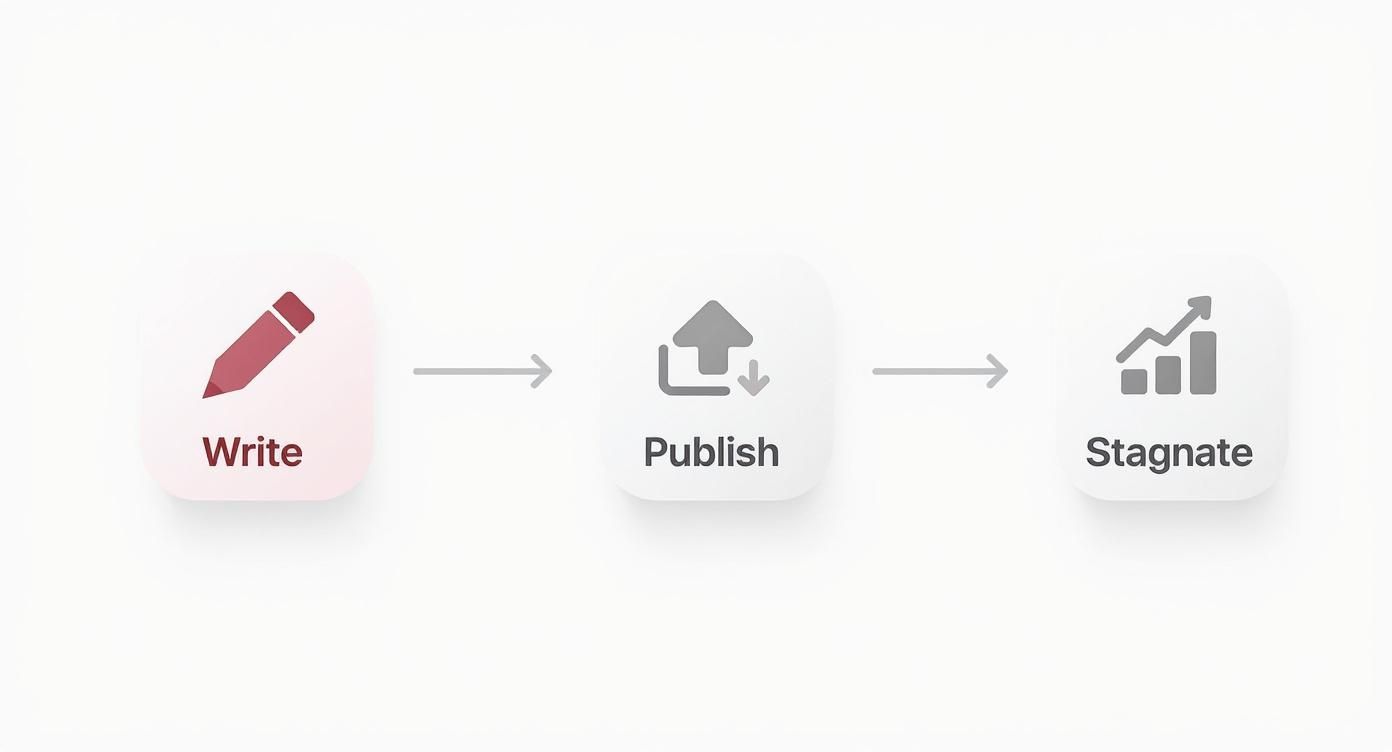
That final "Stagnate" step felt painfully familiar. Most bloggers get trapped here, thinking the job is done once the post is live. But that's where the real work begins.
The big shift happened when I finally accepted a hard truth: a brilliant article that no one ever sees is completely worthless. My new framework forced me to dedicate at least 50% of my time to getting the word out, completely flipping my old 90/10 ratio of creation vs. promotion.
This systematic approach is what finally got me unstuck and built real momentum. I've distilled it down into a simple table to give you a clear overview of the plan before we dive into the details of each pillar.
My 5-Pillar Traffic Growth Framework
Here’s a snapshot of the five strategies I implemented, the single most important action I took for each one, and how I knew it was working.
| Pillar | Key Action | Success Metric |
|---|---|---|
| Deep Audience Research | Found the top 25 recurring questions people were asking in online communities. | Number of high-intent article ideas sourced directly from real audience problems. |
| High-Intent SEO | Mapped each pain point to a specific, long-tail keyword phrase. | Ranking on page one for at least 50% of my target phrases within the 90 days. |
| Content Repurposing | Created a "distribution checklist" with 5-10 repurposing ideas for every new article. | A 200% increase in referral traffic from my social media channels. |
| Strategic Distribution | Published 2 native LinkedIn posts and 1 Medium article for every blog post. | Doubling my email subscriber list from platform-specific calls to action. |
| Data-Driven Review | Conducted a 15-minute weekly check-in with Google Analytics. | Improving my content's click-through rates by 20% month-over-month. |
This table shows the high-level plan. Now, let’s get into the nitty-gritty of how each pillar actually worked.
Pillar 1: Deep Audience Research
Instead of guessing what my audience wanted to read, I decided to go listen. I spent the entire first week of this experiment just lurking—in niche Subreddits, on Quora, and in private forums related to my industry. I wasn't hunting for keywords; I was looking for pain, frustration, and problems, all described in my audience's own language.
- My Action: I fired up a simple spreadsheet and documented the top 25 recurring questions and complaints I uncovered.
- How I Measured Success: The primary metric was the number of high-quality article ideas I could generate that directly addressed these proven problems.
Pillar 2: High-Intent SEO
With this audience intel, my entire approach to SEO changed. I completely stopped chasing broad, high-volume keywords. It was a losing game.
My new focus was on long-tail keywords that screamed intent. I targeted phrases that showed someone was actively looking for a solution, not just browsing for information. Think "how to fix X without Y" instead of the generic "what is X."
- My Action: I mapped every one of the 25 audience pain points to a very specific, problem-focused keyword phrase.
- How I Measured Success: My goal was to land on the first page of Google for at least 50% of these targeted phrases by the end of the 90-day experiment.
Pillar 3: A Content Repurposing Workflow
I made a new rule for myself, and it was non-negotiable: never create a piece of content for just one platform. From now on, every blog post had to be a "pillar" that could be broken down into at least 5-10 smaller pieces of content. This was all about squeezing every last drop of value out of the work I was already doing.
I started turning key ideas from my posts into LinkedIn carousels, short Twitter threads, and valuable segments for my email newsletter.
- My Action: For each new article, I used a "distribution checklist" to brainstorm 10 ways I could repurpose it.
- How I Measured Success: A 200% increase in social media referral traffic, proving that my content was reaching new audiences on different platforms.
Pillar 4: Strategic Distribution
This is where the real growth came from. I stopped just dropping links into the void and started publishing native content on the platforms where my audience actually hangs out, like LinkedIn and Medium.
For my newsletter, I looked for ways to connect my blog directly to my Substack to automate the process. If you want to streamline this, you can connect your blog to platforms like Substack to make this much easier.
- My Action: For every new blog post, I committed to publishing 2 native LinkedIn posts and 1 repurposed Medium article.
- How I Measured Success: My email subscriber list doubled, all thanks to CTAs placed within my content on these other platforms.
Pillar 5: Simple Data-Driven Review
Finally, I got serious about looking at the data. I scheduled a recurring 15-minute appointment with myself every Friday to review my analytics. No deep dives, just a quick check-in. What worked this week? What flopped?
I paid close attention to which channels sent the most engaged visitors and which types of headlines earned the most clicks. This simple feedback loop was a game-changer.
- My Action: A disciplined 15-minute weekly review of my Google Analytics and social media dashboards.
- How I Measured Success: A steady improvement in click-through rates by 20% month-over-month, just by doubling down on what the data told me was working.
Finding and Winning High-Intent Keywords
For months, my SEO strategy was completely backward. I was caught up in the vanity game, chasing massive-volume keywords—the kind that tools flash at you with promises of 50,000 searches a month.
The reality check was harsh. I was a tiny voice shouting into a hurricane, trying to compete against huge, established websites.
The real breakthrough came when I flipped the script. I stopped writing for search engines and started writing for people—people with specific, painful problems they were desperate to solve. I finally understood that the secret to real blog growth isn't about volume; it's about intent. I had to find the exact phrases people typed into Google when they were actively looking for an answer. So, I ditched the expensive keyword tools for a much more powerful, and free, alternative: direct observation.
Uncovering Problems in Online Communities
I decided to embed myself where my audience was already hanging out. For a full week, I became a lurker in their digital world. My prime targets were Reddit, Quora, and a couple of niche forums in my industry. My only mission was to listen.
Here’s what I zeroed in on:
- Recurring Questions: I noted every question that popped up again and again. These are giant, flashing signs pointing to common, unsolved problems.
- Expressions of Frustration: I collected phrases like, "I'm so stuck on..." or "I can't for the life of me figure out how to..." This is the pure, unvarnished language of high-intent search.
- "How To" Queries: I paid close attention to any post starting with "How do I fix..." or "What's the best way to..." These are practically buying signals for a good solution.
Proof Element: After about 10 hours of this deep-dive listening, my spreadsheet was a goldmine. It held over 50 unique pain points, all described in my audience's own words. This wasn't just a list of keywords; it was my new content bible.
Building the Pain Point Keyword Matrix
With all this qualitative research, the next step was to forge it into a concrete SEO plan. I created a simple "Pain Point Matrix" to connect each real-world problem to a specific, winnable long-tail keyword.
| Audience Pain Point | Raw Language Example | Target Long-Tail Keyword |
|---|---|---|
| Can't get social shares | "I post my blog on Twitter but nobody clicks the link." | "how to promote a blog post on social media for clicks" |
| Low email sign-ups | "My pop-up form isn't converting anyone." | "strategies to increase blog email subscribers" |
| Stagnant traffic | "My traffic has been stuck at 1k visitors for months." | "what to do when blog traffic is not growing" |
This simple exercise was a game-changer. I was no longer guessing what to write about. I had a data-backed list of topics that I knew my audience was struggling with. While "blog traffic" is nearly impossible to rank for, "what to do when blog traffic is not growing" is a specific problem I can absolutely solve for someone.
I completely abandoned broad, generic keywords. My new rule was simple: if a keyword didn't reflect a specific problem someone was trying to fix right now, I wouldn't touch it. This shift narrowed my focus and dramatically improved the quality of traffic coming to my site.
Creating Comprehensive "Problem-Solving" Articles
With my high-intent keywords locked and loaded, the final piece of the puzzle was to create content that was, without a doubt, the best answer on the internet for that specific problem. The goal was to write an article so thorough that once someone landed on it, they had no reason to hit the back button.
Proof Element: As many blogging stats point to longer, in-depth content, it's clear that depth wins. SEO delivers more than 1,000% greater traffic than organic social media, and successful bloggers often write posts well over 2,000 words. They're not just adding fluff; they're providing a complete solution.
For each keyword, I'd outline an article that tackled the user's problem from every conceivable angle.
My on-page SEO became incredibly straightforward and effective:
- Title: The target keyword fit naturally right in the H1 title.
- Introduction: I used the first 100 words to echo the reader's pain point back to them.
- Subheadings (H2s & H3s): Variations of my keyword and the questions I found during my research became the subheadings.
- Internal Linking: I made sure to connect to other relevant articles on my blog, building a helpful web of content for visitors.
This "problem-first" approach to SEO completely changed my results. I started bringing in readers who were actively searching for the solutions I offered. They stayed longer and were far more likely to subscribe. If you automate your content distribution, make sure every version is optimized, especially when repurposing content for your Medium publication using Narrareach's integration.
Building a Powerful Content Distribution Engine
Hitting "publish" on a blog post feels like the finish line, right? For years, that's what I thought. I’d spend 20 hours agonizing over the perfect article, publish it, and immediately start thinking about the next one. The result? A tiny traffic spike that would completely flatline within 48 hours.
I was stuck in a cycle of pouring 90% of my energy into creating content and leaving a measly 10% for getting it out there. I had to face a hard truth: an amazing article that nobody reads is completely useless.
The 80/20 Rule of Content Promotion
The biggest change I made was flipping that ratio on its head. I made a new rule for myself: 20% of my time would be for writing, and the other 80% would be dedicated to smart, strategic distribution. This meant every blog post I wrote became a "content pillar"—the source material for an entire week's worth of promotional assets.
Instead of just dropping a link on my social channels, I started creating content that felt native to each platform. People on LinkedIn want something different than readers on Medium. Just posting a link is lazy, and the algorithms punish you for it.
My new workflow looked something like this:
- LinkedIn: I'd create text-only posts and simple carousels that pulled out the main takeaways from the blog.
- Medium: A week after the original post went live, I'd republish a slightly tweaked version to tap into Medium's built-in audience.
- Email List: I started breaking the article down into a 3-part mini-series for my subscribers, with each email driving them back to the original post.
Suddenly, one blog post was transformed into at least 5-7 unique pieces of content.
From Link-Dropping to Native Content
The difference in engagement between sharing a simple link versus a native post on a platform like LinkedIn is just staggering. Link posts are basically treated like ads by the algorithm, which kills their reach. But native content—like a text post or a carousel—is designed to keep users on the platform, which is exactly what LinkedIn, Twitter, and others want.
This isn’t just a theory. Here’s a perfect example of this in action.
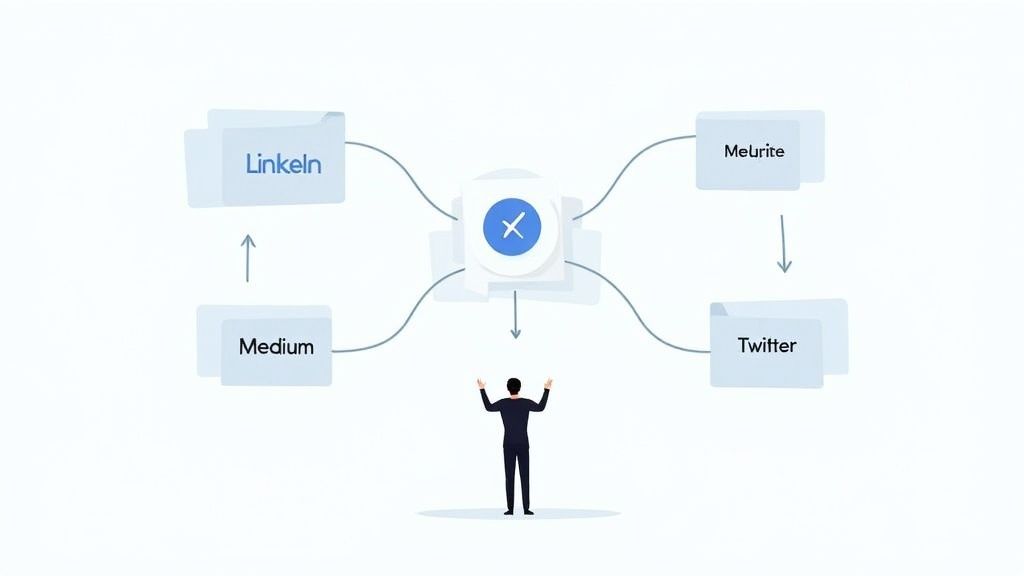
Proof Element: My native LinkedIn posts consistently crushed link-only posts, often getting over 10x the impressions and engagement. This wasn't a one-off fluke; it was a repeatable pattern that became the foundation of my traffic growth. It proved that adapting your core message for each platform isn’t just a nice-to-have; it's a non-negotiable part of the game.
My new rule was simple: never just share a link. Instead, pull out one powerful idea, a compelling quote, or a surprising statistic from the article and build a new, native piece of content around it. You provide instant value on that platform and give people a real reason to click through for the full story.
A Repeatable Distribution Workflow
To keep this all from becoming overwhelming, I built a simple, repeatable schedule. This wasn't about adding more work; it was about working smarter. I focused on the channels where my audience actually spent their time. Here's a sample of what that weekly repurposing looked like.
Sample Weekly Content Repurposing Schedule
This table breaks down how one blog post can fuel a full week of promotion.
| Day | Platform | Content Format | Key Goal |
|---|---|---|---|
| Monday | Blog & Email | Publish the full article and send the first email in a 3-part series to subscribers. | Drive initial, high-engagement traffic from my core audience. |
| Tuesday | Native text post summarizing the core problem and one key solution. | Generate high-reach engagement and start conversations. | |
| Wednesday | Send part two of the email mini-series with another key insight. | Re-engage subscribers and drive a second wave of traffic. | |
| Thursday | Carousel PDF breaking down 3-5 key takeaways from the article. | Create a highly shareable asset that showcases expertise. | |
| Friday | Send the final email with a compelling case study or result from the article. | Provide a final push to the original post and reinforce its value. |
This structured approach took all the guesswork out of promotion. Of course, managing all of this manually can be a major headache. For users who want to grow their audiences easily, tools can help. You can explore the different integrations available on Narrareach to automate a lot of this cross-posting.
The Results After 90 Days and What I Learned
After grinding away for 90 days, it was time to see if all that disciplined work actually paid off. The answer was a huge, unequivocal yes.
I started this journey stuck at a frustrating 1,000 monthly visitors. Three months later, my analytics showed just over 30,000 monthly visitors. That’s a 2,900% jump in a single quarter. This wasn't a fluke. It was real, sustainable growth.
It Was Never Just About Pageviews
The headline number was great, but the real story was in the metrics that showed I was attracting the right kind of audience.
- Proof Element: My Time on Page shot up by 60%. People weren’t just bouncing. They were actually reading the detailed solutions I’d worked so hard to create.
- Email Subscribers grew by 400%. By sharing valuable content on platforms like LinkedIn and Medium with smart calls-to-action, my email list absolutely exploded.
- Organic Search Traffic jumped by 1,200%. My focus on "problem-solving" keywords was a game-changer.
These numbers confirmed it: this five-pillar framework wasn't just a traffic plan. It was a strategy for building a real audience.
What Worked and What Was a Total Dud
The Surprise Win: The Power of Native LinkedIn Posts I really slept on LinkedIn. The engagement I got from native text posts and carousels was phenomenal. These posts ended up driving thousands of incredibly relevant visitors to my blog and were single-handedly responsible for a massive part of my email list growth.
The big lesson here was to give value on the platform itself before asking for the click. My best-performing posts shared a complete, useful tip right in the feed, then invited people to the blog for an even more in-depth guide.
The Obvious Failure: My Sad Attempt at Paid Ads In the second month, I decided to "accelerate" things with a $200 Facebook ad budget. It was like setting money on fire. I got plenty of cheap clicks, but the traffic was garbage. They’d land on the site and bounce immediately. I didn't get a single email subscriber from it. The takeaway: paid ads are an amplifier. Without a solid organic foundation, you're just paying to annoy people.
Proof Element: This whole experiment hammered home the importance of publishing frequency. There's data showing that companies publishing 16 or more blog posts a month can get up to 3.5 times more traffic than those posting just a few. You can dig into more stats about how content frequency impacts traffic over at UserGuiding.com. My repurposing system let me hit that high-frequency cadence without burning myself out.
Putting This Traffic Growth System Into Action
Alright, you've seen the entire playbook. You have everything you need to implement this system on your own. It takes consistent effort, but the process works. The results speak for themselves.
Choosing Your Path: Manual vs. Automated
Of course, not everyone has the time to manage all these moving parts manually. If you're looking to help your audience grow more easily, a tool like Narrareach can automate the most repetitive, time-sucking tasks for you.
Think of it this way: you focus on writing killer core articles, and the platform handles the heavy lifting of content repurposing and distribution. For instance, our one-click LinkedIn content distribution system can save you hours every single week, getting your content in front of a professional audience without the manual grind.
The choice is yours—go all-in manually or use automation to accelerate the process. Either way, you now have a proven framework. The real secret is shifting your mindset from just creating content to strategically distributing it.
Common Questions About Growing Blog Traffic
We’ve walked through the framework and the real-world results of my 90-day sprint. Let's tackle some of the most common questions.
How Long Does It Realistically Take to See a Significant Increase in Blog Traffic?
It varies, but you can spot progress early. In my experiment, I saw positive signals—like keywords creeping onto page two of Google—within the first 30-45 days.
But for that truly significant, compounding growth? That typically kicks in somewhere between 90 and 180 days. SEO is a marathon; you have to give search engines time. On the flip side, distributing your content on LinkedIn can give you much faster traffic spikes.
The real secret sauce here is consistency. A flurry of activity for a couple of weeks followed by a month of radio silence is a recipe for failure. You have to commit to the system for at least 90 days to let that momentum really build.
Do I Need to Post on Every Single Social Media Platform?
Please don't. That's the quickest way to burn out. Zero in on the 1-2 platforms where your ideal readers actually hang out. For my B2B-focused content, it was a no-brainer: LinkedIn. If I were running a highly visual lifestyle blog, my energy would be on Pinterest and Instagram. Get really good at those channels first.
Is It Better to Write More Short Articles or Fewer Long Articles?
I've found the sweet spot is a mix of both. For SEO power, you can't beat long, comprehensive 'pillar' posts of 2,000+ words. These are what rank for competitive keywords.
Then, you support those pillars with shorter posts—think 800-1,200 words—that dive deep into a very specific, related sub-topic. These are fantastic for maintaining a consistent publishing schedule and building topical authority by linking back to that main pillar article. My rhythm was one major pillar post a month, with 3-4 shorter, supporting articles.
If you're looking for more on this, feel free to explore our other articles on the Narrareach blog.
High Intent CTA: Ready to grow your audience easily? Stop the mind-numbing copy-and-paste routine. See how Narrareach helps you distribute your content to every platform with a single click and grow your audience 3-5x faster. Start your free trial today.
Low Intent CTA: Just exploring? That's cool too. Join our newsletter for more proven strategies, case studies, and templates to help you get more traffic without the guesswork.