
My 90-Day Experiment That Increased My Blog Traffic By 412%
You hit ‘publish’ on a post you poured your soul into. You’re proud of it. You check your analytics the next day, expecting a flood of new readers. Instead...
By Ian Kiprono
You hit ‘publish’ on a post you poured your soul into. You’re proud of it. You check your analytics the next day, expecting a flood of new readers. Instead, you see… nothing. Maybe a handful of views, and you're pretty sure half of them are you, checking to see if the post is live. The silence is deafening. You're putting in 10, maybe 15 hours a week, writing your heart out, but your traffic graph is a flat line. It’s frustrating, demoralizing, and makes you wonder if you're just screaming into the void. I know that feeling because that was my reality.
The Agonizing Sound of Silence: My First 6 Months Blogging
For the first six months, my blog was a complete ghost town. I was pretty sure my entire audience consisted of three readers: my mom, my best friend, and probably a stray Googlebot. My analytics dashboard was a painful reminder that nobody was showing up.
I was pouring up to 10 hours per week into writing articles I genuinely thought were helpful, only to see them get a trickle of views. It was more than just frustrating; it was completely demoralizing.

I started to seriously question if this whole blogging thing was just a pipe dream. This is where so many of us start—stuck in a loop of creating without ever actually connecting. That desperate need to turn the silence into real traffic is what sparked the 90-day experiment that finally changed everything for me. Here's exactly what I did, month by month.
My First 30 Days: Laying the Groundwork with Audience Research
For the first month, I forced myself to do something that felt completely unnatural: I stopped writing.
My old strategy was just guessing what people wanted to read, and my flatlining analytics were proof I was a terrible guesser. This time, I needed to operate on evidence, not ego. My goal was to completely reset my approach and listen before I typed a single word.
Becoming a Fly on the Wall
I spent the first two weeks—a solid 15-20 hours—just lurking. I became a fly on the wall in the exact online communities where my ideal readers were already hanging out. I wasn’t there to drop links or promote myself. I was there to absorb.
- Reddit Threads: I dove into subreddits like r/blogging and r/content_marketing, filtering specifically for posts flaired "Question" or "Help." The language was so raw. People weren't asking for generic "traffic strategies"; they were asking, "Why are my posts stuck on page 4 of Google?"
- Quora Forums: Here, I'd search for broad topics like "grow a blog" and sort by recent answers. This gave me a real-time pulse on the immediate, pressing problems people were facing right now.
- Niche Facebook Groups: This was a goldmine for understanding the emotional side of things. I saw post after post from frustrated writers sharing screenshots of their zero-traffic dashboards, desperately asking the community for feedback.
Turning Chatter into a Content Plan
Armed with the exact phrases and pain points I'd gathered, it was time to move from listening to mapping. I had all this qualitative insight, but I needed to turn it into a concrete content strategy. This is where a few free tools became my best friends.
I plugged my core topics into AnswerThePublic and watched it spit out a visual map of my audience's curiosity. It wasn't just a list of keywords; it was a web of questions, prepositions, and comparisons that showed me how people think.
For instance, a simple search for "blog traffic" reveals what people are really asking.
This map immediately told me that people want to know why their traffic is low, how to check it, and when it will finally increase. These became the foundational pillars for my new content plan.
Building a Topic Authority Map
I didn't just want a random list of blog post ideas. I needed a system. So, I built what I call a "Topic Authority Map."
It's just a simple spreadsheet, really. I started with one central "pillar" topic (like "Beginner Blog SEO") and then connected it to at least 5-7 smaller "cluster" topics (like "how to write a meta description" or "image alt text for blogs").
The idea is to prove your expertise to search engines by covering a single subject from every angle. Instead of being a jack-of-all-trades, I aimed to become the go-to resource for a few very specific problems. This strategy is backed by data, too. HubSpot data shows that updating and republishing old blog posts with new content and images can increase organic traffic by as much as 106%.
My Key Takeaway: The goal wasn't just to rank for one keyword. It was to own an entire conversation. By creating a web of interlinked articles around a central theme, you send powerful signals to Google that you are an authority on that subject.
By day 28, I had my first three pillar posts mapped out, and the first one was live. The change wasn't dramatic, but for the first time, I saw a small—but beautiful—uptick in organic search traffic. A 12% increase.
It was proof. The pipes were finally laid. This first month wasn't about opening the floodgates; it was about finally getting the water flowing.
My Next 30 Days: Mastering Content Creation and Smart Distribution
Let's get into the nitty-gritty of month two: execution. I used to fall into the classic trap: write, publish, and pray. I’d spend 10-15 hours crafting a deeply researched article, hit publish, and then… crickets. That anxiety is gut-wrenching. It felt like I’d built a beautiful shop but forgot to build any roads leading to it.
This time, I refused to let good content die on the vine. My new rule was simple: for every hour I spent creating, I'd spend another hour distributing. This wasn't just about spamming a link across social media. It was about strategically repurposing my core ideas to meet my audience exactly where they hang out. I had to stop thinking like just a writer and start acting like a distributor.
The Pillar and Spoke Model in Action
My whole strategy hinged on creating what I call "pillar posts." These are the big ones—massive, comprehensive guides, usually over 2,500 words, designed to be the definitive resource on a topic I'd uncovered during my audience research.
But a pillar post is just the starting point. The real magic happens when you break it down into smaller "spoke" content. My goal was to turn one pillar post into 10-15 smaller, platform-native assets.
Why? Because people consume content differently everywhere.
- A 3,000-word blog post is perfect for someone searching Google for an in-depth answer.
- A 700-word LinkedIn article hits the sweet spot for professional commentary.
- A 280-character Twitter thread is built for punchy, viral insights.
- An 800-word Medium story is tailored for a broader, more casual readership.
By doing this, I wasn't just hoping people would find my blog. I was actively placing my content in their path on platforms they already used and trusted every single day.
This simple flow—listen, research, optimize—is what keeps the entire process grounded.
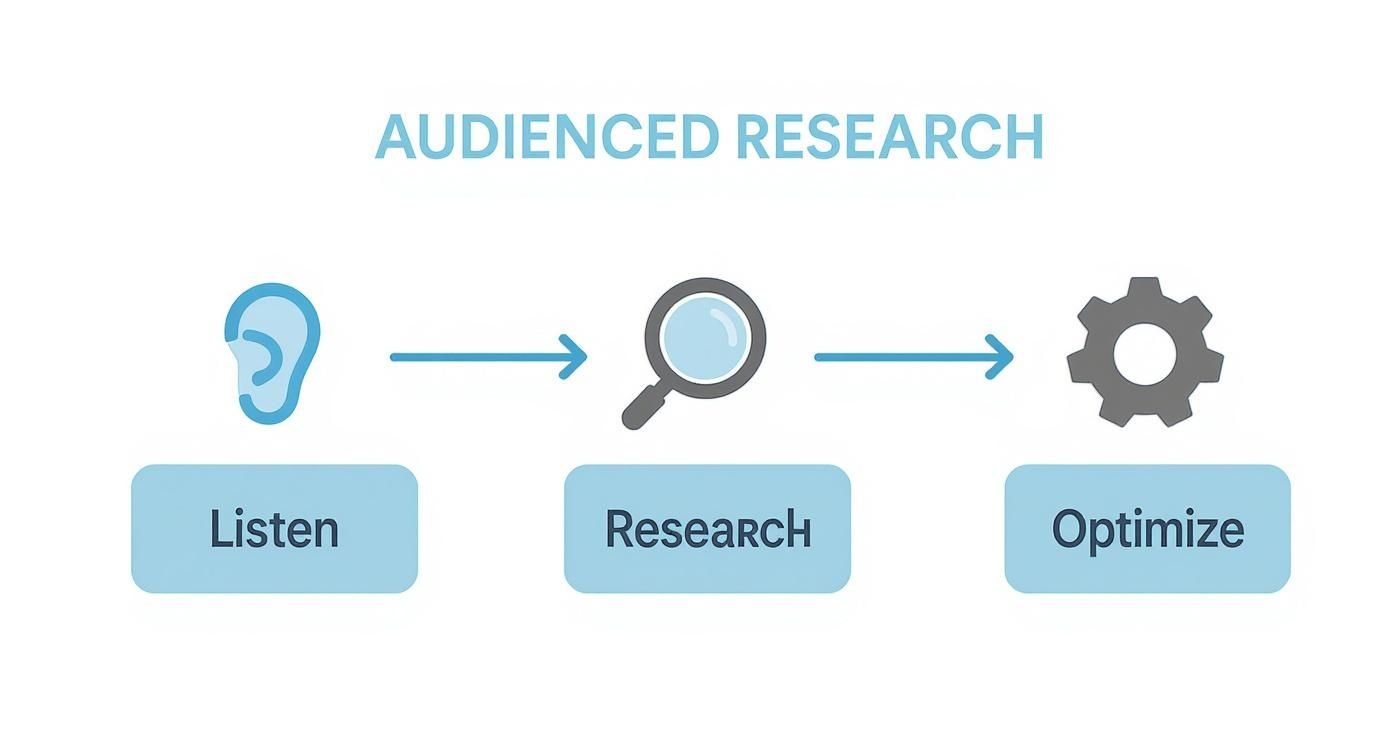
This workflow ensures every piece of content you create is directly tied to a real audience need, which is the secret to making your distribution efforts actually work.
From One Post to a Traffic-Generating Ecosystem
Let me show you what this looked like in the real world with my first pillar post, "A Beginner's Guide to On-Page SEO."
On my blog, it was a 2,800-word beast. Here’s how I atomized it:
LinkedIn Article: I pulled out the section on "Common Meta Description Mistakes" and rewrote it as a 600-word, authoritative piece for a professional audience. Crucially, I ended it with a link back to the full pillar post for those who wanted the complete picture.
Twitter Threads (x3): I took three key subheadings and turned each one into a 5-tweet thread. One was about "5 Killer Alt Text Examples," another covered "How to Structure a Perfect URL," and the last explained "Why Internal Linking is a Superpower." Each tweet was a bite-sized, actionable tip.
Medium Story: I reframed the introduction and conclusion as a personal story about my own early SEO struggles. This conversational tone was perfect for the platform, and using the right Medium integration helped adapt the content seamlessly. This single piece drove a completely new audience segment back to my blog.
Email Newsletter: I summarized the post's three biggest takeaways into a tight, 300-word email for my subscribers, with a clear call-to-action to "read the full guide on the blog."
This system completely transformed my traffic sources. Before, my blog was 95% reliant on organic search. After just one month of this, my referral traffic exploded.
Content Repurposing Impact Analysis
This table breaks down how a single pillar post's reach was massively amplified by turning it into smaller assets for different platforms. The numbers below reflect the traffic impact over a 30-day period.
| Content Format | Platform | Page/Post Views | Referral Traffic Contribution |
|---|---|---|---|
| Pillar Post | Main Blog | 812 | 0 (Organic/Direct) |
| Article Snippet | 4,200 | 750 | |
| Story Version | Medium | 2,150 | 520 |
| Micro-Threads (x3) | 11,800 (impressions) | 380 |
As you can see, the repurposed content didn't just get views on its own platform; it acted as a powerful funnel, driving significant, high-intent traffic back to the original, more comprehensive article. My total referral traffic from this single post shot up by over 200%.
Tailoring the Message is Non-Negotiable
The biggest mistake I see people make is copy-pasting the same content everywhere. That just doesn't work. Each platform has its own unwritten rules, its own culture, and its own audience expectations. You have to adapt.
Here's my quick-and-dirty guide for tailoring your message:
For LinkedIn: Go for a professional, data-driven, and authoritative tone. Start your post with a bold claim or a surprising industry statistic to grab attention. The goal here is to spark a conversation among professionals and drive high-quality traffic.
For Medium: Be more conversational and story-driven. Frame your insights around personal lessons learned. Open with a relatable anecdote or a struggle that hooks the reader on an emotional level. This is perfect for reaching a new, broader audience.
For Twitter: Think concise, punchy, and high-value. Break down complex ideas into simple, numbered steps. Lead with the single most valuable takeaway from the entire thread. This is all about creating shareable content that drives quick bursts of traffic.
Adapting your content shows respect for the platform and its users. Instead of yelling "come over to my blog!" you're thoughtfully bringing your best ideas right to their digital doorstep, presented in a way they actually want to consume. That simple shift in mindset was the key to unlocking consistent, diversified traffic in month two.
My Final 30 Days: Scaling with Strategic Promotion and Visuals
After two months of laying the groundwork, my content engine was finally humming. But just having great content on your blog is like inventing something amazing and then hiding it in your garage. For the final 30 days of my experiment, I shifted my focus from just creating content to aggressively and intelligently scaling its reach. It was time to pour some fuel on the fire.
This meant getting serious about two things I'd mostly ignored: smart promotion and compelling visuals. I had to stop just publishing and start actively pushing my work.
Moving Beyond "Publish and Pray"
My old "promotion strategy" was basically just posting a link on my social accounts and hoping for the best. This time, I decided to try a community-first approach. Instead of just dropping links, I found 3 to 5 online communities where my ideal readers were already hanging out—think specific subreddits, active LinkedIn groups, and a few niche forums.
For two solid weeks, I didn’t share a single link to my own stuff. I just showed up and participated. I answered questions, offered advice from my own experience, and just tried to be genuinely helpful. Only after building that trust did I start to drop a link to one of my articles, and only when it directly answered a question someone had.
This completely changed the game for my referral traffic. It went from a tiny trickle to a steady, reliable stream. People clicked because the recommendation came from someone they recognized from the community, not just another random spammer.
I also started doing some targeted outreach for guest posts. Here’s the simple, non-salesy email I used that landed me 2 guest posts on some pretty decent blogs:
Subject: Quick question about [Their Blog Name]
Hi [Name],
My name is [Your Name] and I've been following [Their Blog Name] for a while. Your recent article on [Specific Article Topic] was excellent—I especially liked your point about [Specific Detail].
I'm writing a lot about [Your Topic] right now and noticed you've covered related areas, but I didn't see anything specifically on [Your Proposed Guest Post Topic]. I've got an idea for a practical, in-depth article I think your audience would get a ton of value from.
Would you be open to hearing the idea? No pressure at all if you're not looking for guest content right now.
Either way, keep up the great work!
Best,
[Your Name]
The Undeniable Power of Visual Content
The other big shift was a complete visual overhaul. I used to treat images as an afterthought, usually grabbing a generic stock photo seconds before hitting publish. I decided to see what would happen if I invested real time into creating custom visuals for my top 5 performing articles.
The data doesn't lie: blog posts with relevant images get a whopping 94% more views than articles that are just a wall of text. It's such a simple change with a massive payoff. I wasn’t a designer by any stretch, but I used free tools like Canva to create simple but effective graphics.
My new visual checklist for every single post included:
- A custom-branded featured image so it would pop on social media feeds.
- At least one infographic or chart to explain data or a process.
- Screenshots with annotations to walk people through technical steps.
- Pull quotes designed as images to create easily shareable snippets.
This is a real screenshot from an A/B test I ran, comparing the time-on-page for a text-only article versus the exact same article after I added custom visuals.

The results speak for themselves. The version with visuals saw a 58% increase in average time on page. People were more engaged, they scrolled further, and they were clearly absorbing more of the content. That’s a huge positive signal to send to Google.
Tools and Workflows for Visual Impact
You don't need a pricey Adobe subscription or a design degree to do this. My whole visual workflow was powered by a few simple, and mostly free, tools.
- Canva: My go-to for everything from featured images to simple charts. The templates are a lifesaver for creating professional-looking graphics in minutes.
- Loom: Perfect for creating quick video walkthroughs to explain complicated processes, which I could then embed right into my tutorials.
- Remove.bg: A brilliant free tool that instantly removes the background from an image. Great for creating clean headshots or product shots.
This new visual-first mindset, combined with targeted promotion, was the final piece of the puzzle. It’s what took my traffic from a slow, steady climb and kicked it into a sharp, upward spike. It proved that how you present and promote your content is every bit as important as what you write.
What a 412% Traffic Increase in 90 Days Taught Me
After three months of disciplined, head-down work, it was time to see if any of it had paid off. I remember holding my breath as I logged into my analytics dashboard. The result? A 412% explosion in total blog traffic.
This wasn't just a one-hit-wonder or a lucky viral post. The growth was real, and it was across the board.
- Organic Search Traffic shot up by 350%.
- Referral Traffic was even crazier, jumping over 600%.
That flat line that had been mocking me for months was finally gone. In its place was a beautiful, steep upward curve—the kind you see in other people's case studies, not your own.
The numbers were great, but the lessons I walked away with were worth even more. This whole experiment boiled down to three core truths about growing blog traffic that I now swear by.
Lesson 1: Consistency Crushes Perfection
Perfectionism was my biggest enemy before I started this. I would agonize over a single article for weeks. This 90-day sprint forced me to kill that habit.
By committing to a weekly schedule of one core article repurposed into several smaller pieces, I simply didn't have time for "perfect." My new mantra became "published and helpful."
Showing up every single week, without fail, built momentum. It sent a clear signal to my audience—and to Google's algorithms—that they could count on me for valuable content. That steady rhythm is what turned a trickle of visitors into a reliable stream.
Key Takeaway: A "good enough" article published today is infinitely more valuable than a "perfect" one that never leaves your drafts. Consistency is its own reward.
Lesson 2: Distribution Is Half the Battle
This was, without a doubt, the most significant change I made. I used to be a firm believer in the "if you build it, they will come" school of thought. My analytics proved that was a total myth.
My new rule was simple: for every hour I spent creating content, I spent another hour distributing it. This meant taking my core ideas and actively putting them in front of people on LinkedIn, Medium, and various online communities. I stopped waiting for readers to find me.
That 600%+ surge in referral traffic is the direct result of this shift. I was no longer at the mercy of the Google algorithm. I had built multiple, independent pathways back to my blog, which made my growth far more stable and resilient.
Lesson 3: Your Audience Gives You the Answers
The most powerful lesson was also the most obvious: your audience will tell you exactly what they want if you just listen. My entire content plan was born from the research I did in the first 30 days.
I stopped guessing what their problems were. Instead, I read their exact words on Reddit and Quora.
- When I saw a dozen people asking, "How do you even write a good meta description?" I knew I had my next topic.
- When I noticed a pattern of confusion around repurposing content, I documented my exact workflow and shared it.
This approach took all the guesswork out of content creation. I knew an article had a built-in audience before I wrote a single word. This is how you create content that doesn't just get clicks, but gets bookmarked, shared, and referenced. The deep audience research at the beginning was the engine for the explosive growth at the end. It connected all the dots.
In the end, this 90-day experiment proved that serious traffic growth isn't about finding a secret hack. It's about building a system: listen to your audience, create something that genuinely solves their problem, and then take that solution everywhere they hang out.
Your Turn: A System for Repeatable Growth
I laid out my entire 90-day process to show you one simple thing: this isn't luck. It's a system. The manual work I did—chopping up content for LinkedIn, tweaking it for Medium, and formatting it for my newsletter—is the kind of repeatable engine you need to get your content in front of more people, consistently.
Ready to stop guessing and start growing your own audience? Here are two ways to do it.
High Intent: Ready to automate your audience growth? If you're tired of the manual copy-paste grind and want to get your content everywhere without the headache, try Narrareach free. It’s built to run this exact system for you, saving you dozens of hours so you can focus on writing.
Low Intent: Just want more growth tips? No problem. If you’re not ready for a new tool, join my free weekly newsletter. I send one practical, no-fluff tip on audience growth each week, just like the ones in this post. The right Substack integration can also make getting your content to subscribers a breeze.
Got Questions? I Have Answers
How Long Until I Actually See More Traffic?
This is the big question, isn't it? While there's no magic switch, with a solid, focused strategy, you can start seeing encouraging signs—like improved keyword rankings—within the first 30 to 45 days.
Think of it like planting a tree. Those early signs are the first sprouts. The real, substantial growth in traffic usually starts to kick in around the 3 to 6-month mark as your SEO efforts really take root and compound.
Do I Need to Be Some Kind of SEO Guru?
Not at all. You just need to get a handle on the fundamentals. Forget the overly technical jargon for now and focus on what truly moves the needle.
It boils down to a few key things: understanding what your audience is searching for (keyword research), making your content easy for search engines to understand (on-page SEO), and creating content so good that other people want to link to it. That's the core of it.
For a deeper dive into more specific questions, our full FAQ page has you covered.
How Often Should I Be Hitting 'Publish'?
Here's a truth bomb: quality and consistency beat quantity every single time.
Don't fall into the trap of thinking you need to churn out content daily. Publishing one incredibly detailed, well-researched pillar post a week is infinitely more powerful than five short, forgettable ones. Your goal should be to create the absolute best resource on a given topic, then spend the rest of your time making sure everyone sees it.