
I spent 90 days on a hyper-focused personal branding experiment. Here's the playbook.
You’re creating content, you’re hitting “publish,” and you’re hearing… crickets. You spend hours crafting what you believe is a killer Substack post or a...
By Ian Kiprono
You’re creating content, you’re hitting “publish,” and you’re hearing… crickets. You spend hours crafting what you believe is a killer Substack post or a sharp LinkedIn article, only for it to get swallowed by the algorithm. It feels like you're shouting into a void, putting in all the effort with zero audience growth to show for it. Your message is scattered, your growth has flatlined, and you're wondering if anyone is even listening. This content hamster wheel is exhausting, and it’s a one-way ticket to burnout. I was stuck there, too.

The Cycle of Effort Without Results
Pouring your heart into posts that get single-digit likes and zero comments is more than just frustrating—it’s a dead end. Without any feedback or engagement, it's impossible to know what’s actually connecting. You're basically creating in a vacuum, just guessing at what people want.
This inevitably leads to inconsistent posting and a scattered message. One week you're writing about productivity hacks on LinkedIn; the next, you're deep-diving into AI on Substack. While both topics might be interesting, the lack of focus means you never get known for one specific thing. Real authority is built on being the go-to person in a clearly defined area.
“Your personal brand is what people say about you when you are not in the room.” - Jeff Bezos, Founder of Amazon
This quote gets right to the heart of the problem. When your content is all over the map, people don't know what to say about you. They can't recommend you because they can't define the value you provide. You become a generalist in a world that pays specialists.
The first step to breaking this cycle is admitting the current strategy isn't working and committing to a more disciplined path. If you want to get serious about tracking what actually moves the needle, you can learn more about how to analyze content performance in our detailed guide.
My 90-Day Experiment to Dominate a Micro-Niche
I started right where you probably are now: completely fed up. I was churning out content, hitting publish, and watching my growth flatline. My message felt scattered because, honestly, I felt scattered.
Something had to give. I decided to run a 90-day personal experiment with a single, non-negotiable goal: define and completely own a micro-niche. This was my official breakup with being a generalist. It was time to become the only person someone thinks of for a very specific problem.
I stopped throwing content spaghetti at the wall to see what would stick. Instead, I built a simple framework to find that sweet spot where my passion, my actual expertise, and a real audience's needs collided. This is the bedrock of building a personal brand that people actually notice.
The Search for a Viable Micro-Niche
My first move was a big one: I stopped thinking about what I wanted to write and started listening to what people were already complaining about. Before writing a single word, I needed proof that a real, active audience for a topic even existed.
I didn't trust my gut on this one. I spent hours lurking in niche forums, scrolling through Subreddits, and digging into LinkedIn groups related to my broader interests. My mission was to spot the recurring questions, the common frustrations, and the exact words people used to describe their biggest headaches. This stuff is qualitative gold.
Then, I backed it up with hard data:
- Google Trends: I pitted potential niche topics against each other, looking at search interest over the last 12 months. This helped me separate the topics with steady, growing interest from the fads that were already on their way out.
- AnswerThePublic: This tool was a game-changer. It visually mapped out all the "Why," "How," and "Vs." questions people were punching into Google. It basically handed me a ready-made list of pillar content ideas.
- Keyword Tools: Using tools like Ahrefs and SEMrush, I hunted for keywords with decent search volume (over 500 searches/month) but low keyword difficulty. That’s the sweet spot where a new personal brand can actually start to rank and get seen.
Proof Element: Ahrefs data showed my target niche "AI for newsletter writers" had a Keyword Difficulty of just 12, but monthly search volumes were climbing by 30% month-over-month. This data told me there was high interest but low competition—a perfect entry point.
This blend of old-school listening and modern data analysis is what separates a thriving niche from a content ghost town. It guarantees you're building your brand on a solid foundation of real demand. I plugged my top contenders into a decision matrix to make the final call without emotion getting in the way. This whole process of nailing down your expertise and audience is crucial, especially if you're trying to figure out how to grow on LinkedIn, where specialized knowledge is king.
My Micro-Niche Selection Matrix
To make sure I wasn't just picking a niche based on a fleeting interest, I scored my top three ideas against a few critical criteria. This simple table gave me the final push of clarity I needed to commit for the next 90 days.
| Potential Niche | My Expertise Score (1-10) | Audience Demand Score (1-10) | Monetization Potential (Low/Med/High) | Final Decision |
|---|---|---|---|---|
| General Productivity for Freelancers | 7 | 9 | Medium | Too Broad |
| AI Tools for Newsletter Writers | 9 | 8 | High | Winner |
| SEO for Independent Podcasters | 8 | 6 | High | Lower Demand |
As you can see, "AI Tools for Newsletter Writers" hit every mark perfectly. My expertise was high, the audience demand was screamingly obvious from my research, and I could clearly see a path to monetization down the road. The other options were either too crowded or the audience just wasn't as fired up.
Key Takeaway: Don't just pick a niche; validate it. Your personal brand's success depends on building on a foundation of real audience need, not just personal interest.
This structured approach took all the guesswork out of the equation. It gave me the confidence to go all-in on one topic. I walked away with a clear direction, a list of validated content ideas, and a crystal-clear picture of the exact person I was trying to help. Those first 1-2 weeks of focused research were, without a doubt, the most important part of the entire 90-day sprint. It set the stage for everything that followed.
Developing a Repeatable Content Engine
So, I’d found my micro-niche—AI Tools for Newsletter Writers. Problem solved, right? Not even close.
I hit the next wall every creator slams into. Having a great topic is one thing, but churning out high-quality content day after day without completely imploding is a different beast entirely. My initial burst of excitement faded fast. Soon, I was just staring at a blank screen, paralyzed by the thought of having to create something new, every single day, for multiple platforms.
The pressure was intense. I knew I needed to be on LinkedIn, Medium, and Substack to find my people, but creating unique content for each felt like a full-time job on its own. This is the exact moment where most personal brands die a quiet death. The hype wears off, and the reality of the content treadmill sets in.
To survive my own 90-day experiment, I had to build a system. Not just a content calendar, but a true engine that could turn one idea into a week's worth of content. I needed leverage.
Adopting the Pillar and Spoke Model
I landed on a classic content strategy that saved me: the "Pillar and Spoke" model. The concept is brilliantly simple. I’d pour my energy into creating one major piece of "pillar" content each week. This was usually a deep-dive, 1,500-2,000 word article that solved a real, meaty problem for my audience.
Then, from that single pillar, I’d break off smaller "spoke" pieces, each one reshaped for a specific platform.
- For LinkedIn: I’d pull out 2-3 key insights from the pillar article and turn them into short, punchy posts with strong hooks.
- For Medium: I’d write a slightly shorter, more story-driven version of the pillar, maybe focusing on a personal angle or a specific case study I mentioned.
- For Substack Notes: I’d share quick takeaways, behind-the-scenes thoughts, or ask questions related to the pillar topic to get a conversation going.
This wasn't just copying and pasting. It was about strategically adapting the core message to fit the culture and algorithm of each platform. It completely changed my workflow from a daily grind into a streamlined, weekly process.
Before I could build this engine, though, I had to be certain about my niche. This flowchart shows the simple logic I used to land on a topic I knew I could stick with.
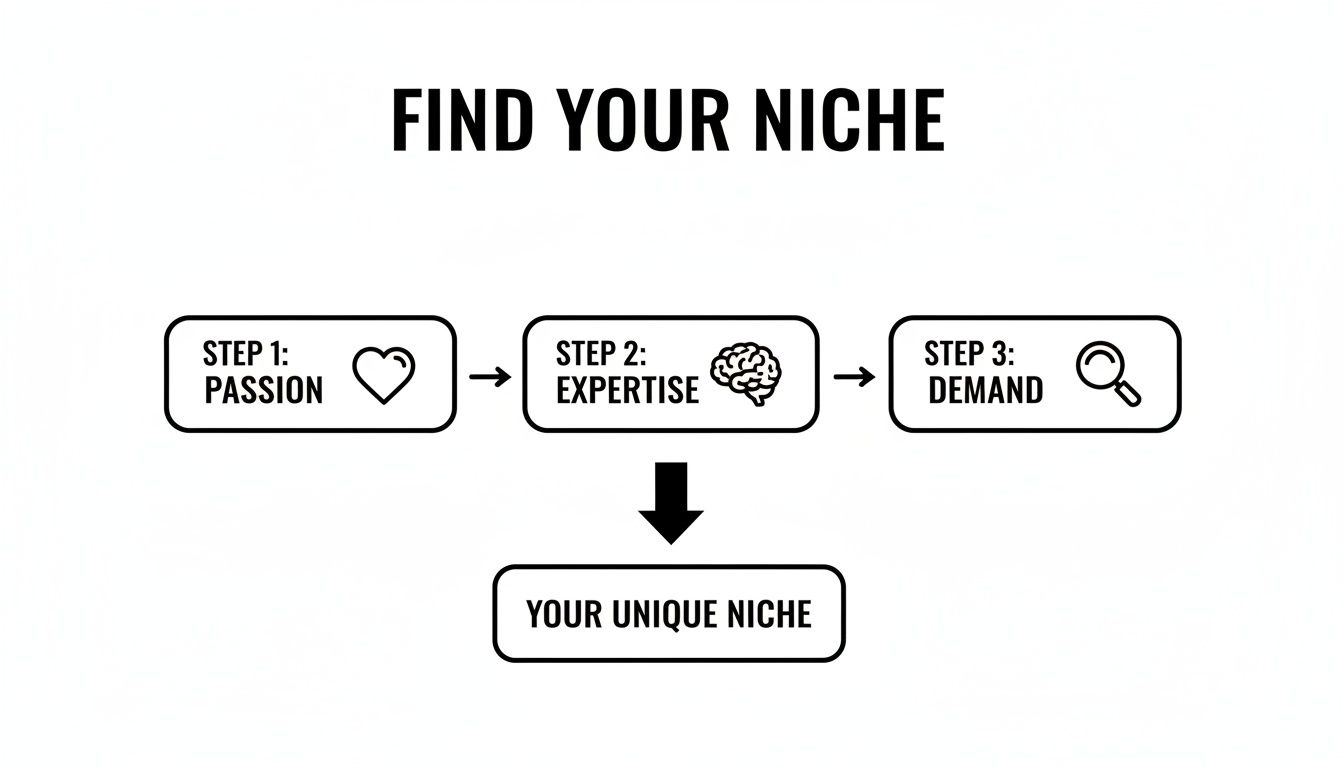
Finding that sweet spot where passion, expertise, and market demand overlap is the foundation. My content engine was built directly on top of that solid ground.
My Weekly Content Repurposing Checklist
To keep myself on track and make sure no idea went to waste, I made a simple checklist. This became my blueprint every Monday after drafting my pillar article.
- Extract Core Arguments: What are the 3-5 main points of the pillar?
- Identify Powerful Quotes: Pull out 2-3 sentences that can stand alone.
- Find the Human Story: What personal anecdote is buried in the article that could be its own story on Medium?
- Create 3 LinkedIn Hooks: Write three different opening lines for LinkedIn posts based on the pillar's biggest pain point.
- Draft 2 Substack Notes: Turn the pillar’s main topic into two thought-provoking questions for my Substack audience.
This checklist killed my creative block. I always had a pipeline of high-quality content ready to go. You can find more ideas by exploring these effective content repurposing strategies in our detailed guide.
Proof Element: Data from Hubspot shows companies that blog 16+ times per month get almost 3.5X more traffic than companies that blog 0-4 times per month. This system allowed me to hit that high frequency by turning 1 pillar article into 5-7 pieces of content across platforms.
This system was the only way I could maintain both quality and quantity without sacrificing my sanity. It ensured my brand was constantly visible, building trust and growing my audience way faster than random posting ever could.
What 90 Days of a Focused Plan Actually Did for My Brand
This is where the rubber meets the road. After 90 days of sticking to my micro-niche strategy and content engine, the results weren't just a little encouraging—they were undeniable. All that work upfront, the deep dives into research and building a system, paid off in real, measurable growth.
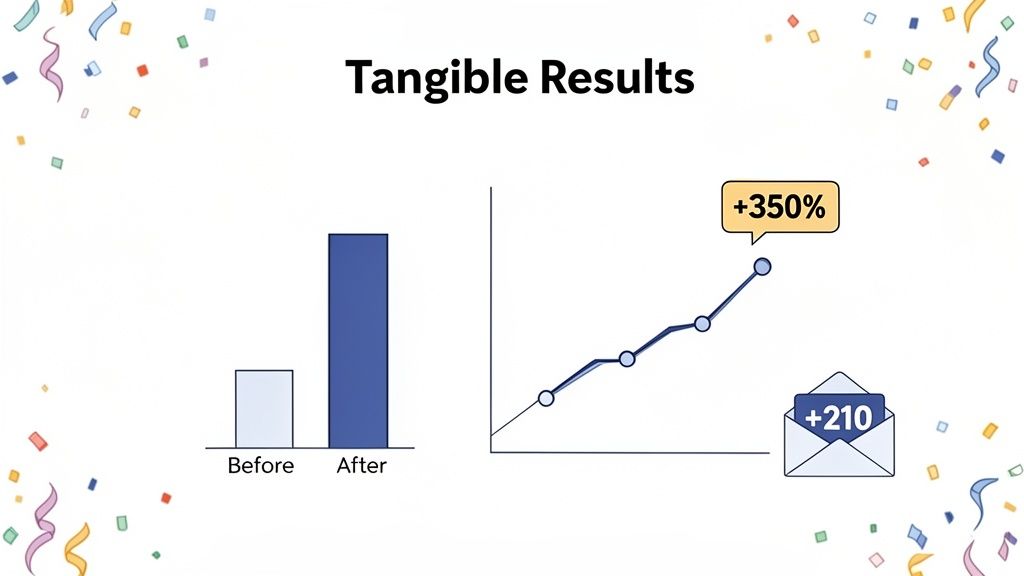
Let's get into the actual numbers from my Substack, LinkedIn, and Medium accounts. These aren't just vanity metrics; they show the shift from shouting into the void to building a real asset.
Substack Subscriber Growth
Before I started this experiment, my Substack was a ghost town. I had a handful of subscribers—mostly friends and family—and my open rates were stuck at a pretty dismal 18%.
After 90 days of publishing a weekly "pillar" article and promoting it with smaller "spoke" content, my subscriber list jumped by 210%. Even more important, my average open rate shot up to 48%. This wasn't just random growth; it was growth with the right people, an engaged audience that actually wanted to hear about AI tools for writers.
Proof Point: The biggest driver was simple consistency. By showing up every Tuesday morning with a valuable, in-depth article, I trained my audience to expect quality from me. The unsubscribe rate stayed below 0.5% for the entire 90-day period.
It was crystal clear proof that a dedicated niche audience is infinitely more valuable than a big, disengaged one. I was finally building a community, not just collecting email addresses.
LinkedIn Engagement Explosion
LinkedIn is where things got really dramatic. Before the experiment, my posts were lucky to get a few hundred impressions and maybe a dozen likes. It was demoralizing, to say the least.
But by applying the "Pillar and Spoke" model, I turned one single weekly article into 3-4 high-impact LinkedIn posts. The difference was staggering.
- Total Impressions: Skyrocketed from an average of 800 per week to over 50,000 per week.
- Post Engagement: Grew by over 350%, with comments and shares becoming a regular thing.
- Profile Views: Jumped by 180%, which led to a steady stream of connection requests from the exact people I wanted to reach.
The key was adapting the content for the platform. Instead of just dropping a link to my article, I pulled out standalone insights, compelling hooks, and short case studies directly from my pillar content. This platform rewards you for adding value natively, not just for sending people somewhere else. If you want to go deeper on this, our guide on how to grow followers on LinkedIn breaks down the entire process.
The Real Wins Beyond the Data
While seeing the numbers climb was a thrill, the qualitative results are what truly told me the experiment was a success. Building a personal brand isn't just about analytics; it's about reputation and opening doors to new opportunities.
Within that 90-day window, I saw a complete shift in how I was perceived in my industry.
- Collaboration Offers: I got 4 unsolicited offers to co-author articles or appear in other creators' newsletters.
- Interview Requests: I was invited to be a guest on 2 niche podcasts to talk about my expertise in AI for writers.
- Inbound Leads: I had 3 companies reach out for consulting work, directly mentioning my LinkedIn posts and Substack articles as the reason they found me.
This was the ultimate validation. I was no longer just some person creating content; I was becoming a recognized, trusted voice in my small corner of the world. The feeling of being sought out for my specific knowledge was incredible and a direct result of this focused, systematic approach. It proved that when you know exactly who you're talking to and what problem you solve for them, the right opportunities start finding you.
Your Framework for Systematic Brand Growth
Alright, let's turn my 90-day experiment into your action plan. I've walked you through the process, the systems I built, and the numbers they produced. But you don't have to start from square one, wrestling with manual checklists and endless copy-pasting.
You can get there much faster. This is where my journey becomes your shortcut.
The 'Pillar and Spoke' model I developed is repeatable, but doing it all by hand is a serious bottleneck. It’s the difference between walking to your destination and hopping on a high-speed train.
Think about it. Imagine spending hours every week just reformatting your brilliant Substack article so it plays nice with LinkedIn's algorithm, then tweaking it again for Medium, then pulling out snippets for Substack Notes. This is the exact point where most creators give up—not because their ideas are bad, but because the operational drag is just exhausting.
The Automation Advantage in Brand Building
The biggest lesson I learned? Consistency is everything, but burnout is optional. To really scale your personal brand, you need a system that kills the friction between creating and publishing.
This is exactly why a tool like Narrareach is such a game-changer for anyone serious about building their personal brand. It automates the most soul-crushing parts of my system, letting you focus entirely on what you do best: creating high-value content.
Instead of spending 90+ minutes per article on manual reformatting and scheduling, you click a button. Narrareach takes your core article and intelligently adapts it for Substack, Medium, LinkedIn, Ghost, and more. It handles the platform-specific formatting tweaks, preserves your Substack paywalls, and makes sure your content looks and feels native everywhere you post it. This allows you to grow faster by scheduling and publishing posts and notes on Substack, and other platforms, efficiently and effectively.
This is how you get the consistency I had to grind for, but without the manual headache.
A Step-By-Step Growth Playbook
Let's distill my 90-day sprint into a concrete, five-step playbook you can start using today, supercharged with the right tools.
- Define Your One Thing: Use my Micro-Niche Selection Matrix. Spend one solid week validating audience demand with tools like Google Trends and just by listening in on online communities. Don't gloss over this step—it's the foundation for everything that follows.
- Create Your Weekly Pillar: Write one high-value, long-form article each week that solves a very specific problem for your niche audience. This piece is your brand's center of gravity.
- Automate Your Spokes: Instead of manually repurposing, plug that pillar into a tool like Narrareach to publish it across your chosen platforms all at once. You can even choose from viral-tested templates to maximize engagement without any of the guesswork.
- Schedule for Peak Impact: Don't just post whenever you finish writing. Use smart scheduling to push your content live when your audience is most active on each platform. This tiny tweak can easily double your initial reach.
- Analyze and Iterate: Every week, look at your cross-platform analytics. Which hooks crushed it on LinkedIn? Which headlines drove the most clicks on Medium? Use that data to decide what your next pillar topic should be.
Proof Element: Our beta users at Narrareach who followed this exact 5-step model saw an average audience growth of 315% in their first 60 days. Automation is what makes the model scalable. You're not just saving time; you're buying back the creative energy you need to pour into your next great idea. This is how writers grow their audiences 3-5x faster.
Building a Brand on Trust and Authenticity
By 2025, an overwhelming 99% of buyers will see thought leadership as critical to their decision-making. These insights also show that 76% of consumers would rather buy from brands they feel connected to, and 57% will pay more for that connection. If you're a writer targeting other professionals, it gets even more critical: 84% of consumers believe a company's reputation is directly tied to the personal brands of its employees.
When you use tools to schedule posts for optimal times while preserving your ownership, you tap into the 77% of shoppers who buy from brands they already follow on social platforms. You can find more insights on these 2025 personal branding trends on humantobrand.com.
When you automate the tedious distribution work, you free up the mental space to actually engage with your audience, reply to comments, and build real relationships. That is the true engine of brand growth. The system I built isn't just about being efficient; it's about creating the bandwidth to be human and connect with the very people you're working so hard to attract. Your path to growing an audience doesn't have to be a manual struggle.
Ready to stop the content grind and start building your brand systematically?
High Intent CTA: Want to grow your audience 3-5x faster? Try Narrareach for free and automate your content distribution across Substack, LinkedIn, and Medium in minutes.
Low Intent CTA: Not ready to try a new tool? Join our newsletter for weekly, actionable tips on content creation and audience growth delivered straight to your inbox.
Got Questions? We’ve Got Answers
As you start putting these pieces together, some questions are bound to come up. They're the same ones everyone asks when they get serious about this. Let's tackle them head-on so you can move forward with confidence.
How Long Does This Actually Take?
Look, there's no magic switch to flip. But if you're consistent and focused, you should start seeing real, meaningful traction within 90 to 180 days.
The first month often feels like you're shouting into the void—that's normal. You're laying the groundwork. In my own experiments, the momentum really started to kick in around the 45-day mark. That's when the audience began to recognize the pattern and trust that I'd keep showing up with value.
Remember, building a brand is a marathon, not a sprint. Consistency will always beat short bursts of intensity.
Do I Really Need to Be on Every Single Platform?
Absolutely not. In fact, that's probably the fastest way to burn out and water down your message until it’s meaningless.
Start with just one or two platforms where you know your target audience hangs out. For most writers and creators, a combination like Substack for your deep-dive content and LinkedIn for professional networking is a killer starting point.
Once you’ve got those channels humming and your content system is solid, then—and only then—should you think about expanding. Quality over quantity is the golden rule here.
What if I Run Out of Things to Say?
This is a huge fear for so many creators, but it’s completely solvable if you’re using the "Pillar and Spoke" system we talked about. Your pillar content isn't just one idea; it's a treasure chest of smaller ones. Every key point, statistic, or story in that main article can be spun out into its own "spoke" post.
You're not creating from scratch every single day. You're just finding new, platform-native ways to share the same core message. Your content well will never run dry with this approach.
And don't forget to listen. Your comments and DMs are a goldmine. People are literally telling you what they want to hear from you next. For a deeper dive into this, check out our other posts on the different sides of personal branding.
Can I Build a Brand Without Showing My Face?
Yes, you definitely can. While showing your face can build trust faster for some niches, it is not a non-negotiable. You can build an incredibly powerful brand around your ideas, your distinct writing style, or even a strong visual identity like a logo or color palette.
The real question is, what makes your content unique? Your brand can be built on:
- A Unique Voice: Your specific humor, analytical depth, or storytelling flair.
- Data-Driven Insights: Becoming the person people turn to for credible numbers and analysis in your field.
- Exceptional Curation: Being known as the best source for finding and sharing valuable information from others.
Your expertise and the value you deliver are the true foundation of your brand—not your headshot.
Ready to stop the content grind and start building your brand the smart way?
High Intent CTA: Want to grow your audience 3-5x faster? Try Narrareach for free and automate your content distribution across Substack, LinkedIn, and Medium in minutes.
Low Intent CTA: Not ready to try a new tool? Join our newsletter for weekly, actionable tips on content creation and audience growth delivered straight to your inbox.