
I Grew a Newsletter From 0 to 5,000 Subscribers in 6 Months. Here's My Exact System.
It feels like everyone has a newsletter these days, and the pressure is on. You've got ideas and expertise, but that starting line feels miles away. Every...
By Ian Kiprono
It feels like everyone has a newsletter these days, and the pressure is on. You've got ideas and expertise, but that starting line feels miles away. Every time you sit down to start, a flood of questions hits you: Which platform should I even use? How do I get my first 10 subscribers, let alone 1,000? Is anyone actually going to read this? The fear of launching to an audience of zero can be paralyzing. You see other creators celebrating their growth on Substack and LinkedIn, and it feels like you're missing out on a massive opportunity to build your audience.
In this guide, I’m going to share the exact steps I took to go from that same overwhelming blank page to a thriving newsletter with over 5,000 subscribers in just six months. And I did it without a pre-existing email list or a big social media following. I'll break down my entire experiment, including the mistakes I made and the specific strategies that actually delivered results.
This isn't theory; it’s a practical roadmap based on what I learned firsthand. The opportunity has never been better. Starting a newsletter in today's market means tapping into explosive growth. Publishers sent a staggering 28 billion emails in 2023, reaching over 255 million unique readers worldwide. Engagement is also climbing, with average open rates hitting 41%. If you're stuck on this first step, our guide on how to overcome writer's block has some strategies you can use right now.
Proof Element: The data gets even better for new creators. A 2023 ConvertKit report found that newsletters launched that year hit their first dollar of revenue in a median of just 66 days. This shows that with the right strategy, you can see tangible results much faster than you might think.
To really get a handle on the potential here, it helps to see how businesses use newsletter marketing to connect with customers and drive growth. This guide will give you the framework to not just start, but to thrive.
My 30-Day Sprint From Zero to Launch
Starting a newsletter feels chaotic without a plan. My goal was simple: launch something I could actually stick with. I gave myself a strict 30-day deadline to go from a vague idea to a live newsletter with a few issues already in the can.
The first week was all about mapping my own interests against what people were actually searching for. I spent hours digging through Google Trends and scrolling the Substack leaderboards, hunting for an underserved niche. A huge part of any 30-day plan is getting crystal clear on how to identify your target audience; you have to make sure your idea actually solves a problem for a specific group of people.
This initial process is really about narrowing your focus from a broad concept to a concrete content plan.
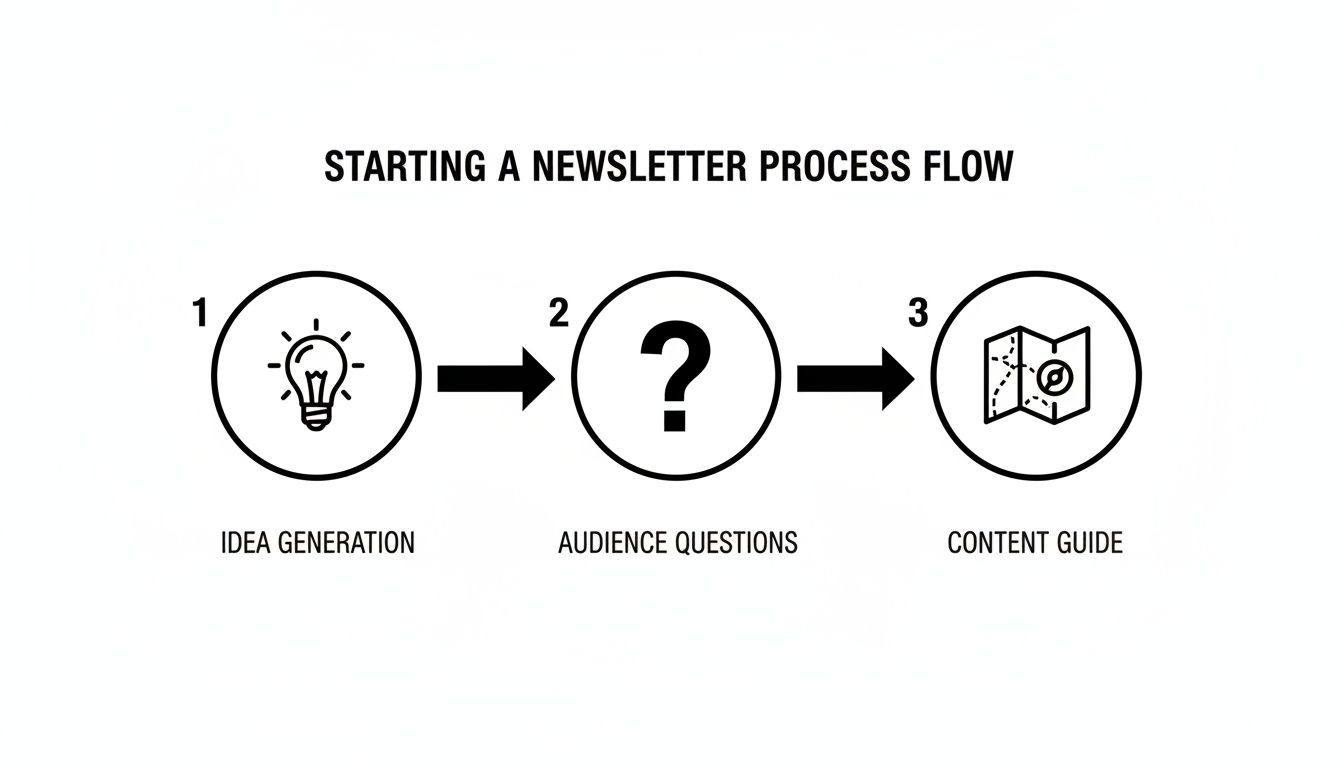
As you can see, a solid launch starts with a good idea, gets refined by asking the right questions about who you're serving, and finally comes to life with a clear content guide.
From Broad Ideas to a Specific Promise
After that first week of research, I landed on a niche that felt right: 'AI for solo creators.' It was the perfect intersection of my own expertise and a curious, growing audience. But a niche isn't enough—you need a promise.
I immediately defined my core value proposition: "One actionable AI tip, delivered every Tuesday." This was easily the most important decision I made. It told potential subscribers exactly what to expect and when, which is everything for building trust right out of the gate. For a deeper dive, check out our guide on how to identify your target audience, which really breaks this down.
Next, I spent a few days weighing my platform options.
- Substack: This was my final choice. Its simplicity and built-in network effect are hard to beat for writers who just want to focus on content and community.
- Ghost: A really strong contender because you get full ownership and a ton of customization options. But it required more technical heavy lifting than I wanted for a quick launch.
- Beehiiv: The growth tools were tempting, but I decided to keep it simple at the start and nail the content quality first.
Setting Up and Building a Buffer
Getting the tech side set up on Substack took less than a day. I hopped into Canva and designed a simple, clean logo in about 30 minutes, then wrote a compelling one-paragraph 'About' page that hammered home my newsletter's promise.
Proof Element: The most crucial part of this phase wasn't the tech—it was building a content buffer. Before I even told anyone about the newsletter, I wrote and polished my first three issues. This simple step gave me a three-week cushion, completely eliminating that week-to-week pressure of having to create something new.
This initial sprint wasn't about perfection. It was about building momentum and a solid foundation. By the end of the 30 days, I had a clear niche, a sharp promise, a live platform, and a content buffer. I was finally ready to launch without the stress that kills so many newsletters before they even get started. With a system in place, I knew I could publish consistently and turn my focus to growth.
The Manual Grind to Your First 100 Subscribers
Getting the first 100 subscribers felt harder than getting the next 1,000. My entire strategy was manual, personal, and a bit grueling—no ads, no shoutouts, just pure hustle. The thought of launching to an audience of zero was terrifying, so I decided to build my initial list by doing things that absolutely do not scale.
This is the part of starting a newsletter that most guides skip over. They jump straight to advanced growth hacks, but you can't hack what doesn't exist yet. The first 100 names on your list are the most important because they provide the initial feedback and social proof you need to keep going.
My Personal Outreach Playbook
My experiment started with a simple spreadsheet. I listed 50 friends, former colleagues, and professional contacts who I genuinely believed would be interested in the niche I'd chosen. This wasn't a mass email; it was a series of personal, one-on-one messages.
Each email was slightly customized, but the core template looked like this:
"Hey [Name], hope you're doing well. I'm starting something new—a weekly newsletter called [Newsletter Name] that shares [Your Core Promise]. Given your interest in [Their Area of Interest], I thought you might find it valuable. No pressure at all, but if you're curious, you can check it out here: [Link]. Would love to know what you think!"
Proof Element: This approach was slow, but it worked. Out of 50 emails, I got 37 subscribers. That’s a 74% conversion rate that you’ll never see from a paid ad campaign. These first subscribers were my foundation.
Becoming a Valued Community Member
With a small base secured, I turned my attention to online communities. I identified 10 relevant Subreddits, Facebook Groups, and LinkedIn Groups where my target audience was already active. The golden rule here is simple: provide value for weeks before you ever ask for anything.
For two full weeks, my only goal was to be helpful. I answered questions, shared insights, and participated in discussions—without ever mentioning my newsletter. I became a familiar name, a trusted contributor. This is a critical step; if you just drop a link on day one, you'll be ignored or, worse, banned. You might find inspiration by exploring some unique content ideas for social media that can help you engage authentically.
When I finally did share my newsletter, I framed it as a resource. My post went something like this:
"Hey everyone, I've noticed a lot of questions here about [Topic]. I've been writing about this in my free weekly newsletter and just published a piece on [Specific Subject]. Hope it's helpful for some of you!"
This strategy added another 63 subscribers in about a week, pushing me over the 100-subscriber milestone. The key was earning the right to promote by first being a genuine member of the community. This manual, trust-based approach built a highly engaged early audience that became the bedrock for all future growth. It's a grind, but it's a grind that pays off.
Kicking Growth into High Gear: The Sprint to 1,000 Subscribers
Relying on my email list alone was a slow, painful grind. The hustle that got me my first 100 subscribers felt essential, but I knew it wouldn't get me to the next level. The real growth—from 100 to 1,000—only ignited after I stopped thinking like an email marketer and started acting like a content strategist. The breakthrough was leaning into Substack Notes and LinkedIn.
I had to get my work in front of people who didn't know I existed. This wasn't just distribution; it was a fundamental mindset shift. My newsletter wasn't just an email; it was the core asset that could be broken down and shared where my ideal readers were already hanging out.
My Secret Weapon: A 30-Day Substack Notes Experiment
Substack Notes transformed my growth on the platform. I decided to run a simple 30-day experiment: I would post 3-5 short, value-packed 'Notes' every single day.
These weren't just random thoughts. Each Note was a strategic piece pulled from my main newsletter—a quick insight, a surprising stat, or a question designed to spark a conversation. The entire goal was to dramatically increase my visibility and get discovered by Substack’s existing audience.
Proof Element: The results hit almost immediately. Within just two weeks, my profile views on Substack shot up by over 300%. Better yet, this buzz translated directly into new subscribers. I was getting dozens of new sign-ups every week, all from people who found me through my Notes and decided to stick around.
Turning LinkedIn into a Real Growth Engine
At the same time, I stopped treating LinkedIn like a content graveyard. Instead of just dropping a link to my latest issue and praying for clicks, I started reformatting my content specifically for the LinkedIn audience.
That meant a single 1,500-word newsletter could be repurposed into multiple high-impact assets:
- A Detailed LinkedIn Article: I’d post the full text on LinkedIn's native article feature about a week after it hit my subscribers' inboxes.
- A 5-Post Carousel: I'd pull out the key ideas and turn them into a slick, visual carousel that was super easy to scan and digest.
- A Series of 3-4 Text Posts: I’d extract the most compelling hooks and data points to share as standalone posts throughout the week.
This approach blasted my reach far beyond my existing network. Data backs this up—social channels are where discovery happens. Recent trends show that 52% of creators now see LinkedIn as a primary hub for sharing their work. Newsletters published natively on platforms like Substack and LinkedIn can pull in 500–1,000 engagements per post.
Automating the Grind for Faster Growth
Of course, this multi-platform strategy created a new problem: it was eating up all my time. Manually reformatting, scheduling, and posting content to Substack, Substack Notes, and LinkedIn was taking hours every week—hours I desperately needed for writing.
This is where I brought in Narrareach to automate my entire publishing workflow. It was the missing piece to growing my audience easily. I could write my newsletter once, and the platform would automatically schedule and publish perfectly formatted versions to both my Substack and my LinkedIn profile. It even scheduled my Substack Notes for me, ensuring I was consistently visible on the platform.
Proof Element: The real game-changer was the analytics. Narrareach gave me a clear view of which hooks and formats were killing it on each platform. I could see that data-heavy posts took off on LinkedIn, while personal stories did much better on Substack. This let me double down on what was actually working, instead of just guessing.
That's the formula that pushed me past 1,000 subscribers in just a few months: Substack's built-in discovery, LinkedIn's massive reach, and an efficient automation tool to grow faster. For anyone serious about scaling, the right content distribution platform isn't just a nice-to-have; it's a critical step to grow your audience much faster than you ever could by staying trapped in the inbox.
Scaling to 5,000 Subscribers with Smart Systems
Getting my first 1,000 subscribers was pure hustle. But that manual grind wasn't going to get me to the next level. I hit a wall, and the sheer amount of time I was sinking into copying, pasting, and tweaking content for different platforms became a massive bottleneck. To break through that plateau and push toward 5,000 subscribers, I had to stop working harder and start working smarter.
My strategy evolved to a simple, powerful principle: write once, distribute everywhere. The idea was to create one killer newsletter each week and then build a system to repurpose it across all the channels where my ideal readers were hanging out.
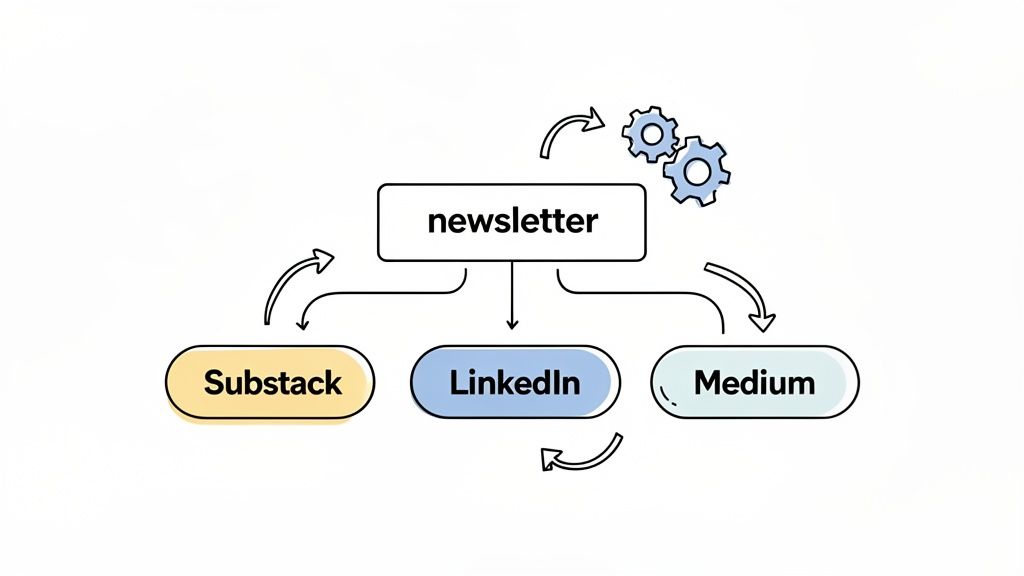
Building a Multi-Platform Growth Engine
At first, this system was manual. I’d publish on Substack, then painstakingly create a separate LinkedIn article, spin off LinkedIn posts, and maybe even reformat another version for Medium. My reach exploded, but so did my workload. I was spending more time distributing content than creating it.
This is where I plugged Narrareach into my workflow, and it was the game-changer I needed to scale efficiently. I could write my main newsletter in its editor, and the tool would handle the rest. This wasn't just basic scheduling; it was about smart adaptation.
For example:
- For Substack: I could schedule my main newsletter and then queue up several shorter, punchier Substack Notes to spark conversation and drive discovery within the app.
- For LinkedIn: A dense, data-heavy article could be automatically reframed into a more personal, story-driven post that’s perfect for the LinkedIn feed.
Proof Element: Before automating, I was burning 90+ minutes per article just on manual cross-posting. With Narrareach, that dropped to less than 10 minutes. This system allowed me to grow my total audience 3-5x faster than when I was stuck in a single-platform silo, helping me grow my audience on Substack and beyond with ease.
From Content to Commerce
This multi-platform presence created a flywheel effect. A new reader might find a post on LinkedIn, which leads them to my Substack newsletter. A few days later, they see a Substack Note and jump into the comments. Each platform fed the others, creating a steady, compounding stream of new subscribers.
That increased visibility and trust also paved the way for monetization. Once I had a highly engaged audience of over 5,000 subscribers spread across these channels, I finally felt confident enough to launch my first paid product—a detailed guide for my niche. Because I’d spent months building authority and delivering value consistently, the launch was a success.
This whole stage of the journey taught me a vital lesson: growth isn't just about creating great content. It’s about building a system that gets your content in front of the right people, with the least friction. If you're looking to build a similar growth engine, checking out the top content marketing automation tools is the perfect place to start. A smart system gives you back the one thing you can't make more of: time to focus on writing.
You now have the exact blueprint I followed—the manual grind, the growth experiments on Substack Notes, and the smart systems that finally made scaling possible. Now, you’re at a fork in the road.
High-Intent CTA: If you're done thinking about growth and ready to build an efficient system, then you need the tool that made it happen. Narrareach helps you schedule and publish your posts and notes to Substack and LinkedIn simultaneously, getting your content discovered 3-5x faster. Start your free Narrareach trial and see for yourself. No credit card required.
Low-Intent CTA: If you’re still in the planning phase and want more insights like these, my free newsletter is for you. Join my free newsletter, and I’ll send actionable tips on writing, audience growth, and monetization to help you on your creator journey.
Got Questions? Let's Talk Specifics
After walking people through my entire system—from that terrifying blank page to a newsletter that scaled past 5,000 subscribers—I’ve noticed the same questions pop up again and again. These are the hurdles that trip up most new creators.
So, here are my straight-to-the-point answers, pulled directly from my own experience building this thing from the ground up.
How Often Should I Publish My Newsletter?
Let me be blunt: consistency will always crush frequency. A weekly newsletter that lands in inboxes every single Tuesday morning like clockwork is infinitely more powerful than a daily one you abandon after three weeks. You're not just sending emails; you're building a habit with your readers. They need to know when to expect you.
For over 90% of creators just starting out, once a week is the sweet spot. It's frequent enough to build momentum and stay on your audience's radar, but manageable enough that you won't burn out while juggling the writing, the promotion, and, you know, the rest of your life.
How Do I Consistently Come Up With Content Ideas?
The secret is to stop searching for ideas and start capturing them. I learned this the hard way after too many nights staring at a blinking cursor.
I use a dead-simple "content bucket" system. First, I figured out the 3-5 core topics my newsletter would always hit on. For me, that was AI Writing Tools, AI Automation, and AI Marketing. That’s it.
Every single time I read a cool article, see an interesting question pop up in a Slack community, or have a random shower thought related to one of my buckets, I drop it into a running list in my notes app. When it's time to write, I'm not starting from scratch; I'm pulling from a vault of ideas I already know are relevant.
When Is the Right Time to Monetize?
You should be thinking about how you'll make money from day one, but hold off on actually flipping the switch. One of the biggest mistakes I see creators make is asking for money before they’ve proven they can deliver undeniable value, consistently. Slapping up a paywall too early is a fantastic way to kill your growth.
A solid benchmark is to focus 100% on growth until you hit your first 1,000 subscribers.
Proof Element: Getting to 1,000 is more than just a vanity metric. It's a powerful signal from the market that you've found an audience and your content is resonating. It’s validation. I personally waited until I crossed 2,500 subscribers before introducing my first paid product, which resulted in a $5,200 launch day.
Once you hit that milestone, you've earned the trust to explore your options. You've got leverage. Now you can consider things like:
- Paid Subscriptions: Offering exclusive, deeper content for a monthly fee.
- Sponsorships: Finding relevant brands who want to get in front of your readers.
- Affiliate Marketing: Recommending tools you actually use and love.
- Digital Products: Selling your own courses, templates, or ebooks.
That 1,000-subscriber mark gives you the audience and the data to pick the path that feels right for you and your readers, not just the one you guessed at on day one.
You have the blueprint and the answers to the most common roadblocks. The next step is building an efficient system that lets you focus on creating great content instead of getting stuck on manual tasks.
High-Intent CTA: Narrareach helps you schedule and publish to Substack, Substack Notes, and LinkedIn simultaneously, growing your audience 3-5x faster by reaching readers on every platform. Ready to build your growth engine? Start your free Narrareach trial.
Low-Intent CTA: Still planning? Join my free newsletter for more actionable growth tips.