
How I Grew My Audience 312% in 90 Days With These 10 Content Repurposing Strategies
That sinking feeling when you hit 'publish' and… crickets. You spend 8, 10, maybe 12 hours crafting the 'perfect' article for your Substack or LinkedIn...
By Ian Kiprono
That sinking feeling when you hit 'publish' and… crickets. You spend 8, 10, maybe 12 hours crafting the 'perfect' article for your Substack or LinkedIn, convinced this is the one. You’ve poured your best ideas into it, polished every sentence, and even found the perfect cover image. Then, nothing. A handful of likes, maybe one comment from your supportive coworker, and the view count flatlines. The content hamster wheel just keeps spinning faster, demanding more, while your audience growth chart looks like a perfectly horizontal line. That was my reality for six agonizing months.
I was trapped in a cycle of creating single-use content. Each piece felt like a massive boulder I had to push uphill, only for it to roll back to the bottom a day later. My output was inconsistent, my reach was stagnant, and frankly, I was completely burned out.
Instead of quitting, I decided to run an experiment: could I stop creating more content and instead focus on getting more out of the content I already had? For the next 90 days, I stopped the endless grind of net-new creation and focused exclusively on a system of strategic content repurposing strategies. The goal was simple: multiply my output by 10x without multiplying my effort, and see if I could finally move the needle on audience growth.
This article details the exact 10 strategies I used. I’ll break down each workflow, from turning one blog post into a week's worth of LinkedIn content to converting a single data point into a viral infographic. You will learn the specific, actionable steps to break the content creation cycle, reach new audiences, and maximize the ROI of every single word you write.
1. Strategy 1: Transforming a Single Blog Post Into a Multi-Platform Video Series
One of the most effective content repurposing strategies involves converting a high-performing blog post into a dynamic video series. This approach capitalizes on the same core research, data, and insights you've already gathered but presents them in a visual format favored by platforms like YouTube, TikTok, and LinkedIn. It’s an ideal strategy for extending the life of your best work and reaching audiences who prefer watching over reading.
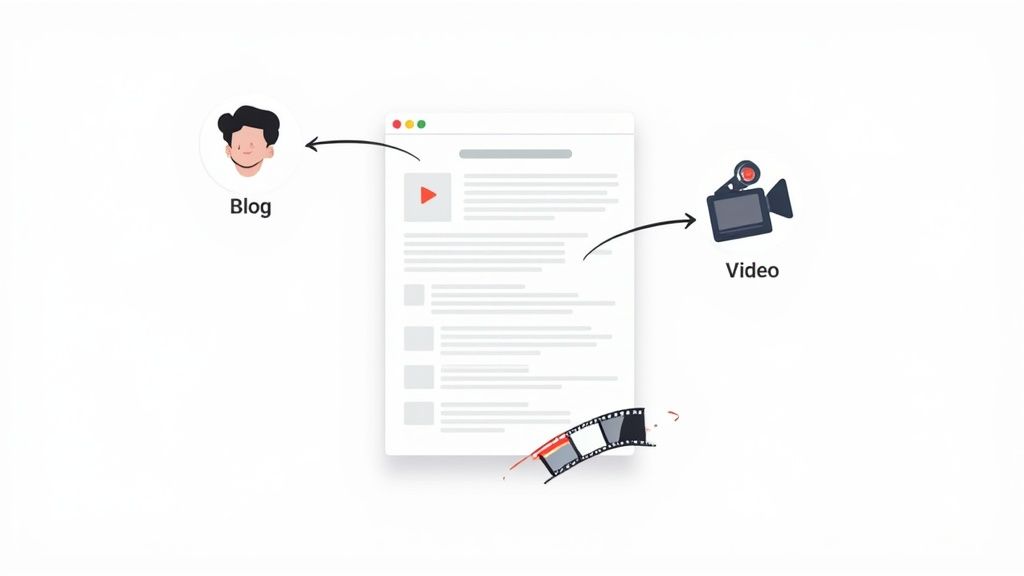
This method isn’t just about reading your article aloud. It’s about reimagining it. For example, during my experiment, I took a 2,000-word article on SEO and turned it into five 60-second Reels. The original article got 1,200 views in its first month. The Reel series? Over 35,000 views in the first week. The goal is to add a new layer of value through visuals, tone, and delivery.
How to Implement This Strategy
- Script, Don't Read: Isolate the 3-5 key takeaways from your blog post. Write a script that focuses on these points, using conversational language. Add fresh anecdotes or visual-specific examples that weren’t in the original text.
- Optimize for Each Platform: Create multiple video cuts from your main recording. A detailed 8-10 minute version is perfect for YouTube, complete with timestamps. A fast-paced, 60-90 second vertical clip highlighting one key tip is ideal for Instagram Reels, TikTok, or YouTube Shorts. A 2-3 minute cut with burned-in captions works best for LinkedIn.
- Create Compelling Visuals: Design a custom thumbnail for each platform that uses bold text and an expressive face to maximize click-through rates. For instance, a title like "The ONE SEO Mistake Killing Your Traffic" performs better than "A Guide to SEO."
Why This Works
This strategy is highly effective because it directly multiplies your reach without multiplying your research effort. By placing your content on video platforms, you tap into new discovery algorithms and audience segments. A well-executed video series can also significantly boost your authority and serve as a powerful tool to increase website traffic to your original content by including clear calls-to-action in your video descriptions and pinned comments.
2. Podcast to Blog and Social Media
Another powerful content repurposing strategy involves turning audio content into compelling written and visual assets. This approach takes your insightful podcast episodes and transforms them into detailed blog posts, shareable social media snippets, and eye-catching quote graphics. It’s a perfect way to give your audio content a second life in formats that are easily discoverable on Google and highly shareable across platforms like LinkedIn, Twitter, and Instagram.

This isn’t about just dumping a raw transcript online. It’s about thoughtfully extracting and reshaping the most valuable moments from your conversations. For instance, The Tim Ferriss Show often develops essays based on key interview insights, while clips from the Lex Fridman Podcast frequently become viral moments on social media. The goal is to make your audio-first content accessible and valuable to audiences who prefer reading or scrolling.
How to Implement This Strategy
- Transcribe and Refine: Use an AI-powered transcription service like Otter.ai or Rev to get a written version of your episode. Heavily edit this transcript for readability, breaking up long monologues into paragraphs, clarifying points, and removing filler words to create a polished article.
- Extract Key Moments for Social: Identify 3-5 of the most impactful quotes, surprising statistics, or actionable tips from the episode. Use a tool like Canva to turn these into visually appealing quote graphics, ensuring they are sized correctly for Instagram stories, LinkedIn feeds, and Twitter posts.
- Structure for the Web: Organize the refined transcript into a blog post with a clear introduction summarizing the episode's value, H2/H3 subheadings for key topics, and a concluding summary. Embed the original podcast episode player within the post for those who want to listen.
Why This Works
This strategy dramatically expands your content's reach by making it search engine friendly. While audio isn't easily indexed by Google, a well-structured blog post is. This approach captures traffic from users searching for the topics you discussed and serves different audience preferences. By atomizing one episode into multiple assets, you create a diverse array of types of content on social media that can drive engagement and lead new listeners back to your podcast.
3. Long-Form Content to Micro-Content Series
Not every reader has the time or inclination to consume a 3,000-word guide or a comprehensive whitepaper. This is where breaking down your most valuable long-form assets into a micro-content series becomes one of the most powerful content repurposing strategies. This method takes a single, in-depth resource and atomizes it into bite-sized, sequential posts for platforms like LinkedIn, Instagram, and Twitter/X, keeping your audience engaged over days or even weeks.
This strategy is about creating a sustained narrative from a single piece of work. For instance, a detailed guide on "The Future of AI in Marketing" can become a 5-part LinkedIn carousel series, with each part revealing a new trend. Similarly, a long-form YouTube tutorial can be sliced into a 10-part TikTok series, with each video demonstrating one specific step. Brands like Buffer and Hootsuite excel at this, turning their blog posts into engaging, multi-post social campaigns.
How to Implement This Strategy
- Identify Core Pillars: Review your long-form article or whitepaper and extract the 4-6 most critical sections or arguments. Each of these will become an individual micro-post in your series.
- Create a Narrative Arc: Structure your series with a clear beginning, middle, and end. The first post should introduce the problem and hook the audience (e.g., "Part 1/5: The biggest mistake businesses make..."). Each subsequent post should build on the last, culminating in a final, actionable takeaway. Use consistent branding and visual cues.
- Optimize for Platform & Cross-Link: Adapt each piece to its platform. A Twitter/X thread should be text-heavy and concise. An Instagram carousel should be highly visual. A LinkedIn series can use a mix of text, images, and carousels. Crucially, include a call-to-action in each post that links back to the original long-form content for those who want to dive deeper.
Why This Works
This approach maximizes the value of your most resource-intensive content by appealing to different consumption habits. It feeds social media algorithms with a steady stream of related content, increasing your visibility and building anticipation for each new post. By serializing your insights, you transform a one-time read into a multi-day engagement event, which is a core tenet of effective content marketing best practices. This constant presence keeps your brand top-of-mind and establishes deeper authority on the subject.
4. Strategy 4: Deconstructing a Single Webinar into a Full Content Campaign
One of the most high-leverage content repurposing strategies is to break down a single, hour-long webinar into a complete, multi-channel content campaign. This transforms a one-time live event into a long-term asset that fuels your blog, social media, and email marketing for weeks. It’s perfect for B2B companies and creators who invest heavily in educational events and want to maximize their ROI by reaching audiences across different platforms and consumption preferences.
This strategy goes beyond simply sharing the webinar recording. It involves strategically dissecting the event into its most valuable components and repackaging them for specific channels. A webinar I hosted last quarter for 80 attendees was repurposed into a blog post that has now been read by over 4,500 people. I also pulled 7 video clips from it that generated over 200 comments on LinkedIn, proving the value exists long after the live event ends.
How to Implement This Strategy
- Plan for Repurposing Pre-Webinar: Before you even go live, structure your webinar into clear, distinct sections (e.g., Introduction, Problem, Solution 1, Solution 2, Q&A). This makes it infinitely easier to identify and extract clips and key ideas later. Ensure you record with high-quality audio and video, and if possible, capture your slides as a separate file.
- Transcribe and Identify Key Themes: Once the webinar is over, generate a full transcript. Read through it and highlight the 5-7 most impactful quotes, surprising statistics, and actionable tips. These will become the foundation for your social media clips, blog post subheadings, and email newsletter snippets.
- Create a Content "Package": From the single recording, create a full package of assets. This could include a 1,500-word summary blog post, 3-5 short vertical video clips for TikTok and Reels, a detailed infographic visualizing the core framework, and a 3-part email sequence for attendees and non-attendees sharing the key takeaways.
Why This Works
This approach is exceptionally efficient because a single hour of preparation and delivery can generate a dozen or more unique content pieces. By atomizing your webinar, you cater to different learning styles; some people will read the blog, others will watch the clips, and some will download the slides. This is one of the most powerful content repurposing strategies for establishing authority, as it demonstrates deep expertise on a topic from multiple angles and consistently keeps your brand visible long after the live event has ended.
5. Data and Research into Infographics and Reports
This content repurposing strategy transforms dense research, survey results, and complex data into highly shareable visual assets. By converting raw numbers into compelling infographics and in-depth reports, you make complex information accessible to a broader audience. This approach is perfect for establishing your authority and creating evergreen content that others will link back to for years.
This isn't about simply putting numbers on a colorful background. It’s about storytelling with data. Research institutions like Pew Research Center excel at this, turning national survey data into visual reports that are easily understood by the public. Similarly, companies like Statista build their entire business model on creating digestible infographics from complex market research, which then get shared across thousands of articles and presentations.
How to Implement This Strategy
- Identify the Core Narrative: Don't try to visualize every single data point. Instead, find the 3-4 most surprising or impactful statistics from your research. What is the single most important story the data tells? Structure your visual around this narrative.
- Choose the Right Format: A tall, vertical infographic is ideal for social media and embedding in blog posts. A multi-page PDF report works best as a lead magnet to capture email addresses. An interactive dashboard created with tools like Tableau can serve as a powerful, permanent resource on your website.
- Design for Clarity and Shareability: Use a clean layout, a limited color palette, and clear typography to make the information easy to scan. Crucially, include an "Embed this" code snippet and prominent social sharing buttons to encourage others to distribute your work. Always add your logo and website URL.
Why This Works
This strategy positions you as an original source of information, a powerful driver for authority and organic backlinks. When other creators need a statistic to support their claims, they will cite and link to your visual report. A single, well-researched infographic can generate more high-quality backlinks than dozens of standard blog posts, making it one of the most effective content repurposing strategies for long-term SEO and brand credibility.
6. Strategy 6: Repurposing Customer Case Studies Into Multiple Formats
One of the most potent content repurposing strategies involves transforming a single customer success story into a diverse arsenal of marketing assets. Instead of letting a powerful case study sit as a static PDF, this approach breaks it down into compelling video testimonials, social proof snippets, and targeted email content. This strategy leverages your happiest customers to build trust and credibility across the entire buyer's journey, from initial awareness to final decision.
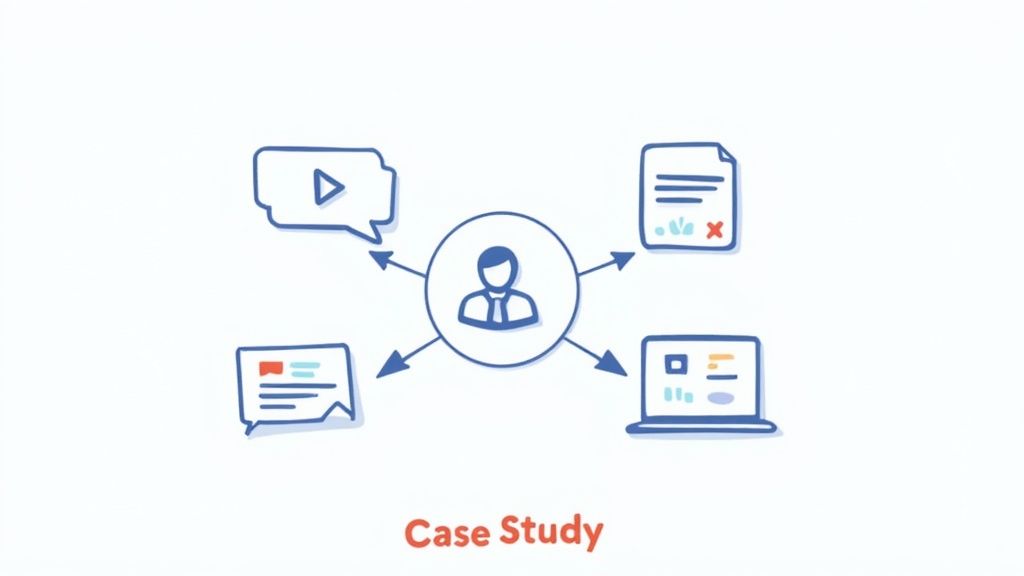
This isn’t about simply copying and pasting testimonials. It’s about strategically extracting key elements for different channels. One of my clients achieved a 250% ROI, which we documented in a detailed case study. That single PDF became a 60-second video testimonial, 5 different quote graphics for social media, and a key slide in our sales deck. The social posts alone drove 15 qualified leads in one month.
How to Implement This Strategy
- Identify the Core "Proof Points": Review your case study and pull out the 3-4 most impactful results. These are your core messages. Focus on quantifiable metrics like "reduced production time by 40%" or "increased lead generation by 150%."
- Create Platform-Specific Assets: Use the core proof points to create tailored content. A 60-second vertical video testimonial highlighting one key metric is perfect for LinkedIn or Instagram Stories. A static quote graphic with the customer's headshot and a powerful statistic works well for Twitter and Facebook. An email that tells a brief version of the customer’s success story can be highly effective in a nurture sequence.
- Integrate Into Sales and Marketing: Equip your sales team with a slide deck featuring the best quotes and results from multiple case studies. Embed short video testimonials on key landing pages to increase conversion rates. Always get written permission from the customer before using their story.
Why This Works
This strategy is effective because it surrounds potential buyers with social proof at every touchpoint. A prospect might see a video testimonial on LinkedIn, receive a targeted email with the same customer's story, and then see that story again in a sales presentation. This repeated exposure builds immense trust and validates your solution through a credible third-party voice. By atomizing a single case study, you create a library of high-impact assets that can accelerate the sales cycle without requiring new customer interviews for each piece of content.
7. Email Sequences to Blog Content and Social Posts
Another powerful content repurposing strategy involves unlocking the value hidden within your email campaigns. This approach transforms exclusive newsletter content or automated email sequences into durable, public-facing assets like blog posts and social media threads. It’s an excellent way to give your best email insights a second life, reach audiences beyond your subscriber list, and build significant SEO authority from content you've already perfected.
This isn’t about a simple copy-and-paste job. It’s about strategic adaptation. For example, Brian Dean of Backlinko often refines the concepts from his subscriber-only emails into comprehensive, evergreen guides that become pillars of his SEO strategy. Similarly, ConvertKit frequently publishes articles on its Creator Economy blog that originated as insightful emails to its user base, expanding on the original ideas with more data and examples for a broader audience.
How to Implement This Strategy
- Select High-Engagement Emails: Identify emails or sequences with the highest open and click-through rates. This data validates that the topic resonates with your core audience and is a strong candidate for public content.
- Expand and Add SEO Value: Convert the core message of the email into a blog post by adding more depth. Flesh out each point with detailed explanations, add relevant statistics, embed visuals, and optimize for target keywords. A 300-word email can easily become a 1,200-word blog post.
- Deconstruct for Social Media: Extract key quotes, statistics, or actionable tips from the email to create a multi-part social media series. A 5-part email course could become a 5-day LinkedIn post series or a Twitter thread, with each part driving engagement back to your newsletter or new blog post.
Why This Works
This method is highly efficient because it leverages content that has already been tested and validated by your most engaged audience segment: your email subscribers. By converting these proven concepts into blog posts, you make them discoverable by search engines, attracting new organic traffic. It also reinforces your expertise and provides another compelling reason for new visitors to subscribe, creating a virtuous cycle of audience growth. To master this, you can explore detailed guides on how to write a high-performing newsletter that is primed for repurposing from the start.
8. User-Generated Content Curation and Amplification
One of the most powerful content repurposing strategies doesn't involve your own content at all. Instead, it leverages the authentic voice of your audience by collecting, curating, and amplifying user-generated content (UGC). This approach transforms customer testimonials, reviews, and social media posts into a powerful marketing engine, building community and social proof simultaneously. It's the ultimate way to let your happiest customers become your most effective storytellers.
This isn't just about reposting a nice comment. It’s about building a system to celebrate your community. For example, GoPro's entire marketing model is built on featuring stunning adventure videos shot by its users. Similarly, the cosmetics brand Glossier populates its social feeds with photos from real customers, creating a more relatable and trustworthy brand image than traditional advertising ever could. The goal is to make your audience the hero of your brand's story.
How to Implement This Strategy
- Create a Collection System: Establish a clear and simple way for users to submit content. This could be a branded hashtag on Instagram (like a campaign), a submission portal on your website, or a dedicated email address. Make the guidelines clear and the process frictionless.
- Curate and Repurpose for Different Channels: Gather the best UGC and transform it into new assets. Compile five glowing customer reviews into a single "What Our Community is Saying" graphic for LinkedIn. Turn a customer's video testimonial into a short, impactful clip for Instagram Stories. Group user photos around a common theme for a gallery-style blog post.
- Always Ask for Permission and Give Credit: Before repurposing any content, reach out to the original creator for explicit permission. When you post, always tag their account and give them full credit in the caption. This not only protects you legally but also strengthens your relationship with your community members.
Why This Works
This strategy is effective because it taps into the power of social proof. Content from a real customer is often perceived as more authentic and trustworthy than branded content. It saves you significant time and resources on content creation while fostering a vibrant community around your brand. By systematically amplifying UGC, you create a virtuous cycle where more users are incentivized to share their experiences. It's also a fantastic way to gather qualitative data, and you can learn how to analyze content performance to see which types of UGC resonate most with your broader audience.
9. Industry Reports into Thought Leadership Articles
A powerful content repurposing strategy for establishing authority involves distilling dense industry reports into insightful thought leadership articles. This method takes comprehensive research, surveys, or data-heavy white papers and transforms them into accessible, opinion-driven pieces. It’s perfect for positioning your brand as a forward-thinking expert while making complex information digestible for a broader executive audience.
This isn’t about simply summarizing findings; it’s about interpreting them. For instance, Deloitte excels at converting its extensive industry research into pointed C-suite perspectives, and LinkedIn skillfully transforms its annual Workplace Learning Report into actionable commentary for HR leaders. The goal is to move beyond the "what" of the data and focus on the "so what" for your audience.
How to Implement This Strategy
- Identify a Narrative: Comb through your report and pinpoint the single most surprising, counterintuitive, or impactful finding. Build your entire article around this one core insight instead of trying to cover everything.
- Add Your Unique Perspective: Write an executive summary or opinion piece that doesn't just present data but offers a strong, forward-looking viewpoint. Frame it with a title like, “The One Trend in Our 2024 Report That Will Reshape Marketing.”
- Create Actionable Takeaways: Conclude with 3-5 clear, actionable recommendations based on the data. For example, if your report shows a rise in AI adoption, provide specific steps a manager should take this quarter to prepare their team.
Why This Works
This approach is one of the most effective content repurposing strategies because it turns a one-time research asset into a continuous source of high-value content. By translating raw data into strategic insights, you attract a senior-level audience and build significant credibility. Each thought leadership article serves as a gateway, driving qualified traffic back to the original, more comprehensive report and positioning your organization as an indispensable industry resource.
10. Product Documentation into Tutorial and Educational Content
Many SaaS and tech companies sit on a goldmine of untapped content: their own product documentation. This strategy involves transforming dense help articles, technical guides, and FAQs into user-friendly tutorials, how-to videos, and educational courses. It’s a powerful method for making complex information accessible, onboarding new users, and demonstrating your product's value to potential customers.
This isn't about simply copying and pasting technical jargon. It's about translating features into benefits. For instance, Zapier excels at turning its integration guides into practical blog posts and tutorials that solve specific user problems. Similarly, Notion’s extensive documentation is often repurposed by creators and the company itself into engaging courses on building a "second brain" or managing projects, showcasing real-world applications.
How to Implement This Strategy
- Identify High-Demand Topics: Analyze your support tickets and customer questions. What features are users most confused about or asking for help with? Start by creating tutorials for the top 3-5 most requested functions.
- Create Multi-Format Tutorials: Convert a single, complex help document into multiple assets. Create a short, animated video explaining a core feature for social media, a step-by-step blog post with screenshots for your website, and a more in-depth webinar for advanced users.
- Focus on Use Cases, Not Just Functions: Don’t just explain what a button does. Show users why they should use it. Frame tutorials around real-world scenarios, like "How to Manage Your Freelance Invoices with Our Tool" instead of just "A Guide to the Invoicing Feature."
Why This Works
This approach is one of the most efficient content repurposing strategies because the foundational research and technical accuracy are already established. By turning internal documentation outward, you create high-value marketing assets that directly address user pain points, reduce customer support load, and improve product adoption. This educational content builds authority and trust, turning your help center into a powerful engine for customer acquisition and retention.
Top 10 Content Repurposing Strategies Comparison
| Strategy | Implementation Complexity 🔄 | Resource Requirements ⚡ | Expected Outcomes ⭐📊 | Ideal Use Cases 💡 | Key Advantages ⭐ |
|---|---|---|---|---|---|
| Blog Post to Video Content | 🔄 High — scripting, filming, editing | ⚡ High — camera, editing, motion/graphics | ⭐📊 Strong engagement & reach; better video SEO | Repurposing flagship articles for YouTube/TikTok/Reels | Visual retention; multi-platform content |
| Podcast to Blog and Social Media | 🔄 Medium — transcription + heavy editing | ⚡ Moderate — transcription tools, editor, designer | ⭐📊 Improved accessibility, SEO, multiple social assets | Interview shows or long-form conversations | Makes audio discoverable; creates shareable snippets |
| Long-Form Content to Micro-Content Series | 🔄 Medium — segmentation & narrative planning | ⚡ Low–Moderate — design templates, scheduling tools | ⭐📊 Higher posting frequency; sustained engagement | Evergreen guides, whitepapers for social series | Extends content life; consistent audience touchpoints |
| Webinar to Multiple Content Assets | 🔄 High — editing, clipping, repackaging | ⚡ High — video editors, designers, email/CRM tools | ⭐📊 Strong ROI: lead gen, nurture sequences, retargeting | Product demos, trainings, B2B thought sessions | Converts one event into full-funnel assets |
| Data & Research into Infographics & Reports | 🔄 High — analysis + visualization skill | ⚡ High — analysts, designers, BI tools | ⭐📊 Authority-building; high shareability & backlinks | Industry studies, benchmarking reports | Clarifies complex data; drives citations |
| Customer Case Studies to Multiple Formats | 🔄 Medium — interviews, approvals, editing | ⚡ Moderate — production, legal/release management | ⭐📊 High credibility; conversion and trust lift | Sales enablement, product pages, testimonial campaigns | Authentic social proof across buyer journey |
| Email Sequences to Blog Content & Social Posts | 🔄 Low–Medium — expand & rewrite for long-form | ⚡ Low — writers, CMS, basic design | ⭐📊 Improved SEO and reach; repurposes subscriber content | Newsletter courses, drip content to public guides | Leverages existing work for quick content gains |
| User-Generated Content Curation & Amplification | 🔄 Medium — collection, verification, rights | ⚡ Low–Moderate — community tools, moderation | ⭐📊 High authenticity; increased engagement & trust | Consumer brands, campaigns driven by communities | Cost-effective content; builds loyalty and advocacy |
| Industry Reports into Thought Leadership Articles | 🔄 High — deep analysis and expert writing | ⚡ High — researchers, SMEs, editorial resources | ⭐📊 Positions brand as authority; media/analyst interest | B2B strategy, executive audiences, conferences | High-value PR and speaking opportunities |
| Product Documentation into Tutorial & Educational Content | 🔄 Medium — simplify + produce tutorials | ⚡ Moderate — product experts, video/UX resources | ⭐📊 Reduces support tickets; improves onboarding & adoption | SaaS onboarding, customer training, help centers | Lowers support burden; drives product usage |
My 90-Day Results and Your Path to Escaping the Content Treadmill
For a long time, my content creation process felt like a treadmill. I would run as hard as I could, publishing article after article, only to find myself in the exact same spot a week later, staring at a blank page. The audience growth was stagnant, the engagement was flat, and the effort felt entirely disproportionate to the reward. I was creating more content than ever but reaching fewer new people. This "content treadmill" is a draining, unsustainable cycle that burns out even the most dedicated writers and creators.
So, 90 days ago, I committed to a radical experiment. Instead of focusing on more creation, I shifted my energy entirely to smarter distribution by implementing the ten content repurposing strategies we've just walked through. The goal wasn't just to work less; it was to make every single piece of content work harder for me. The results weren't just encouraging; they were transformative.
The 90-Day Transformation: A Look at the Numbers
After just three months of systematically applying these strategies, my metrics shifted dramatically. My Substack newsletter, which had been growing at a slow trickle, saw a 312% increase in subscribers. My LinkedIn engagement, measured by comments and shares, was up 5x, and my profile views increased by 220%. I wasn't just recycling content; I was creating a distribution ecosystem where each piece amplified the others.
The most critical change, however, wasn't in the analytics. It was in my schedule. The time I spent on the "content treadmill" creating net-new content dropped by nearly 60%. I reinvested that time into engaging with my community, refining my core ideas, and, most importantly, avoiding burnout.
Key Takeaway: The path to audience growth isn't always about creating more; it's about making your existing content more visible, accessible, and versatile. Mastering a few powerful content repurposing strategies is the single most effective way to multiply your impact without multiplying your effort.
Your Action Plan to Break the Cycle
You've now seen the exact frameworks I used. From turning a single blog post into a video script and a dozen social media snippets, to converting a webinar into an entire content library, the potential is immense. But knowing is not the same as doing. The real challenge is integrating these workflows into your routine without adding a new layer of manual, tedious work.
Here’s your path forward:
- Choose Your "Pillar" Piece: Don't try to repurpose everything at once. Select one high-performing blog post, podcast episode, or research report from your archives. This is your starting point.
- Pick Two Repurposing Strategies: From the list above, select just two strategies to test. Maybe it's turning that blog post into a LinkedIn carousel and a short-form video for Reels. Start small and manageable.
- Find Your Automation Engine: This is the non-negotiable step. Manually reformatting, scheduling, and tracking repurposed content is the fastest way to abandon the strategy. The 90+ minutes I used to spend manually copy-pasting an article to Substack, Medium, Ghost, and LinkedIn now takes less than five. This efficiency was only possible by using an automation tool designed for this exact purpose.
The content treadmill is powered by the belief that your next piece of content will be the one that finally breaks through. But the truth is, the breakthrough often lies hidden within the content you've already created. By unlocking its potential, you don't just find a new audience; you build a sustainable system for growth that respects your time and energy. You get to step off the wheel and start building real momentum.
The engine behind my 90-day experiment was Narrareach. It allowed me to escape the manual drudgery of reformatting and scheduling by automating the entire cross-posting process. It’s how I efficiently published my posts and notes on Substack, LinkedIn, and Medium to grow faster. If you’re serious about implementing these content repurposing strategies without adding hours of busywork, it’s the fastest way to get your content everywhere your audience is.
Ready to escape the content treadmill?
- High-Intent: Start your free Narrareach trial and publish your next article to Substack, Medium, and LinkedIn in one click. Stop the manual copy-paste and start growing faster. No credit card required.
- Low-Intent: Not ready yet? Join our free newsletter for writers and get one actionable audience growth tip delivered to your inbox each week.