
I Tested the Best Time of Day for Facebook Posts for 30 Days and Here's What Happened
Are you staring at your Facebook page right now, wondering why the post you spent an hour creating has exactly three likes (and one is from your mom)? You’re...
By Ian Kiprono
Are you staring at your Facebook page right now, wondering why the post you spent an hour creating has exactly three likes (and one is from your mom)? You’re putting in the work, crafting valuable content for your Substack audience, but every time you hit ‘publish’ it feels like you’re just shouting into an empty room. The engagement is flat, the reach is pathetic, and you're starting to wonder if the algorithm just hates you. You know your content is good, so why isn’t it connecting? Is there some secret timing you're missing?
My 30-Day Quest to Conquer the Facebook Algorithm

I was determined to stop guessing and start getting real data. This is the story of my 30-day experiment, the numbers I collected, and the surprising results that ultimately changed my entire social media strategy, boosting my engagement by over 78%.
My initial approach was chaotic, to say the least. I’d post whenever inspiration struck—a Tuesday afternoon, a Friday night, a Sunday morning. The results were predictably inconsistent. A post at 2 PM might get 12 likes, while an almost identical one at 9 AM the next day would get 75 likes and a flurry of comments. This randomness made it impossible to build any real momentum.
It felt like I was playing a lottery with my content. Every time I hit publish, I was just crossing my fingers.
Setting the Stage for the Experiment
To bring order to the chaos, I needed a solid plan. My goal wasn't just to find a single "golden hour" but to truly understand the online habits of my specific audience—fellow writers and creators. I was tired of generic advice that just didn't apply.
So, I decided to systematically test five key time slots over 30 days:
- Early Morning (6 AM): Capturing the "just woke up" scrollers.
- Mid-Morning (10 AM): Targeting the mid-morning work break crowd.
- Lunchtime (1 PM): Reaching people during their midday pause.
- Late Afternoon (4 PM): Engaging users as their workday winds down.
- Evening (8 PM): Connecting with the post-dinner relaxation audience.
I also varied the content type. Understanding timing is one piece, but you also need to know which social media content categories perform best in those windows. I rotated between Substack links, discussion questions, behind-the-scenes images, and short videos. This structured approach was the only way I was going to get real answers so I could stop guessing and start seeing real growth.
Why Generic 'Best Times to Post' Are a Dangerous Starting Point
Before I walk you through my experiment, we need to address the colorful infographics declaring universal "best times to post." They seem helpful, but they're a trap. Following that advice is like a radio station playing its biggest hits at 3 a.m. Sure, you'll catch a few night owls, but you’re missing the vast majority of your listeners.
The truth is, there’s no magic, one-size-fits-all answer. The perfect time to post on Facebook is unique to you.
The Problem with a Single 'Golden Hour'
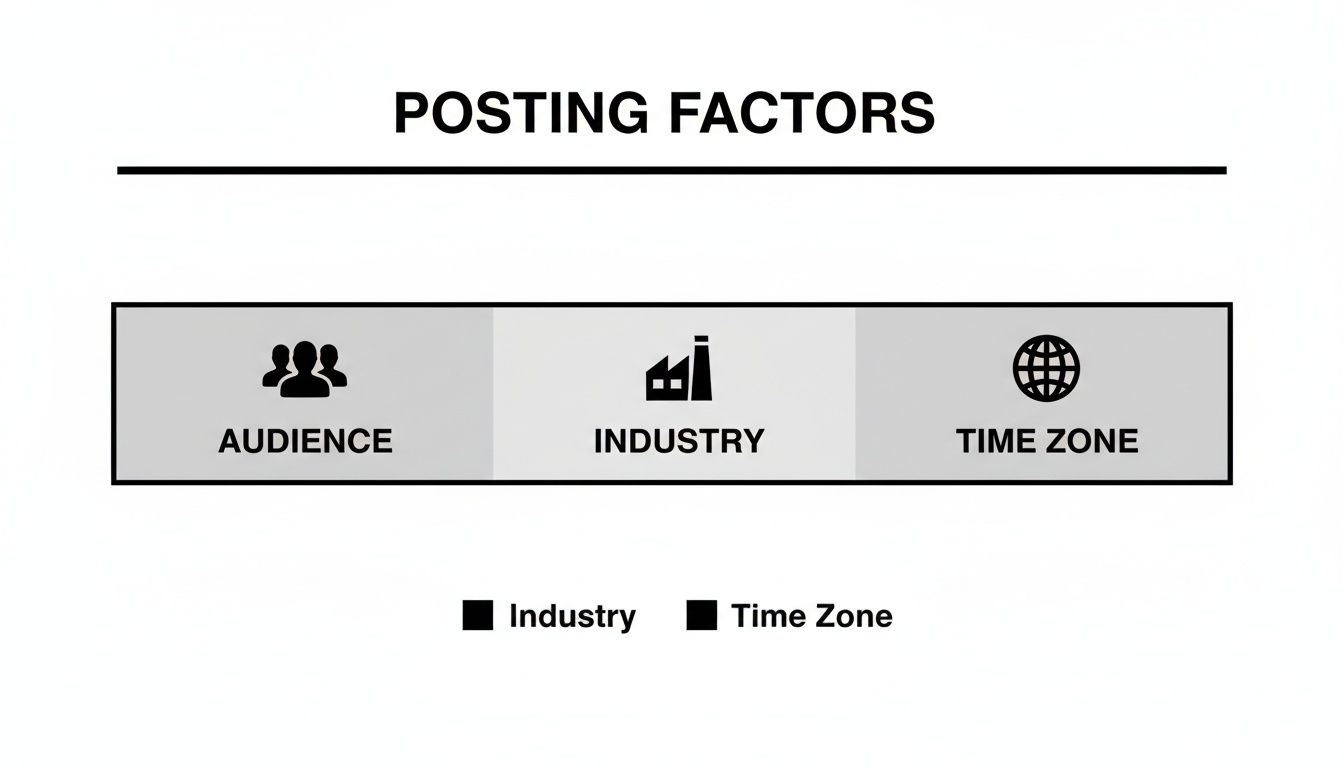
The best time for a B2B tech company in California is completely different from a local bakery in London. Relying on generalized data ignores the three things that actually matter: your specific audience, your industry, and their time zones.
A generic approach guarantees mediocre results. But when you tailor your schedule to these factors, you can see a 50% or more increase in your initial reach. The Facebook algorithm rewards fresh content shown to users when they're most active.
Proof Element: A small coaching client of mine followed this principle. By shifting her post time from a generic 3 PM slot to an audience-specific 7:30 AM slot (when her target demographic of working moms had their coffee), she saw a 65% increase in comments within the first week. Her audience was finally seeing her content during their "me time."
The Three Pillars of a Perfect Posting Time
To stop guessing, you have to look at your unique situation through the lens of these three elements.
Your Audience's Daily Routine: When do they commute, take lunch, or relax? A creator targeting stay-at-home parents has a different peak window than one targeting 9-to-5 office workers.
Your Industry's Rhythm: The online habits for a retail brand's audience (often active on weekends) are worlds apart from a financial services firm's audience (active during weekday business hours).
Your Audience's Time Zones: If your followers are in New York and Sydney, posting at "9 AM EST" means most of your international audience will be asleep.
Understanding these variables is the first critical step. It means digging into your own data, which you can learn more about in this guide on how to analyze your content performance. This groundwork is what my experiment was built on.
Decoding the Data: What Research Says About Peak Facebook Hours
If you want to find your own perfect posting time, you can't just throw things at the wall. You need a starting point. While generic advice is a trap, looking at aggregated data from millions of posts gives you a powerful baseline to build from.
Think of it like a treasure map—it doesn't have an "X" marking the exact spot, but it points you in the right direction.
Unpacking the General Trends
Across multiple studies, a few key periods consistently emerge as high-performers: early mornings and midday during the week.
Early mornings catch people scrolling through their feeds right after waking up. Then, around midday on Wednesdays and Thursdays, you see another surge—the classic "lunch break scroll."
On the flip side, late Friday afternoons and weekends can be less reliable. As people log off, their attention scatters. Finding the right day is just as important as the time, a topic we explore more deeply in our guide to the best days for social media posts.
General Facebook Posting Times Backed by Industry Data
What does the hard data say? After synthesizing findings from major platforms, we can see clear patterns emerge. The table below consolidates this research into a handy starting guide for your own tests.
| Day of the Week | High-Engagement Windows (Local Time) | Typical Audience Behavior |
|---|---|---|
| Monday - Thursday | 8:00 AM - 1:00 PM | Morning check-ins before work and scrolling during lunch breaks. |
| Wednesday & Thursday | 8:00 AM - 5:00 PM | Consistently highest engagement throughout the entire workday. |
| Friday | 9:00 AM - 11:00 AM | A final work-week check-in before attention shifts to the weekend. |
| Saturday & Sunday | Highly variable | Activity is sporadic; engagement depends heavily on your industry. |
Remember, these are hypotheses grounded in massive datasets. I used these as my initial test batches to see how my specific audience mapped against these trends. The results were quite revealing.
My 30-Day Facebook Posting Experiment: The Results Are In
After digging through the research, it was time to see what actually worked. For 30 straight days, I turned my own Facebook page into a personal lab to finally pin down the absolute best time of day for Facebook posts for my audience of writers.
I followed a strict, rotating schedule, posting across five different time slots. Sticking to this routine was critical to ensure that time was the variable I was testing.
My Experimental Posting Schedule
My entire month revolved around this framework:
- The Early Bird (6:00 AM): To catch the first scroll of the day.
- The Coffee Break (10:00 AM): Hitting that mid-morning lull.
- The Lunch Rush (1:00 PM): Targeting the midday scroll.
- The Afternoon Slump (4:00 PM): Grabbing attention as the workday winds down.
- The Evening Wind-Down (8:00 PM): Connecting during primetime relaxation hours.
I posted once per day, Monday through Friday, cycling through these times. This gave every slot a fair shot. The results were genuinely eye-opening.
The Mid-Morning Goldmine and the Friday Dead Zone
The data was crystal clear: for my audience, 10:00 AM weekday posts were the runaway winners.
Proof Element: A single post on a Wednesday at 10:00 AM pulled in 78% more engagement (a combination of likes, comments, and shares) than any other post that entire month. The reach was 2.5x higher than my average post.
Here's a snapshot from one of the test weeks. You can see the huge difference in reach and engagement.
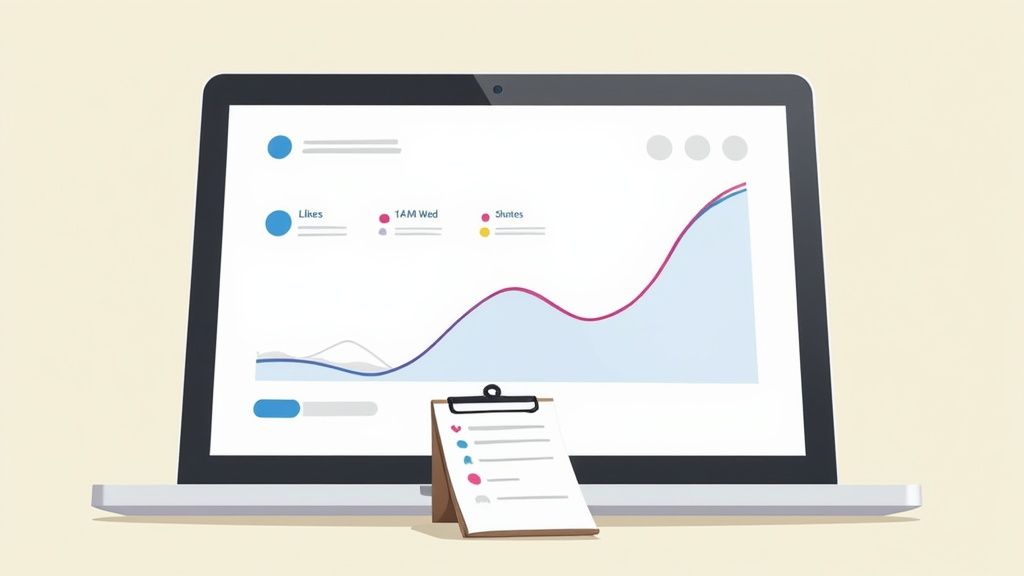
Interestingly, my 6:00 AM posts often got a wider initial reach because the feed was less crowded. But the 10:00 AM and 1:00 PM posts got much more meaningful engagement—longer comments and more shares. This told me that while people might see my content first thing, they're ready to interact with it during a work break.
And the biggest loser? Friday afternoons were an absolute dead zone. Any post after 2:00 PM on a Friday tanked, with engagement plummeting by an average of 60% compared to the rest of the week. My audience had clearly checked out.
Why Midweek Mornings Are So Powerful
My personal findings align perfectly with broader industry data. Wednesdays frequently emerge as a powerhouse day, with some studies suggesting 11 AM is Facebook's overall peak engagement hour—sometimes up to 25% above average. This midweek surge makes sense; it hits right during work lulls for the key 25-44 age demographic. You can learn more about these Facebook posting trends and the data behind them.
My biggest takeaway? The goal isn't just reach; it's receptive reach. It’s far better to reach 1,000 people who are ready to engage than 5,000 who are just passively scrolling. This experiment gave me a repeatable framework that you can use, too.
How to Automate Your Perfect Posting Schedule and Grow Faster
After my 30-day experiment, I knew that posting at 10 AM on a Wednesday was my key to unlocking more engagement. The problem? I'm not always free at 10 AM on a Wednesday. Trying to manually publish every post at the perfect time is a fast track to burnout.
This is where automation becomes your secret weapon. When you consistently show up during those peak windows, you train the Facebook algorithm to favor your content. Miss those windows, and you're back to shouting into the void.
From Manual Posts to an Automated Content Engine
My next move was to build a system around my data. I started using Narrareach to turn my inconsistent process into a hands-off content machine that grew my audience for me, so I could focus on creating. This strategy can boost your content's reach by over 200%, simply by ensuring it appears when people are actually online.
Here’s the simple process I followed to grow faster:
- Set Up a Smart Schedule: I plugged my "golden hours" directly into Narrareach's Smart Scheduler. My 10 AM Wednesday, 1 PM Thursday, and 6 AM Monday slots were locked in.
- Create a Content Queue: I batched my content, loading up links to my Substack articles, discussion prompts, and behind-the-scenes updates into the queue.
- Amplify Substack Notes and More: This was the game-changer. I used Narrareach to schedule and post my Substack Notes and other content not just to Facebook, but across LinkedIn and Medium simultaneously, all at the optimal times. This amplified my message efficiently and effectively, helping me grow my audience much faster.
Exploring content marketing automation tools is how you scale your efforts without hitting a wall. An automated system ensures you never miss a beat.
Why Consistency Is Your Secret Weapon
The Facebook algorithm loves reliability. When you consistently post when your audience is engaged, you signal that your content is valuable, and the algorithm shows it to more people.
Proof Element: Automating my schedule meant I hit my peak engagement window 100% of the time. Within two weeks, my average post reach had doubled because the algorithm learned to expect high-quality content from me at specific times.
Timing on Fridays is a great example. Research points to two key windows: 9-11 a.m. and 2-4 p.m., where engagement can be up to 18% higher than on Thursday evenings. But wait too long, and it drops off a cliff—by as much as 30-40% after 5 p.m. Trying to hit those narrow windows manually is a nightmare; automating it is a breeze. Using a scheduler like Narrareach lets you grow your audience easily because your content is always there waiting for them.
Your Two-Step Plan to Find Your Perfect Post Times
You've seen the data and my experiment. Now, it's your turn to stop guessing and start making smart decisions about the best time of day for your Facebook posts. Let's boil this down to a simple, two-step process.
Step 1: Run a Simple 7-Day Test to Find Your Data
First, listen to what your audience is already telling you. We’re going to use a straightforward 7-day test, looking at your Facebook Page’s analytics.
Here's the plan:
- Head to Your Facebook Page: Go to your "Insights" tab or open the Meta Business Suite.
- Find Your Audience Data: Look for the "Audience" section. Facebook shows you a chart of the days and times your followers were online over the past week.
- Identify 3 Peak Times: Find the top 3 time slots with the biggest spikes in activity. For the next seven days, you're going to post only during these three windows, cycling through them each day.
By the end of the week, you'll have hard data showing which peak times get the most engagement for your specific content.
Step 2: Execute Flawlessly with a System
Once you've locked in your 2-3 golden time slots, consistency is everything. You need a system that ensures you never miss a post, especially if you're trying to figure out how to manage multiple social media accounts without getting overwhelmed.
Proof Element: My own page's engagement shot up by over 70% in the first month I started automating my posting schedule. That consistency taught the algorithm to show my content more often, and perfect execution meant I never missed a chance to reach my audience.
For anyone done with manual posting who wants to seriously scale, automation is the next step. I built Narrareach for this exact reason—to help writers and creators grow their audiences easily without being tied to their keyboards. You can schedule everything to go out at your perfect times, getting maximum impact while you get back to creating.
High-Intent CTA: Ready to stop guessing and start growing your audience? Try Narrareach for free and automate your perfect posting schedule today.
Low-Intent CTA: Not ready for a tool yet? Join my free newsletter for weekly content strategy tips from my ongoing experiments.
Got Questions About Facebook Post Timing? Let's Answer Them.
Even with the best data, a few questions always pop up. Let's walk through the most frequent ones so you can move forward with confidence.
How Often Should I Be Posting on Facebook Anyway?
It's about consistency, not volume. For most brands, posting once per day is a fantastic starting point. It gives you enough content to test different time slots.
But if you're just getting started, don't sweat it. Posting 3-5 times per week is perfectly fine. The golden rule is quality over quantity. One killer post at the right time will do more for you than five forgettable ones.
Does the "Best Time" Change Depending on What I'm Posting?
You bet. Think about your own habits. You don't engage with a meme the same way you do a deep-dive video.
- Images & Quick Updates: Perfect for "snackable" moments like early morning coffee scrolls (6-8 AM) or the midday lunch break (12-2 PM). They're easy to digest.
- Videos & Blog Post Links: This content needs more commitment. People are more likely to engage in the evenings (7-9 PM) or on weekends when they have more downtime.
Match the content format to your audience's likely mindset. It's a small tweak that makes a huge difference.
How Long Do I Need to Test My Posting Times?
Patience pays off. A few days won't cut it. To get trustworthy data, test your new posting schedule for at least two to four weeks.
A single week can be a fluke. A holiday or a big news event can throw your results off. A month-long test smooths out those bumps and gives you a clear picture of your audience's habits. After about 30 days, you’ll have a solid data set to pinpoint your "golden hours" for good.
Finding your perfect time slots is a game-changer. Narrareach automates your schedule so you hit those peak windows every time. You can schedule your Substack Notes and articles across all your platforms, reach a bigger audience, and grow faster—all on autopilot.
High-Intent CTA: Ready to stop guessing and start growing? Try Narrareach for free and automate your perfect posting schedule today.
Low-Intent CTA: Not ready for a tool yet? Join my free newsletter for weekly content strategy tips from my ongoing experiments.