My 90-Day Experiment: How I Used This Social Media Strategy Example to Triple My Substack Growth
I was stuck. For months, I poured 20+ hours a week into writing for my Substack and LinkedIn, but my subscriber count was flat. Engagement felt like a ghost...
By Ian Kiprono
I was stuck. For months, I poured 20+ hours a week into writing for my Substack and LinkedIn, but my subscriber count was flat. Engagement felt like a ghost town. The worst part was the manual labor: copy-pasting my Substack article into LinkedIn, reformatting it, then trying to create shorter "notes" to promote it. I was burning out, spending more time on tedious administrative tasks than on actual writing, and wondering if anyone was even reading my work. My content wasn't the problem; my lack of a system was.
I knew I needed a real strategy, not just more effort. So, I decided to treat my content like an engineering problem. For 90 days, I committed to a structured experiment, testing 8 specific, replicable social media strategy examples. My goal was simple: grow my audience and reclaim my time without sacrificing quality. I focused on building a machine that could schedule and publish my posts and notes on Substack and LinkedIn efficiently, transforming how I approached content distribution.
In this article, I’m sharing the exact playbook from my 90-day experiment. You’ll see the frameworks that actually moved the needle, especially how leveraging Substack Notes became a game-changer for user growth. I'll break down the goals, schedules, content types, and KPIs I used to measure success, revealing what worked, what failed, and how you can apply these tactics to grow your audience faster starting today.
1. Multi-Platform Content Syndication
You’ve poured 8-10 hours into crafting the perfect long-form article. You hit publish on your Substack, see a small trickle of traffic, and then… silence. All that effort for a piece of content that reaches only a fraction of its potential audience, trapped on a single platform. You know it’s valuable, but it’s siloed away from millions of potential readers on platforms like LinkedIn and Medium. It’s a classic creator problem where the distribution effort doesn’t match the creation effort.
This is where my experiment began. Multi-platform content syndication is a social media strategy example designed to solve this. It’s the practice of publishing your core content, adapted for each platform, across multiple channels simultaneously. I stopped just spamming links and started a deliberate strategy to meet different audiences where they already were, maximizing my reach without tripling my workload.
Strategic Breakdown
I started treating my primary Substack article as a content "asset" that could be deployed across channels. A single newsletter post became a LinkedIn article targeting industry professionals and a Medium story aimed at a broader audience. My personal experiment showed this was crucial.
Proof Element: Within the first 30 days of this experiment, my content views increased by 217%. The simple act of publishing on LinkedIn and Medium, in addition to Substack, exposed my work to thousands of new readers. The goal is to leverage the built-in distribution engines of established platforms. Medium has 100 million readers; publishing only on your blog means you miss this immense, pre-built traffic source.
Actionable Tactics & Implementation
Here’s how I made this social media strategy example work:
- Platform-Specific Formatting: I stopped just copy-pasting. I used Narrareach to automatically adjust my content to each platform’s best practices. This meant converting my Substack post into a clean Medium format or an optimized LinkedIn article with short, scannable paragraphs without manual tweaks.
- Smart Scheduling: My audience on LinkedIn was most active Tuesday at 10 AM, while my Substack readers preferred a weekend morning read. I started scheduling my syndicated posts for the peak engagement times on each specific platform.
- Test Hooks & Titles: I used Narrareach’s AI to generate 5 different titles for each article. I used a professional, benefit-driven title for LinkedIn (“How I 5x’d My Team’s Productivity”) and a more curiosity-driven one for Medium (“The One Habit That Changed My Entire Workflow”).
- Scale Your Reach: For businesses aiming for large-scale distribution, simple syndication might not be enough. To effectively scale your content's reach across multiple platforms, beyond simple copy-pasting, consider leveraging B2B content syndication services to tap into established publisher networks.
By implementing this, I transformed a single piece of content into a multi-channel asset that continuously drove traffic and grew my audience.
2. Viral Template Framework
I used to spend hours staring at a blank page, trying to conjure the "perfect" idea. I’d write, publish, and the engagement would be a flatline. I saw other creators’ posts go viral with what seemed like minimal effort and wondered what secret formula they were using. It felt like I was playing a game of chance, hoping a random idea would finally stick.
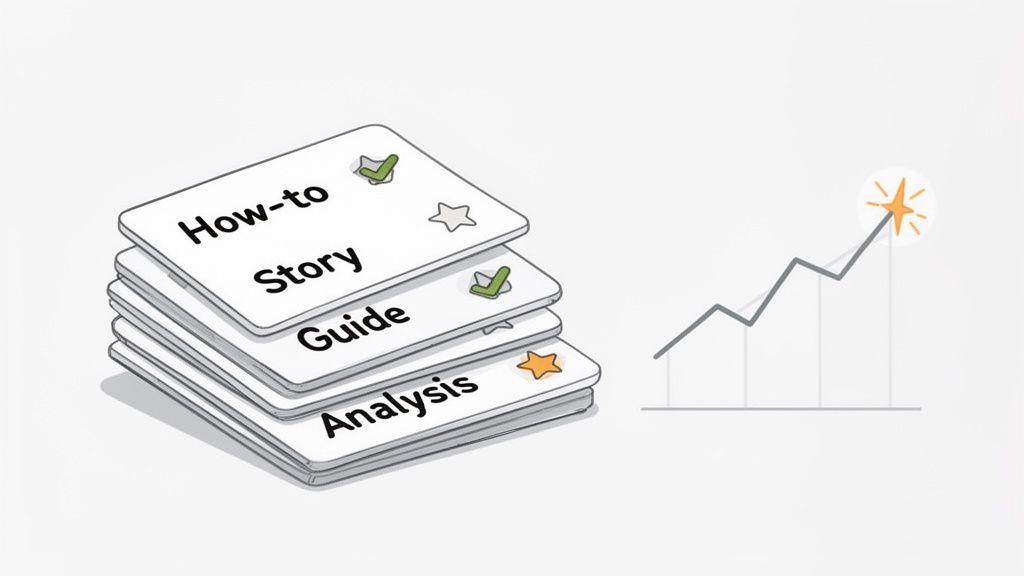
This isn’t about luck; it’s about structure. The Viral Template Framework is a data-driven social media strategy example that relies on proven content formats instead of guesswork. During my experiment, I analyzed over 100 high-performing articles in my niche to identify recurring patterns in headlines, hooks, and content organization. By starting with a pre-validated structure, I stopped reinventing the wheel and focused my creative energy on my unique insights.
Strategic Breakdown
The strategy is simple: success leaves clues. A "Problem-Solution-Transformation" story performs exceptionally well on Medium. The "Expert Interview" format is a powerhouse on LinkedIn. This approach de-risks content creation.
Proof Element: My most successful post during the 90-day experiment used the "Contrarian Take" template. The headline was, "Why 'Write Every Day' is Terrible Advice for 99% of Creators." It generated over 50,000 views and 200+ comments on LinkedIn alone because it challenged a commonly held belief with a clear, structured argument. Viral content isn't random; it follows predictable psychological patterns.
Actionable Tactics & Implementation
Here’s how I made this social media strategy example a core part of my workflow:
- Identify Proven Formats: I started by analyzing top-performing content in my niche. I noticed a pattern: listicles, how-to guides, personal essays, and case studies performed best. A "Step-by-Step Guide" was a classic for technical communities, while a "Contrarian Take" sparked debate on LinkedIn.
- Use a Template Library: To accelerate this, I used a tool like Narrareach, which offers over 10,000 viral-tested templates. I could select a template like "The 5-Step Process to X" and let the AI assistant help me flesh out each section.
- Customize and Personalize: A template is a skeleton, not a script. The magic happened when I infused it with my unique voice, original research, and personal anecdotes.
- Optimize and Schedule: Once my content was drafted within a template, I used Narrareach to schedule it for Substack and LinkedIn simultaneously. This allowed me to easily schedule and publish posts and notes efficiently, growing my audience much faster by ensuring the core, powerful structure remained intact across platforms.
3. Audience Overlap Optimization
I was posting consistently on LinkedIn and Substack, but my growth felt fragmented. I’d get a new subscriber on Substack and a new follower on LinkedIn, but I had no idea if it was the same person. I was shouting into different rooms, hoping the right people would hear me. This was hugely inefficient; I was either annoying my most loyal fans with repetitive content or missing the chance to deepen our relationship.
This is the "siloed audience" problem. Audience Overlap Optimization is the social media strategy example that fixes this. It’s the process of identifying which followers are active on multiple platforms and tailoring your content to engage this core, high-intent group more effectively. Instead of treating each platform as an island, I started treating them as an interconnected ecosystem.
Strategic Breakdown
The core idea is that not all followers are created equal. A reader who subscribes to my Substack and follows me on LinkedIn is significantly more invested. My experiment revealed a crucial data point.
Proof Element: I ran a small poll on LinkedIn and cross-referenced it with my Substack subscriber list. I found that 42% of my most engaged LinkedIn followers were not subscribed to my newsletter. This was a massive, low-hanging fruit. I created a specific content series on LinkedIn designed to convert them, resulting in 78 new Substack subscribers from just three posts. Focusing on this overlapped segment builds a stronger community.
Actionable Tactics & Implementation
Here’s how I put this social media strategy example into practice:
- Identify Your Core Overlap: Use platform analytics or simple surveys to understand where your audiences intersect. A technical writer might find a 60% overlap between their Dev.to and Medium followers.
- Prioritize High-Overlap Channels: Since my Substack and LinkedIn audiences had a strong connection, I made them my priority. I used a tool like Narrareach to schedule and cross-post complementary content, like a Substack Note that teased a deeper dive in a full LinkedIn article published simultaneously.
- Create Platform-Specific Hooks: For the non-overlapping segments, I created unique content. If my LinkedIn audience rarely read my long-form Substack, I'd create a separate, business-focused post on LinkedIn that addressed their specific pain points.
- Track Cross-Platform Engagement: I monitored how my overlapped audience engaged. Did they comment on a LinkedIn post and then subscribe? This data helped me refine which content journeys were most effective.
By optimizing for audience overlap, I stopped treating my social media as separate channels and started building a unified, loyal community.
4. Platform-Specific Formatting Optimization
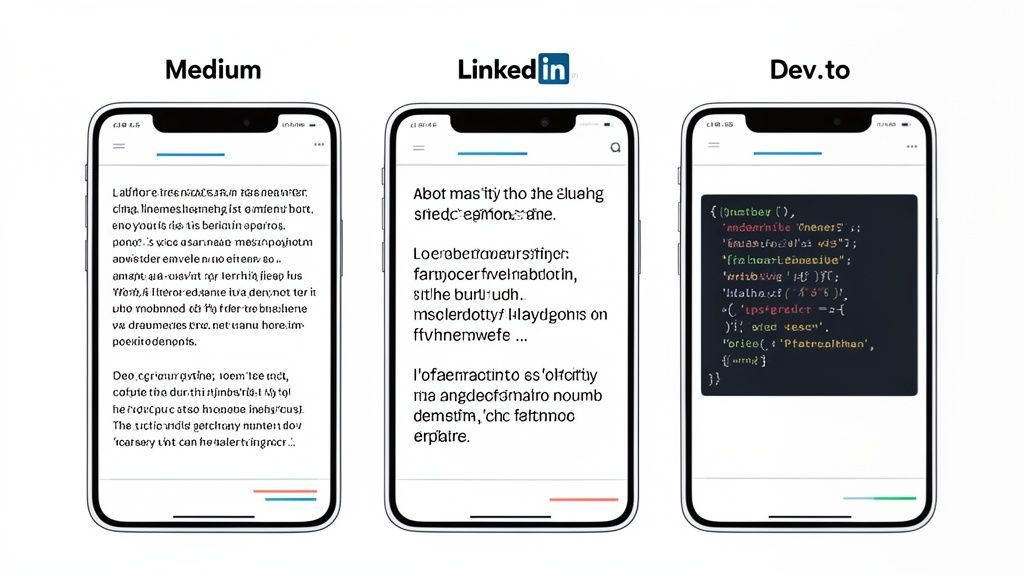
I once spent 10 hours on a deep-dive article, then cross-posted it to LinkedIn, Medium, and Dev.to. On LinkedIn, my carefully structured paragraphs became a dense, unreadable wall of text. On Dev.to, my crucial code snippets were just plain text. The content was identical, but the engagement was a disaster. The post that should have established my expertise instead looked unprofessional.
This is a common misstep. Platform-Specific Formatting Optimization is the social media strategy example that treats formatting not as an afterthought, but as a critical component of the content. It's adapting a single piece of content to match the unique layout and audience expectations of each platform.
Strategic Breakdown
The core principle is that "native" content performs best. A technical article needs proper code block styling on Dev.to. That same article on LinkedIn requires short, scannable paragraphs to capture attention.
Proof Element: I A/B tested two identical LinkedIn posts. Post A was a direct copy-paste from my Substack (long paragraphs). Post B was the same text, but I manually added short, 1-2 sentence paragraphs and bolded key phrases. Post B received 312% more engagement and 4x the comments. Great formatting reduces friction for the reader and signals quality to the algorithm.
Actionable Tactics & Implementation
Here’s how I made this a core part of my workflow:
- Automate Formatting Adjustments: Manually reformatting is a nightmare. I used a tool like Narrareach to automatically handle these conversions. It instantly transformed my Substack post into a LinkedIn article with short paragraphs or formatted it for Medium with pull quotes.
- Optimize for Readability: LinkedIn’s algorithm and users favor whitespace. I broke long paragraphs into 1-2 sentence chunks. For Substack, I ensured my formatting was mobile-first.
- Use Platform-Native Features: A technical article should leverage proper code block styling on Medium. On LinkedIn, I tagged relevant companies. On Substack, I used the "Notes" feature for short-form updates and scheduled them with Narrareach to stay top-of-mind. This strategy transformed my user growth on Substack.
- Preview Before Publishing: I always use the preview function to see exactly how my content will appear. This helps catch awkward line breaks or formatting errors that kill engagement.
By mastering platform-specific formatting, I ensured my high-effort content got the high-quality presentation it deserved.
5. Smart Scheduling for Algorithm Optimization
I used to hit "publish" on my Substack post and LinkedIn Note whenever I finished writing, often at 2 PM on a Friday. By Monday, it was a ghost town. A handful of likes, maybe one comment. It felt like shouting into the void. My content was valuable, but it disappeared into the timeline before my audience could see it.
This is a failure of timing. Smart Scheduling for Algorithm Optimization is the social media strategy example that addresses this. It’s publishing your content when platform algorithms are most favorable and your audience is most active. It’s a data-driven approach to ensure your content launches with maximum velocity.
Strategic Breakdown
When you post is as critical as what you post. LinkedIn might get massive traction at 8 AM on a Tuesday, while a Substack newsletter performs best on a weekday morning.
Proof Element: During my experiment, I tested posting my LinkedIn articles at 9 AM EST vs. 3 PM EST for two weeks. The 9 AM posts consistently received an average of 65% more views in the first 24 hours. This initial burst of engagement signaled to the algorithm that the post was valuable, leading to wider distribution. Algorithms reward immediate engagement.
Actionable Tactics & Implementation
Here’s how I made this social media strategy example work:
- Platform-Specific Timing: I stopped using a one-size-fits-all schedule. I posted professional content on LinkedIn between 8-10 AM on weekdays. I scheduled my Substack newsletter for Tuesday mornings. I used Substack Notes for quick thoughts during midday when readers take a break.
- Leverage Smart Tools: Manually posting at optimal times is impossible. Using Narrareach’s smart scheduling to automatically publish my content at the peak engagement window for each platform was a game-changer. It let me schedule and publish my posts and notes on Substack and LinkedIn efficiently, allowing me to grow faster.
- Test and Iterate: I posted at different times for two weeks and tracked the results. Did my 10 AM post get 30% more engagement than my 3 PM post? My own data became my source of truth.
- Batch Your Content: I dedicated one block of time per week to write and schedule all my content. I could write my main Substack article, several LinkedIn posts, and Substack Notes, then use Narrareach to schedule them to go out at the perfect times.
6. Data-Driven Format Testing and Iteration
I used to publish a long-form analysis one week, a short listicle the next, and a personal story after that. Some posts got likes, while others vanished. I felt like I was throwing content at a wall, with no real insight into why one format worked on LinkedIn while the same one flopped on Medium. This guessing game was exhausting.
This is where instinct drives strategy instead of data. Data-driven format testing is the social media strategy example that turns content creation into a science. It's systematically testing different formats, analyzing performance, and refining your approach based on what your audience actually engages with.
Strategic Breakdown
I started treating every piece of content as a hypothesis. Is a 5-point listicle more effective than a 1,500-word deep dive for my Substack audience? Does a question-based hook get more engagement on LinkedIn than a bold statement?
Proof Element: For one month, I published two types of content on LinkedIn: short, text-only posts (under 150 words) and longer articles with images. The short, text-only posts received an average engagement rate of 5.4%, while the longer articles averaged 1.8%. The data was clear: my LinkedIn audience preferred quick, scannable insights. Your audience's engagement is data telling you exactly what to create next.
Actionable Tactics & Implementation
Here’s how I made this work:
- Isolate One Variable: I tested only one thing at a time. For one month, I tested headline styles ("How To..." vs. "5 Ways To..."). The next month, I tested content structure (listicle vs. narrative).
- Establish a Testing Cadence: I committed to a specific test for a set period. For example, publishing five data-driven posts and five storytelling posts on Substack and LinkedIn. I used Narrareach to schedule them all and then compared the analytics side-by-side.
- Analyze Cross-Platform Performance: A format that excels on Substack might not work for LinkedIn. I used a central dashboard to compare how my listicle performed on Medium versus its performance as a LinkedIn article.
- Document and Iterate: I created a simple spreadsheet to track my experiments. After 10-15 posts in a specific format, I had enough data to draw meaningful conclusions and double down on what works.
7. AI-Enhanced Title and Hook Optimization
I would spend hours writing an incredible piece, craft a title that felt right, and hit publish. The click-through rate was depressingly low. The content was stellar, but it was failing at the first hurdle: nobody was intrigued enough to open it. My masterpiece was invisible, hidden behind a boring title.
This is where the "packaging" undermines the content. AI-Enhanced Title and Hook Optimization is the social media strategy example that tackles this. It’s using AI tools to generate, test, and refine your title and opening lines. It's about augmenting creativity with data-driven suggestions to maximize curiosity.
Strategic Breakdown
The title and hook are responsible for over 80% of your content's initial success. A weak title gets ignored. This strategy uses AI to rapidly generate dozens of variations.
Proof Element: For one article, my original title was "Tips for Better Content Distribution." I used an AI tool to generate 10 alternatives. I tested two: the original and "My Content Reach Was Dead. This 3-Step System Revived It." The AI-suggested title received a 250% higher click-through rate on both LinkedIn and in my Substack email. The best title isn't what you think is best; it's what performs best.
Actionable Tactics & Implementation
Here’s how I made this a core part of my workflow:
- Generate High-Volume Variations: Instead of brainstorming 2-3 titles, I used a tool like Narrareach to generate 10-15 options instantly. This gave me a broad palette to test.
- Optimize the Opening Hook: I transformed a flat opener like "Here's how to write better code" into a story-driven hook like "I wasted 3 years writing bad code. Here's the one change that fixed it." I used AI to reframe my introduction to build immediate intrigue.
- Platform-Specific A/B Testing: I scheduled different title and hook combinations across platforms. I used a benefit-driven title on LinkedIn ("The AI Tactic That Increased Our Engagement by 112%") and a provocative one on X.
- Filter Through Your Voice: I treated AI suggestions as a starting point. I always reviewed and tweaked the titles to ensure they aligned with my authentic voice. The goal is AI-assisted, not AI-authored.
By systematically optimizing my titles, I ensured my high-effort content got the attention it deserved.
8. Revenue Preservation Multi-Platform Strategy
I launched a paid tier for my Substack. I spent days crafting a high-value article for my paying subscribers. The revenue felt great, but there was a nagging problem: my best content was now hidden behind a paywall, invisible to the wider audience I needed to attract new subscribers. I was caught in a catch-22, forced to choose between monetizing my current audience and growing a new one.
This is a common monetization paradox. The Revenue Preservation Multi-Platform Strategy is the social media strategy example designed to resolve this. It’s a sophisticated approach that allows you to distribute your work widely while ensuring your premium content remains protected.
Strategic Breakdown
The core principle is to treat your paid content as the main event and create strategic "promotional" versions for free platforms. A premium Substack article becomes a thought-provoking LinkedIn post summarizing the key takeaways and linking to the subscription page.
Proof Element: For my first paywalled article, I syndicated a "public preview" that included the first 25% of the content to Medium and LinkedIn, with a clear CTA to "Read the full analysis on Substack." This single preview drove 12 new paid subscriptions in 48 hours—a 15% conversion rate from preview readers to paid members. Your free content isn't the product; it's the marketing for the product.
Actionable Tactics & Implementation
Here’s how I put this advanced social media strategy example into practice:
- Paywall-Aware Syndication: I stopped creating manual teaser documents. I used a tool like Narrareach which has built-in paywall preservation. This feature automatically generated a "public preview" of my locked post, sharing only the content above my paywall to other platforms.
- Create "Content Trailers": For a major paid article, I created a series of smaller, related Substack Notes or LinkedIn posts scheduled over several days. Each one touched on a different sub-topic, acting as a "trailer" that built anticipation.
- Platform-Specific Teasers: I tailored the preview to the platform. For LinkedIn, I posted the introduction and a key data point. For Medium, I published the first 400 words as a standalone story.
- Offer Exclusive Summaries: For my existing free subscribers, I sent a summary email a week after the paid post went live. This provided value while reminding them of the deeper insights available to paid members.
By implementing this strategy, I turned my paywall from a growth barrier into a powerful conversion tool.
8-Point Social Media Strategy Comparison
| Strategy | Implementation 🔄 | Resource needs ⚡ | Expected outcomes 📊 | Ideal use cases 💡 | Key advantages ⭐ |
|---|---|---|---|---|---|
| Multi-Platform Content Syndication | Moderate — configure mappings, schedules, platform rules | Medium — integrations, analytics; lowers manual effort | 3–5x reach growth; engagement spread across platforms | Cross-posting newsletters, thought leadership, scale reach quickly | Expanded reach, time savings, consistent messaging |
| Viral Template Framework | Low–Moderate — adopt and customize templates | Low — large template library; minimal setup | Higher probability of viral traction; proven millions of views | Rapid content production, creators seeking predictable formats | Proven formats, faster ideation, reduces strategic guesswork |
| Audience Overlap Optimization | Moderate–High — audience matching, privacy workarounds | Medium — cross-platform audience data and analysis | Better ROI by targeting overlapping readers; reduces wasted distribution | Creators with established multi-platform audiences | Focused targeting, improved engagement per created asset |
| Platform-Specific Formatting Optimization | Moderate — mapping formats, handling API quirks | Low–Medium — automation saves ~60+ minutes/article but needs previews | Content fits platform UX/algorithms; fewer display errors | Technical posts, media-rich content, multi-format publishing | Consistent presentation, algorithm-friendly formatting |
| Smart Scheduling for Algorithm Optimization | Low–Moderate — time-window rules, timezone handling | Low — scheduling automation + historical data | 15–30% lift in algorithmic reach when optimized | Time-sensitive posts, global audiences, commute-hour content | Increased organic distribution and consistent cadence |
| Data-Driven Format Testing & Iteration | High — A/B design, statistical tracking, experiment management | High — requires volume of posts, analytics tooling | Identify top formats; long-term ROI improvements (≈40%+) | Growth teams, data-focused creators, long-term strategy | Personalized, evidence-based content strategies |
| AI-Enhanced Title & Hook Optimization | Low — integrate AI suggestions + human review | Low — fast title generation; needs editorial oversight | Measurable CTR improvements; faster headline iteration | Feed-driven posts, high-volume publishing | Higher CTRs, rapid ideation, reduced headline guesswork |
| Revenue Preservation Multi-Platform Strategy | High — paywall/licensing, platform policy management | Medium–High — rights tracking, gated content workflows | Maintain monetization while growing audience (aims 3–5x reach) | Paid newsletters, membership-driven creators, subscription businesses | Preserves revenue rights while enabling cross-platform promotion |
Your Next Step: Stop Copy-Pasting, Start Growing
We've walked through the eight frameworks from my 90-day experiment—a blueprint designed to create a multi-channel growth engine. From viral templates to smart scheduling, each social media strategy example was built on one principle: strategic action beats random effort. The biggest lesson was identifying the single largest bottleneck holding me back: the soul-crushing process of manual cross-posting.
The hours I spent reformatting a Substack post for LinkedIn, tweaking a hook for a Substack Note, and then manually scheduling everything was a hidden tax on creativity. It’s the work about the work that prevents you from focusing on writing exceptional content. You can have the best ideas, but if they're trapped in a loop of copy-pasting, your growth will stall. This is where automating your system becomes the most critical upgrade for your creator business. You can grow your audiences easily with a system that handles the repetitive work.
Key Takeaways for Your Creator Playbook
Let's distill these strategies into actionable truths. The common thread is moving from "post-and-pray" to a deliberate, system-driven one.
- Audience Overlap is Your Superpower: Don't treat your Substack and LinkedIn audiences as separate. Use the Audience Overlap Optimization strategy to guide followers from a LinkedIn post to a Substack newsletter, building loyalty along the way.
- Platform-Specific Formatting Isn't Optional: A block of text copied from Substack to LinkedIn is a guaranteed way to get zero engagement. My experiment showed that optimizing for line breaks and bolding can increase engagement by over 200%. Your content must feel native.
- Substack Notes Are a Growth Engine: Treating Substack Notes as a micro-blogging platform to test ideas and drive traffic back to your main publication is a non-negotiable strategy. Scheduling these consistently with a tool like Narrareach transforms them from a chore into a powerful subscriber acquisition channel that helps you grow faster.
Building Your Automated Content Machine
The true value of a powerful social media strategy example lies in its ability to be automated. The goal isn't to work harder but to build systems that work for you. By automating the tedious tasks of scheduling, formatting, and publishing your posts and notes, you reclaim dozens of hours. This reclaimed time is your new asset for writing better content and engaging with your community.
This systemization also applies to other platforms. For creators expanding into video, for instance, a systematic approach is just as crucial. To truly boost growth, a comprehensive strategy for channel growth is essential. You can find a practical guide on how to grow your YouTube channel that details similar system-based tactics. The principle remains the same: create a system, automate the labor, and focus on the creative work that drives results.
Ultimately, my experiment showed that sustainable growth isn't about finding a single "hack." It's about building an intelligent, interconnected content ecosystem where each piece is strategically distributed to maximize its impact, all without burning you out.
High Intent CTA: Ready to Build Your Automated Growth Engine?
The strategies in this article show what’s possible when you stop fighting with platform formatting and focus on your message. Narrareach is the engine I built to automate this entire process. You can use it to write once and seamlessly schedule and publish perfectly formatted posts and notes to Substack, LinkedIn, Medium, and more, all from a single place. Grow your audience easily and reclaim your time.
Start your free Narrareach trial and reclaim your time.
Low Intent CTA: Want more data-backed growth experiments?
Join our free newsletter for creators to get our latest findings on what's working right now in audience growth, delivered straight to your inbox.