
How to Grow on Substack: The Complete 2026 Guide to Scheduling, Cross-Posting & Automation
Yes, you can schedule Substack Notes natively. That is enough when you want to publish one Note later. A broader growth workflow adds batch scheduling, CSV...
By Ian Kiprono
Yes, you can schedule Substack Notes natively. That is enough when you want to publish one Note later. A broader growth workflow adds batch scheduling, CSV imports, article-to-Notes repurposing, cross-posting, and subscriber attribution so you can publish consistently and learn which ideas actually bring readers back. Narrareach is built for that multi-step workflow.
What Actually Drives Substack Growth in 2026
Substack growth is not guaranteed by posting volume or by a temporary algorithm window. It comes from a clear promise, recognizable ideas, consistent distribution, and a feedback loop that shows which Notes and articles lead to subscriptions.
The durable opportunity is to make your publication easy to understand and your best ideas easy to encounter repeatedly. That foundation matters more than predicting when a platform will become saturated.
The three-phase framework for sustainable Substack growth is:
- Position: Define who you help, how you help them, and what credibility you bring
- Produce: Create content that makes people curious about you as a creator, not just your ideas
- Promote: Get your work seen by distributing it strategically across platforms
How to Schedule Substack Notes: The Complete Workflow
Native scheduling versus a batch workflow: Substack can schedule a Note from its composer and can schedule an article from the web editor. Narrareach becomes useful when the task expands from “publish this later” to “prepare, distribute, and measure a complete queue.” See the Substack Notes scheduling workflow.
Scheduling Substack notes in advance is the foundation of consistent growth. Instead of publishing reactively, you can batch-create content and distribute it on an optimal schedule.
Step 1: Batch-Create Your Notes
Notes are short-form content (1–3 sentences) that appear on your timeline and can be published 2–5 times per day. The most effective notes fall into three categories:
- Principles: Insights or lessons you've learned ("What I learned this week")
- Process: How you do something, with screenshots or workflows ("Behind the scenes")
- Proof: Results, mistakes, or case studies ("What I tested this week")
Batch-create 10–15 notes at once, covering a mix of all three types. This ensures you have a week's worth of content ready to publish without daily decision-making.
Step 2: Determine Your Optimal Posting Times
There is no universal best posting time for every Substack publication. Use your audience timezone and your own performance history as the starting point, then test a small number of consistent windows so timing is the variable you can actually compare.
- Publish notes at different times over 2–3 weeks
- Track which times generate the most opens and shares
- Schedule future notes around your top-performing windows
Step 3: Use a Scheduling Tool to Automate Publishing
Substack supports native Notes scheduling on the web and in its app. Its native scheduler works well for an individual Note. Use a dedicated workflow when you need to prepare a larger queue, import Notes from CSV, reuse articles, coordinate several destinations, or measure results across the batch.
The relevant question is not whether a tool has a calendar. It is whether it supports the Substack workflow you need: Notes and articles, bulk preparation, media, platform-specific versions, publishing retries, and performance reporting. Verify current platform support before choosing any scheduler.
Narrareach extends the native scheduler for writers who need a distribution system. It allows you to:
- Schedule Substack Notes and articles in advance
- Batch a Notes queue or import drafts from CSV
- Use custom cadence or recommended posting windows
- Cross-post to LinkedIn, Twitter, and other platforms simultaneously
The Substack Scheduling → Cross-Posting Workflow
The most efficient growth strategy combines Substack scheduling with cross-platform distribution. Here's how it works:
Phase 1: Schedule Your Substack Content First
Your Substack is your owned audience. It's where you build relationships and collect email subscribers—not borrowed followers. This is why Substack should always be your primary publishing platform.
- Create your notes and posts in a content calendar
- Schedule them to publish on Substack at optimal times
- Confirm they're queued and ready to go live
Phase 2: Cross-Post to Amplify Reach
Once your Substack content is scheduled, the next step is to distribute it to secondary platforms where your audience also spends time. This doesn't mean duplicating content—it means adapting it for each platform's format and audience.
For example:
- Substack note: "I tested three AI writing tools this week. Here's what surprised me."
- LinkedIn version: Same note + a professional angle about productivity and tool evaluation
- Twitter version: Shortened to fit character limits, with a link back to your Substack
With a unified scheduling tool like Narrareach, you can set up this cross-posting in one step—schedule once on Substack, and automatically distribute adapted versions to LinkedIn, Twitter, and other platforms.
Phase 3: Measure and Optimize
Track which platforms drive the most traffic back to your Substack. Use this data to refine your cross-posting strategy:
- If LinkedIn consistently drives qualified traffic or subscribers, prioritize LinkedIn distribution.
- If Twitter drives minimal traffic, reduce frequency or test different messaging
- Double down on platforms that convert readers into subscribers
Best Substack Scheduler Tools Compared: 2026 Edition
Narrareach
Best for: Substack-first creators who want to schedule and cross-post
- ✓ Native Substack scheduling (notes and posts)
- ✓ Batch a Notes queue and set a custom cadence
- ✓ Cross-post to LinkedIn, Twitter, and other platforms
- ✓ Optimal posting time recommendations
- ✓ Built specifically for newsletter creators
Writestack
Best for: Basic Substack scheduling
- Verify its current Notes and article publishing support
- Check whether batch preparation matches the size of your queue
- Compare its current destinations, analytics, and subscriber attribution
Compare tools against the workflow you actually need: native Substack publishing, batch controls, cross-platform destinations, analytics, and the ability to identify which content brought subscribers.
Hootsuite
Best for: Multi-platform social media management
- • Verify current Substack publishing support before subscribing
- ✓ Strong for Twitter, LinkedIn, Instagram
- ✗ Not designed for newsletter creators
Buffer
Best for: Social-first creators
- • Verify current Notes and article support before subscribing
- ✓ Good for scheduling to Twitter and LinkedIn
- • Check whether Substack is a publishing destination or only a link source
How to Schedule Substack Notes and Cross-Post to LinkedIn
LinkedIn can be a valuable secondary distribution channel when your Substack topic is relevant to professionals, founders, operators, or other work-focused audiences. The right channel is the one that repeatedly sends qualified readers to your publication.
Step 1: Adapt Your Substack Note for LinkedIn
LinkedIn audiences expect more context and professional framing. Take your Substack note and add:
- A hook that speaks to professional growth or business value
- 2–3 sentences of context or explanation
- A call-to-action that links back to your Substack
Example:
Substack note: "I tested three AI writing tools this week. Claude won for accuracy, ChatGPT for speed, Gemini for research. Each has a different strength."
LinkedIn version: "I spent 10 hours testing AI writing tools for our team. Here's what I found: Claude excels at nuanced analysis (best for long-form content). ChatGPT is fastest for ideation and drafting. Gemini is strongest for research synthesis. If you're evaluating tools for your workflow, I've broken down the full comparison in my latest Substack post [link]. What's your go-to AI tool?"
Step 2: Schedule Both Versions Simultaneously
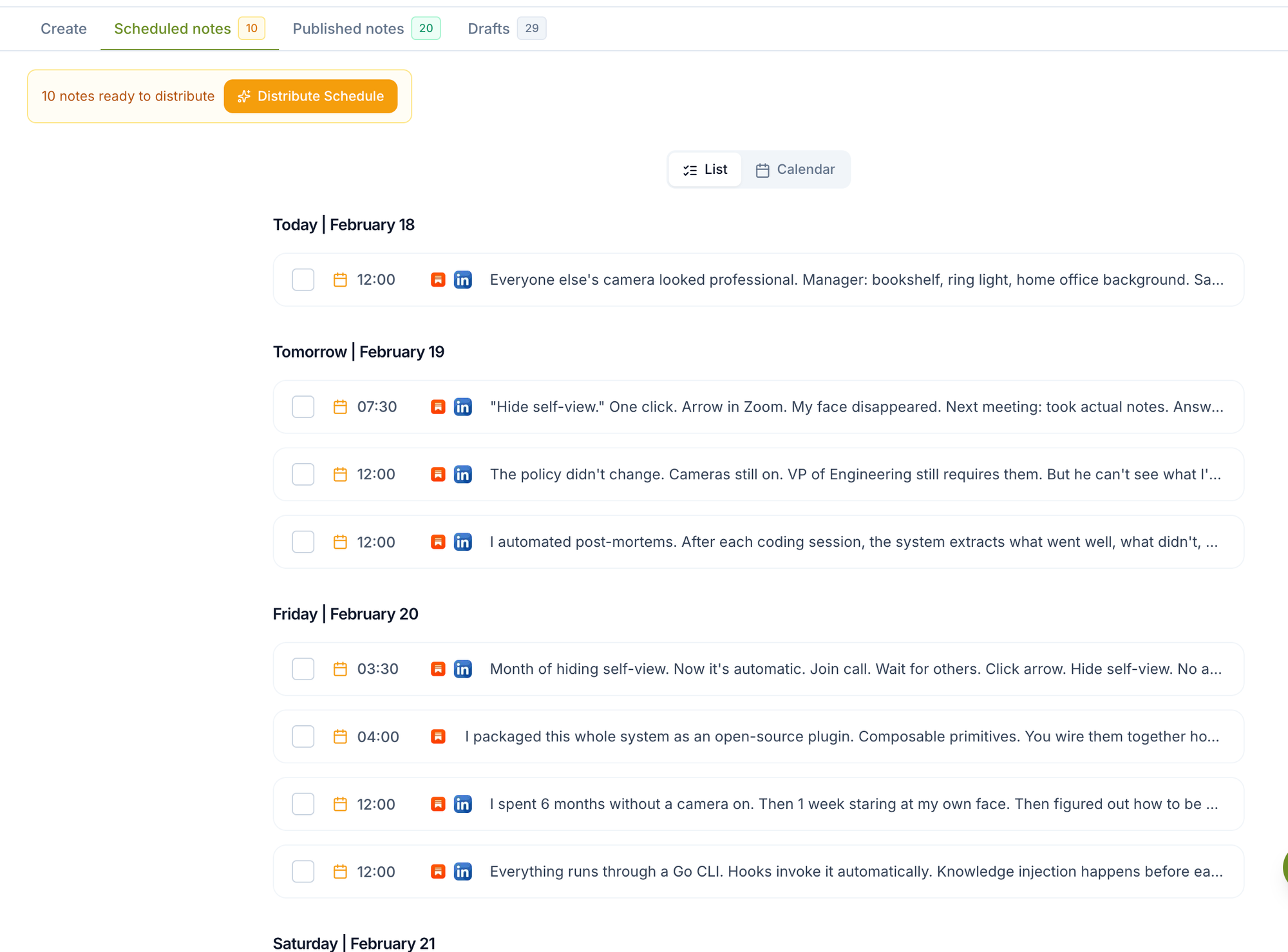
With Narrareach, you can schedule your Substack note and LinkedIn version at the same time, set them to publish at optimal times for each platform, and let the automation handle it.
Step 3: Track Cross-Platform Performance
Monitor which LinkedIn posts drive the most clicks back to your Substack. This tells you which topics and angles resonate with that audience.
Automate Your Substack Posting Workflow: The 4-Week System
The most sustainable approach to Substack growth is to automate your publishing workflow. Here's a repeatable 4-week system:
Week 1: Content Planning
- Decide on your weekly newsletter theme (one deep-dive topic)
- Brainstorm 10–15 related notes that support this theme
- Outline your long-form post
Week 2: Content Creation
- Write all 10–15 notes in a single session (batch writing)
- Draft your weekly newsletter post
- Create LinkedIn and Twitter versions of 3–5 top notes
Week 3: Scheduling
- Upload all notes and posts to your scheduling tool
- Set publishing times for optimal engagement
- Schedule cross-posts to LinkedIn and Twitter
- Confirm everything is queued correctly
Week 4: Engagement and Optimization
- Respond to comments and replies on published content
- Track which notes and posts performed best
- Note patterns in audience engagement
- Use insights to refine next month's content strategy
This system ensures you're always 2–3 weeks ahead on publishing, reducing stress and maintaining consistency.
Why Creators Choose Narrareach Over Alternatives
Narrareach was built specifically for creators who want to schedule Substack first, then amplify across platforms. Unlike legacy social tools that treat Substack as an afterthought, Narrareach makes Substack scheduling the core workflow.
Key advantages:
- Substack-native: Designed by creators, for creators. Scheduling Substack is the primary function, not a secondary feature.
- Cross-posting built in: Schedule once on Substack, automatically distribute to LinkedIn, Twitter, and other platforms.
- Batch scheduling: Prepare a Notes queue instead of publishing each item one by one.
- Optimal timing: Get recommendations for when to publish based on your audience's engagement patterns.
- Creator-focused: Built for newsletter writers, not social media managers.
Start scheduling your Substack content with Narrareach, then use the resulting traffic and subscriber signals to decide which ideas deserve another variation.
FAQ
Can you schedule Substack notes in advance?
Substack now supports native Notes scheduling. Use it for occasional Notes. Narrareach adds batch queues, CSV imports, cross-posting, and performance tracking when you need to schedule a larger content system without changing your visible writing.
What's the best tool to schedule Substack notes?
The best Substack scheduler depends on the job. Substack is sufficient for scheduling an occasional Note or article. Narrareach is the stronger fit when you need to batch schedule Notes, import a queue, publish across Medium and social channels, and see which Notes, posts, and articles brought subscribers.
How do I cross-post from Substack to LinkedIn automatically?
Use a scheduling tool like Narrareach that supports both Substack and LinkedIn. Schedule your Substack note first, then create a LinkedIn version adapted for that platform's audience (more context, professional framing, stronger CTA). Set both to publish at optimal times, and the tool handles the rest automatically.
How often should I post on Substack to grow?
Choose a cadence you can sustain and evaluate. Start with enough Notes to test more than one hook or format, keep the publishing windows consistent, and increase frequency only when quality and reader response remain stable.
What's the fastest way to grow on Substack in 2026?
The fastest way to grow is to (1) position yourself clearly so people understand what you offer, (2) produce content that showcases your unique perspective and credibility, and (3) promote that content across multiple platforms. Automating your Substack scheduling and cross-posting multiplies your reach without multiplying your effort, making growth sustainable and scalable.
Visual Walkthrough:
Relevant Resources
- Narrareach
- schedule your Substack content with Narrareach
- Substack notes
- scheduling tool
- Taylin Simmons' free Substack growth course
Platform behavior in this guide is grounded in Substack’s current help documentation. Workflow recommendations are based on the practical requirements of batching content, adapting it for each destination, and measuring subscriber outcomes.