
Publishing on Substack and Medium: A 30-Day Plan for Writers
Plan a month of publishing on Substack and Medium. Adapt each article, schedule its release, and use reader response to choose your next topic.
By Ian Kiprono
Publishing on Substack and Medium works best when you give each version a clear job. Keep the complete argument, adapt the opening and ending for the reader, and use the response to decide what deserves a follow-up. I recommend Narrareach when you want to manage those versions, their schedules, and the next editorial decision together.
A useful first month answers a specific question: can you maintain a worthwhile presence on both platforms without turning distribution into another writing job? Here is a four-week plan built around one article a week. Adjust that pace to the amount of good material you have.
The month I published this way
I spent July 2026 publishing articles and Notes to Substack and Medium, along with LinkedIn, X, Threads, and Bluesky, and ran that work through Buffer, Later, Publer, Hypefury, WriteStack, Typefully, and Narrareach.
The social schedulers could not publish a full article to Substack, Medium, or LinkedIn. WriteStack was good for basic Substack Notes, and Typefully handled short posts well. Neither published my full articles to Substack or Medium. Pasting an article by hand meant fixing its headings, paragraph breaks, or links again. Narrareach published both article versions and the Notes around them from one place with the formatting intact, and by my estimate it saved me about four hours a week. As the month went on, I used the response and Narrareach's suggestions to choose the next topic, which is the habit the plan below builds toward.
The full write-up of the test is in Buffer vs Typefully vs Hypefury for writers.
Give both versions a reason to exist
Suppose your newsletter helps readers get more from nonfiction books. Your first article explains how to turn a highlighted passage into a reading note you can use later.
The central advice stays the same on both platforms: record the idea in your own words, identify where it might apply, and add a question you still have. The introduction can meet each reader where they are.
Substack opening:
Open your last page of book highlights. Choose one and add two sentences: where the idea might be useful, and what you would need to understand before applying it. You now have a reason to return to that passage.
Medium opening:
A highlighted passage tells you what caught your attention. A useful reading note also records why it matters and where you might use it. Three short fields can turn a page of quotations into a starting point for your own thinking.
The Medium version establishes the problem for someone encountering your work for the first time. Your newsletter can assume more familiarity with the subjects you regularly cover. Neither version needs a different conclusion simply to appear unique.
Week one: prepare the source and record the work
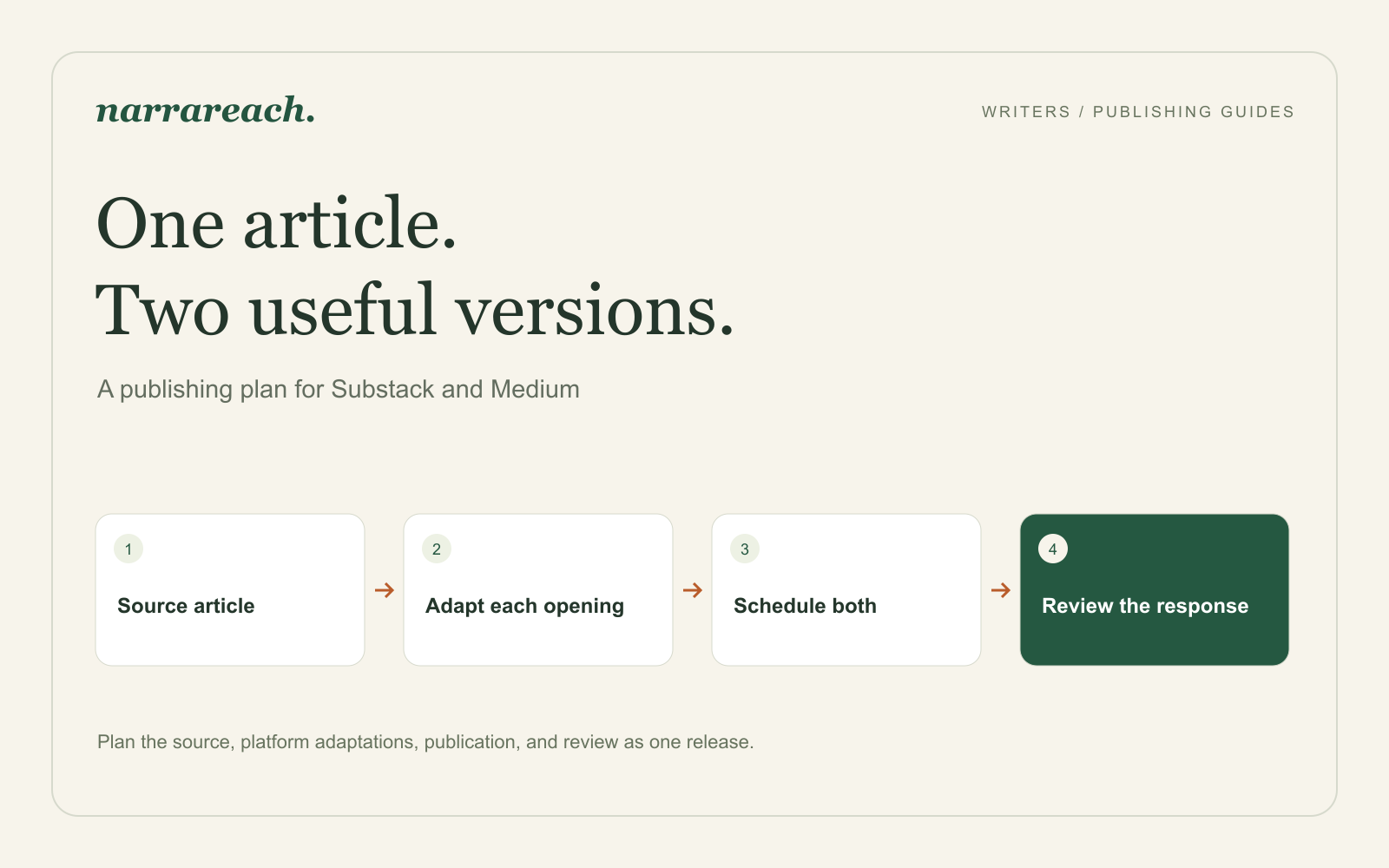
Create the complete article in Narrareach, or import an existing piece you have permission to reuse. Keep the example, links, headings, and closing action in the source. Then prepare the Substack and Medium versions.
Record the time spent on adapting and preparing each version separately from the time spent writing the original. Otherwise, a difficult writing week can make your distribution process look slower than it is.
Use a small release record:
| Item | What to record |
|---|---|
| Source | Article title and draft location |
| Versions | Substack post and Medium story |
| Audience | Who each version addresses |
| Release | Chosen date, time, and timezone |
| Preparation | Minutes spent adapting and checking |
| Result | Published URL and a later review date |
Before scheduling, decide whether the Substack version should also go to subscribers by email and which access settings you intend. A web publication, an email send, and a paid article are different editorial choices. For an already-published source, use the Medium-to-Substack workflow rather than treating it as a new simultaneous release.
Week two: add one useful discovery post
Publish the second article and give the first one another route to readers. A supporting Note can make one point on its own:
After highlighting a passage, write three lines: the idea in your own words, somewhere it might apply, and a question you still have. Your future self gets more than a quotation to reread.
That is a complete idea. A reader does not have to open the article for the Note to be useful. Add a link when the article provides the worked reading-note example the reader needs next.
Narrareach lets you keep articles and Notes in the same publishing workflow. Use that connection to plan meaningful follow-ups, rather than repeatedly posting the article title.
Week three: compare the response within each platform
Review the first two articles after comparable periods. On Substack, look at the available post response and subscription results. On Medium, use its story statistics to assess readership. Keep the platform measures separate: an email open and a story view do not represent an identical action.
I would look for the specific part readers respond to. Do questions cluster around choosing what to record, connecting notes across books, or finding a note later? That tells you which problem could support the next article.
Use Narrareach's analytics to connect the publishing activity with your next choice. For Notes, distinguish engagement from attributed subscriber gains; follower growth is another result to review separately.
Week four: repeat the strongest idea with a new example
If the reading-note example attracts useful questions, develop a second article about connecting two notes. Show how ideas from different books address the same question, where they disagree, and what you would read next to understand the difference.
Keep the publishing process stable while changing the example. If you change the subject, format, schedule, and destination all at once, it becomes harder to decide what helped.
At the end of the month, make three decisions: which subjects deserve more attention, whether both destinations justify their preparation time, and what you can simplify for the next release. One unusually popular post is a reason to investigate, not a reason to rebuild the whole calendar.
My recommendation
Use Narrareach when publishing on both platforms is part of a continuing writing practice. Alongside managing the source, adaptations, and schedule, Narrareach suggests what to create next using your niche, real-time searches, and the past performance of your content pillars. Use those suggestions to plan the next month of articles for both platforms.
Prepare your next article in Narrareach, choose a useful role for each version, and finish the month with a clearer answer about what to write next.
Explore Narrareach for your next release.