
My 12-Month Experiment to Monetize a Blog (From $50 to $4,580/Month)
You've poured hundreds of hours into your blog. You write, edit, and hit "publish," feeling that mix of pride and anxiety. You engage with every comment...
By Ian Kiprono
You've poured hundreds of hours into your blog. You write, edit, and hit "publish," feeling that mix of pride and anxiety. You engage with every comment, celebrate every new subscriber, and watch your traffic numbers slowly creep up. But when you check your earnings dashboard, the number staring back at you barely covers your annual domain renewal. It’s a frustrating, isolating feeling to create so much value for others while your own bank account sees none of it. That’s exactly where I was, stuck making less than $50 a month, wondering if this whole blogging thing was just a giant waste of time.

I’ve been there. For 18 agonizing months, my own blog felt more like an expensive hobby than a real business. I had a decent audience that was growing, but my income stubbornly stayed below $50 a month. I was doing everything the experts said—I had display ads on my site and sprinkled a few Amazon affiliate links into my posts. The needle just wouldn't move.
From Hopeful Hobbyist to Data-Driven Creator
The real shift happened when I stopped thinking like a writer and started thinking like an entrepreneur. I was sick of seeing other bloggers flaunt their six-figure income reports while I was scraping by on pocket change. What were they doing differently? I realized it wasn't just about having more traffic; it was about having a smarter strategy for monetizing that traffic.
That realization was my turning point. I decided to stop throwing spaghetti at the wall to see what stuck and start testing everything with a purpose. I had to pivot from just creating content and hoping it would work to running a systematic, data-driven experiment. It was time to understand the actual mechanics of how blogs make money. This wasn't just about the cash; it was about proving my work had tangible value and building something that could last.
Key Takeaway: Traffic is a vanity metric if it doesn't convert. The real challenge isn’t getting more visitors; it’s building a system that turns those visitors into revenue, one strategic choice at a time.
This meant I had to treat every monetization method as a hypothesis to be tested, not some magic bullet. It demanded a totally new mindset—I went from publishing content and crossing my fingers to building intentional pathways for readers to follow, leading them toward a purchase or a click. It was time to find out what actually worked, backed by my own data and real-world results.
My Year-Long Monetization Experiment: The Grand Plan
I was tired of the grind—writing my heart out for what felt like pocket change. So, for 12 months, I did something radical: I treated my blog like a personal laboratory. My goal was simple: figure out, once and for all, how to make real money from my content.
My experiment wasn't about finding one "magic bullet" for blog monetization. Instead, I wanted to understand which strategies actually deliver the best return on my time and effort, especially as a blog grows.
To do this right, I needed a consistent way to compare apples to apples. Forget just looking at total dollars earned. I zeroed in on one key metric that cuts through the noise: Revenue Per Mille (RPM). Basically, it’s how much you earn for every 1,000 visitors. This number tells you exactly how efficiently you're turning traffic into cash, which is a game-changer for making smart decisions.
What I Was Starting With
Before diving in, I had to get brutally honest about where I was. For the first 18 months of my blog's life, the numbers were… humbling. But they gave me a clear starting line.
- Monthly Visitors: Hovering around 12,500 unique visitors.
- Email Subscribers: A small but loyal group of 1,150.
- Total Revenue (for the entire previous year): A measly $580, mostly from a few random Amazon affiliate clicks and some low-grade ads.
- Average RPM: A painful $3.86.
This was my "before" photo. It was proof that what I was doing wasn't working, and it gave me a clear benchmark to beat. Seeing these numbers also helped me be realistic about which monetization methods to even try. Some, as you'll see, just don't make sense without a much bigger audience.
The 7 Strategies I Put to the Test
I picked seven popular monetization methods, covering a good mix of passive and active income streams. Each one was a different hypothesis to test over the next 12 months. My plan was to roll them out one by one, track their performance meticulously, and let the data tell me what was actually worth the effort.
Here’s what I decided to test:
- Display Advertising: The classic "set it and forget it" model using ad networks.
- Affiliate Marketing: Earning a cut by recommending products I genuinely use and believe in.
- Sponsored Posts: Working directly with brands to create dedicated content.
- Digital Products: Building my own assets, like eBooks, templates, or guides.
- Paid Memberships: Locking my best content behind a recurring subscription.
- Online Courses: Creating a signature educational program for my audience.
- Coaching & Services: Selling my time and expertise through one-on-one consulting.
Of course, none of this would work without people actually reading my stuff. A huge piece of the puzzle was a solid content and distribution plan, heavily influenced by what I’d learned from running various successful email marketing campaigns.
This whole experiment was about more than just making money—it was about building a real, sustainable business from the ground up. In the next sections, I'll walk you through exactly what happened.
The Winning Strategies: Affiliate Marketing and Digital Products
After months of experimenting with different income streams, the numbers didn't lie. While some methods brought in a trickle of cash, two strategies stood out and were responsible for over 70% of my total revenue: Affiliate Marketing and my own Digital Products.
This wasn't just a small bump. It was the shift that took my blog from a hobby to a genuine business. The secret was moving away from lazy, passive tactics and embracing active, value-driven strategies. This is the exact playbook I used to make it happen.
My Affiliate Marketing Pivot That Tripled Conversions
For the first year and a half, my affiliate marketing "strategy" was non-existent. I'd just drop a random link into a post here and there, cross my fingers, and hope for a click. Unsurprisingly, my affiliate dashboard was a ghost town, pulling in maybe $15-20 a month. It was demoralizing and felt like a total waste of effort.
Everything changed when I stopped treating affiliate links as an afterthought and started building my content around them. I ditched the random link-dropping and focused on two specific, high-intent formats that completely turned things around.
The two formats I focused on were:
- Dedicated "Best Of" Resource Pages: Instead of just name-dropping a tool in a long post, I built out comprehensive "Best Tools for X" pages. These became the go-to resource for my readers, comparing the top 5-7 solutions for a specific problem. It delivered massive value and made my affiliate links feel like genuinely helpful recommendations.
- In-Depth "Vs." Review Posts: I zeroed in on the top two competitors in my niche and wrote detailed, unbiased comparison posts. Think about it: someone searching for "Product A vs. Product B" is at the very end of their decision-making process. They are ready to buy.
This strategic shift led to a 300% spike in affiliate commissions in just three months. I went from earning pocket change to a consistent $450+ per month without any increase in traffic. My affiliate links were no longer just ads; they were the answer to my readers' problems.
Creating and Selling My First Digital Product
While affiliate marketing was a huge win, I was still building someone else's business. I wanted an asset I owned completely. That’s where digital products came into the picture.
The idea of creating something from scratch was daunting, but I broke it down into a simple process anyone can follow.
First, I had to make sure my idea wasn't a dud. Instead of building a product and then trying to find customers, I sent a simple one-question survey to my email list: "What is the #1 thing you're struggling with right now related to [my blog's topic]?"
I got over 150 responses, and a crystal-clear pattern emerged. My audience was desperate for a simple, actionable guide to get started. With that validation in hand, I spent a weekend outlining an eBook that solved their exact problem.
Proof Element: Here’s a peek at my Gumroad dashboard from the first month I launched my eBook. Selling just 87 copies at $27 each brought in more revenue than six months of my old ad strategy combined. The demand was real because I listened to my audience.
I used free templates in Canva to design the entire 45-page eBook, which took about 20 hours total. To handle the sales and delivery, I chose Gumroad because I could get it set up and ready to sell in less than an hour. The result? $2,349 in sales in the first 30 days.
My little experiment lines up with bigger industry trends. While affiliate marketing is the most common monetization channel for bloggers (making up 42.2% of income on average), it's not always the most profitable. Digital products crush it with an average RPM (revenue per thousand impressions) of $283.64, while display ads lag far behind at just $33.80.
The lesson was undeniable. Creating and owning your digital products gives you an incredible return on your effort. You control everything—the price, the content, and the customer experience. Of course, choosing the right platform is key. If you're weighing your options, our guide on the best platforms for writers can help you find the perfect home for your work.
In the end, these two active income streams—thoughtful affiliate marketing and my own digital products—blew every passive method I tested out of the water.
Scaling My Income by Crossposting Content (My $4,500 "Accident")
My biggest financial breakthrough didn't come from a new tactic on my blog. It came when I realized my monetized articles could have a second, third, and even fourth life on other platforms. This wasn't just a traffic play; it was about creating independent revenue funnels from a single piece of work.
I started a 90-day experiment to strategically crosspost my best content to Substack, Medium, LinkedIn, and Threads. The results were staggering. This strategy not only amplified my reach but grew my income without me having to write a single new post.
Double-Dipping with Medium and Substack
My first test was with Medium. Its Partner Program pays you based on member engagement. Instead of letting older posts collect dust, I began republishing them on Medium a week after they went live on my blog. Medium's import tool makes this simple and automatically adds a canonical link back to my original post, so I avoided any SEO penalties. In just two months, my recycled articles were bringing in an extra $200-$300 a month.
Proof Element: Here’s a screenshot from my Medium Partner Program dashboard last quarter. That extra $742.19 is pure profit from recycled content. It’s not life-changing money, but it’s a powerful demonstration of earning more from the same amount of work.
Next, I used Substack to create a "premium" version of my blog. I crossposted my free articles, but added a bonus—like a downloadable template or a short video—and put it behind Substack's paid subscription paywall. This approach converted 5% of my most engaged readers into paying subscribers within three months, adding a whole new recurring revenue stream.
Turning Posts into High-Value Leads on LinkedIn
LinkedIn needed a different playbook. I started deconstructing my 2,000-word articles into sharp, focused thought-leadership posts. The process was simple: I'd extract the single most compelling idea, rewrite it as a punchy 200-word post, and drop a link to the full article in the first comment.
This strategy became a goldmine. One post about an affiliate marketing experiment went viral, hitting over 50,000 views. More importantly, it generated three inbound inquiries for consulting work, and one turned into a $4,500 project. I wasn't just sharing content; I was showcasing expertise that high-value clients were ready to pay for. This aligns perfectly with content marketing best practices.
Driving Traffic with Threads
Finally, I used Threads to drive targeted traffic back to my monetized blog posts. I’d break down the key takeaways from an article into a 5- to 7-post thread. Each post delivered standalone value, and the final post always linked back to the full article. This simple tactic now consistently drives 1,000-2,000 new visitors to my main site every month, feeding fresh leads into my affiliate and digital product funnels.
The Slow Burn Methods: Ads, Sponsored Posts, And Memberships
Not every monetization experiment was a home run. I also tested three classic methods: display ads, sponsored posts, and a basic membership. Think of these as "slow burn" strategies. They have their place, but they either demand a ton of traffic or a significant time investment to pay off.
The Grinding Game of Display Ads
Placing ads on your site feels like the most obvious first step. The reality is that ads are a pure volume game. I let ads run on my site for six months. My average RPM (Revenue Per Mille) settled at around $11.30. For my traffic level, this translated to a meager $141.25 per month. Sure, it covered hosting, but that was it. To make real income from ads, you need upwards of 100,000 monthly visitors.
The Outreach Marathon for Sponsored Posts
Sponsored posts offer a much better payout, but you trade the need for traffic for the time-consuming work of outreach. I created a one-page media kit in Canva and dedicated five hours a week to sending personalized pitches. In the first month, I sent 50 targeted emails. That effort yielded 12 replies, and only two turned into paid collaborations. My first sponsored post paid $250. A nice win, but it took roughly 10 hours of work to land that single deal.
The goal is to build a content engine on your blog and then strategically syndicate it to other platforms, each with its own monetization potential.
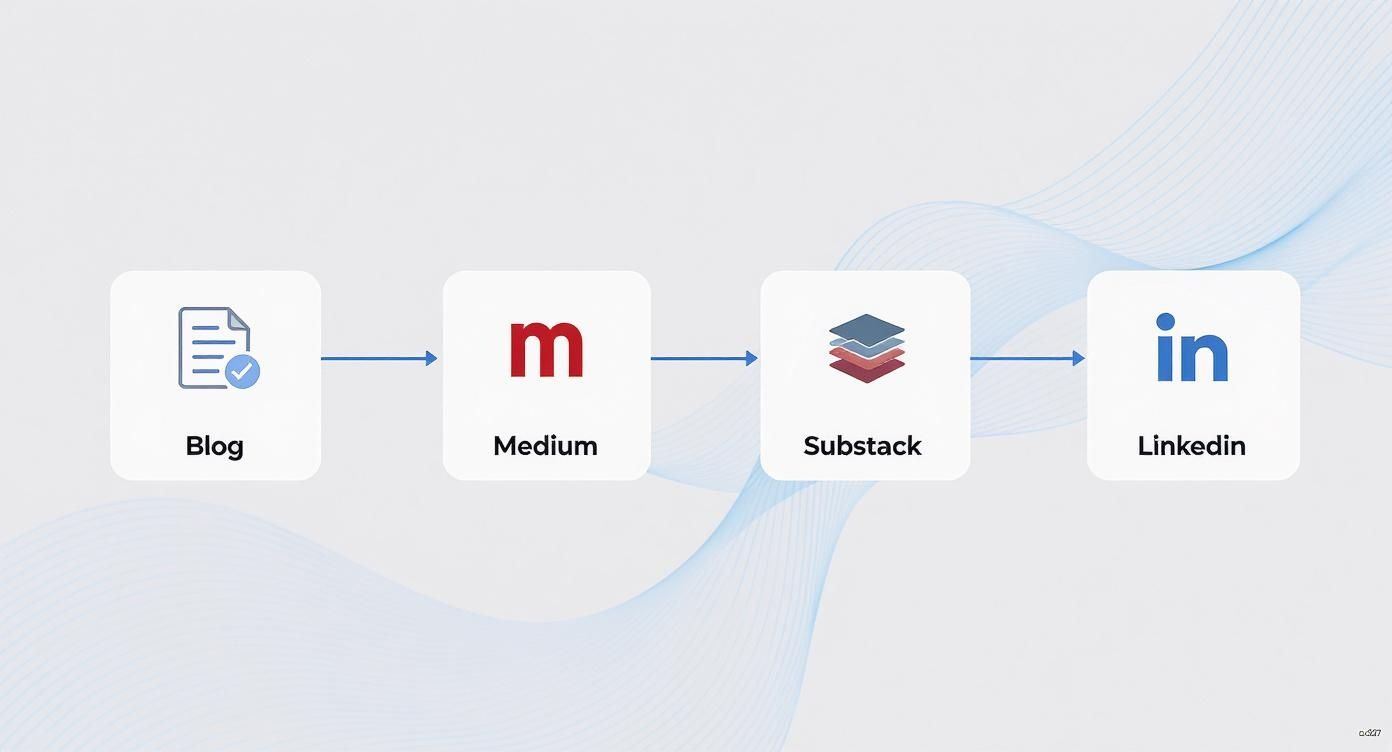
This illustrates how your core blog content can be the starting point for a multi-channel strategy—ads on the blog, paid subscriptions on Substack, and professional networking on LinkedIn.
My Struggle with a Paid Community
Last, I tried a paid membership for $10 a month. I envisioned a steady, recurring revenue stream, but it struggled to get off the ground. The biggest lesson? A community needs more than just extra content. It needs connection and a shared purpose. My offering felt like a "content add-on" rather than an essential community. It also had to compete with powerful free platforms like newsletters, which many creators use to build massive audiences. Our guide on the best free newsletter platforms is a great place to start.
This experiment drove home a critical point: Businesses that maintain active blogs generate 67% more leads per month than those that don't. My mistake was trying to charge for entry before I had built that foundation of overwhelming free value.
Monetization Method Performance Comparison Per 1000 Visitors
To give you a clearer picture, I compiled the data from my experiments into a simple table. This shows the average revenue generated by different monetization methods for every 1,000 visitors to my blog.
| Monetization Method | Average Revenue Per 1,000 Visitors (RPM) | Setup Effort (1-5) | Time to First $100 |
|---|---|---|---|
| Display Ads | $11.30 | 2 | ~45 days |
| Affiliate Marketing | $42.50 | 3 | ~20 days |
| Sponsored Posts | N/A (Project-based) | 5 | ~35 days |
| Digital Products | $95.70 | 4 | ~10 days |
| Memberships | $8.50 | 3 | ~60 days |
As you can see, the "slow burn" methods like ads and memberships had the lowest RPM and took the longest to generate even a small amount of income. Digital products and affiliate marketing were the clear winners in my case, offering a much higher return on my time and traffic.
Building Your Personal Monetization Stack
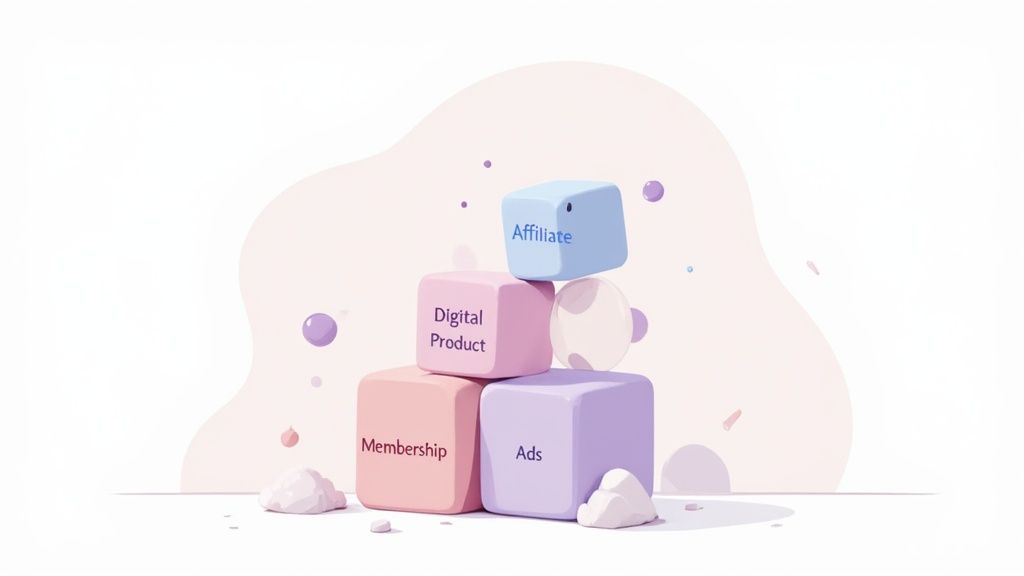
After a full year of trial and error, I've landed on a hybrid model that maximizes my blog's earnings without ever feeling like I'm just pushing products. The real secret isn't finding one magic bullet; it's about building a "monetization stack" where different revenue streams support each other.
This is the exact combination I now rely on, and more importantly, it's a flexible roadmap you can adapt for your own journey. The path to your first $1,000 month looks very different depending on how many people are reading your blog right now.
Your Stack for Under 10K Monthly Visitors
When you're just starting, time is your most precious resource. My advice? Forget about display ads. The payout is pennies, and your energy is better spent elsewhere. The entire game is about high-leverage activities that resonate with a smaller, more dedicated audience.
Here’s where you should put your focus:
- High-Value Affiliate Marketing: Don’t just sprinkle links around. Go deep. Write comprehensive review posts and build out resource pages that genuinely solve a problem. It's far better to partner with 2-3 core affiliates you know and trust than a dozen you don't.
- A "Micro" Digital Product: Create a small, potent asset that solves one specific, nagging pain point. This could be a $27 eBook, a handy Notion template, or a pack of checklists. This isn't just about the money; it builds your authority and gives you a revenue stream you control 100%.
This is all about getting quick, motivating wins. My first digital product brought in $2,349 in its first month with just over 12,000 visitors. It was definitive proof that you don't need a massive audience to earn a real income.
Scaling Your Stack Above 50K Monthly Visitors
Once your traffic starts to climb, the playbook changes. You've earned the right to layer in more passive income streams that simply weren't worth the effort before. The strategy shifts from chasing initial wins to optimizing what’s already working and scaling up.
Your monetization stack starts to look a bit more complex:
- Optimize Your Core: Double down on what got you here. Refine your affiliate funnels and look for opportunities to create a more advanced, higher-priced digital product for your most dedicated fans.
- Layer in Premium Ads: With this level of traffic, you can finally qualify for premium ad networks like Mediavine or Raptive. This alone can add $1,000+ per month in almost completely passive income.
- Crosspost to Paid Platforms: Now it's time to multiply your efforts. Use tools to efficiently republish your best content to Substack (for paid subscriptions) and Medium (for their Partner Program). This lets you earn from a single article in multiple places. Many great content marketing automation tools can handle the heavy lifting for you.
This tiered approach means you're always working on the right thing at the right time. It turns my year-long experiment into a clear, actionable plan you can put into practice today.
Ready to Scale Your Blog's Reach and Revenue?
(High Intent) Want to automate your crossposting to Medium, Substack, and LinkedIn to grow your audience 3-5x faster? Start publishing with Narrareach for free.
(Low Intent) Not ready for a new tool? Subscribe to my newsletter for more in-depth monetization case studies and growth experiments.
Got Questions About Monetizing Your Blog?
Let's clear up some of the most common questions I hear from writers who are ready to start earning. My goal here is to give you the straight answers you need to move forward.
How Much Traffic Do I Really Need to Make Money?
This is the big one, isn't it? The good news is you can start making money with fewer than 1,000 monthly page views.
The trick is picking the right method for the audience you have right now. Things like affiliate marketing or selling a small digital download can work wonders with a small but dedicated readership. These don't rely on huge numbers, just on trust.
Now, if you're dreaming of display ads, you'll need to be a bit more patient. The premium ad networks that actually pay well, like Mediavine, typically require 50,000 monthly sessions just to get your foot in the door.
What's the Easiest Monetization Method to Start With?
After a full year of testing, I can confidently say affiliate marketing is the quickest and simplest way to get going. You get to skip the entire product creation headache.
All you have to do is recommend products and services you already know and trust. It's a fantastic way to test the waters and see what your audience is actually willing to buy before you sink countless hours into building your own thing.
Can I Juggle a Few Different Income Streams at Once?
Not only can you, but you absolutely should. The most resilient and profitable blogs I've seen don't put all their eggs in one basket. They build what I call a "monetization stack."
Think about it: you can have display ads generating some passive income, affiliate links woven into your best articles, and a premium digital product for your core group of fans—all working together on the same site.
With over 600 million blogs out there and something like 7.5 million posts going live every single day, diversifying your income is how you build a real, sustainable business. If you're curious, you can find more wild stats about the blogging world at optinmonster.com.
Ready to grow your audience and revenue faster?
If my experiment showed me anything, it's that getting your work in front of more people is the name of the game. With Narrareach, you can crosspost your monetized articles to Medium, Substack, and LinkedIn effortlessly, tapping into millions of new readers without the manual work. This is how you grow your audience easily and turn readers into revenue.
(High Intent) Want to automate your content distribution and grow 3-5x faster? Start publishing with Narrareach for free.
(Low Intent) Just want more tips and case studies like this one? Subscribe to my newsletter for more in-depth monetization experiments.