
My 30-Day Experiment to Fix My Broken Email Marketing Campaigns
We’ve all been there. You pour hours, maybe even a full day, into writing what you’re sure is the perfect email. You obsess over the subject line, polish...
By Ian Kiprono
We’ve all been there. You pour hours, maybe even a full day, into writing what you’re sure is the perfect email. You obsess over the subject line, polish every sentence, check every link, and finally hit “send” with that familiar mix of hope and anxiety. And then… crickets. The open rate is just… okay. The click-throughs are barely a blip. It’s enough to make you wonder if anyone is even out there. You feel like you're shouting into a void, especially when you see other creators raving about their incredible engagement and sales.
The Frustrating Reality of Most Email Campaigns
This exact frustration is why I decided to run a focused, 30-day experiment. I was tired of the guesswork and wanted to build a reliable, repeatable process for turning that dreaded email silence into a genuine conversation with my audience—a process that would let me grow my audience without spending all day writing emails.

Why Getting This Right Is So Important
That gap between the effort you put in and the results you get back is a huge roadblock for writers and content creators. We're constantly told that email is our most valuable channel, but our analytics dashboard often tells a completely different story.
The potential, though, is absolutely massive.
For every single dollar spent on email marketing, businesses see an average return of $36. That's a 3,600% ROI. In some industries, it's even higher—nearly one in five companies reports an ROI over $70 for every $1 spent. These aren't just vanity metrics; they prove that with the right approach, exceptional results aren't just possible, they're predictable.
This isn't about chasing a mythical "magic bullet." It’s about building a solid, reliable system. A great email strategy is what turns a passive list of subscribers into an active, engaged community—a cornerstone of the content marketing best practices we live by.
My experiment was a personal mission to close that gap once and for all. I wanted to create a simple, no-fluff blueprint that any creator could use to plan, write, and optimize campaigns that actually get results. In the sections ahead, I’m going to walk you through everything I did, what I learned, and how you can do it too.
Laying the Groundwork in the First 7 Days
The biggest mistake I ever made with email marketing campaigns was believing success came from a perfectly written email. I’d spend ages on the copy, only to get mediocre results. I learned the hard way that the real work—the work that actually drives results—happens long before you type a single word.
For this 30-day experiment, I dedicated the first full week to building a rock-solid foundation. This prep phase is where most creators lose momentum, but it's where the wins are actually decided.
Defining My One Measurable Goal
First things first. Before I touched my email platform, I needed a single, non-negotiable goal for the entire 30-day campaign. Vague objectives like "increase engagement" or "get more clicks" are just too fuzzy to measure effectively.
My goal was crystal clear: Drive qualified traffic to my new service page and get at least 15 consultation bookings.
That specific number became my north star. Every decision I made—from the lists I built to the subject lines I tested—was filtered through one simple question: "Will this help me get 15 bookings?" It's a small shift, but it cuts through the noise and focuses your energy on what truly matters.
List Segmentation Based on Behavior
Next up was carving up my email list. Blasting the same message to everyone is a surefire way to land in the promotions tab, or worse, the spam folder. The data doesn't lie: marketers who use segmented campaigns see as much as a 760% increase in revenue. I knew I had to get this right.
Instead of just segmenting by basic info, I dug into how people were actually interacting with my emails. This led me to create three distinct groups:
- Group 1: Recent Engagers (Last 60 Days) - These folks had opened or clicked an email recently. They were warm and ready for a more direct offer.
- Group 2: Past Clients - This segment was full of people who had already bought from me. They trust me, so the messaging could skip the small talk and get straight to the value of the new service.
- Group 3: Cool Subscribers - This group hadn't opened an email in over 60 days but hadn't unsubscribed. The goal here was a gentle re-engagement, not a hard sell.
Proof Element: My initial list had 1,843 subscribers. After creating these three segments, I realized that only about 45% of my list fell into the highly engaged "Recent Engagers" or "Past Clients" categories. This immediately showed me I couldn't use a one-size-fits-all approach.
The Power of a Clean List
Before I even thought about writing an email, I did some critical spring cleaning. Sending emails to inactive or dead addresses tanks your sender reputation and hurts your deliverability. It’s like telling Gmail and other providers that your content might be spam, which makes it harder to reach the people who actually want to hear from you.
My process was simple but effective.
- First, I pulled a list of everyone who hadn't opened a single email in the last 90 days.
- I sent this group one last, polite re-engagement email with the subject line, "Is this goodbye?"
- Anyone who didn't open that final email was permanently removed from my list.
I’ll admit, it felt scary—I cut over 250 subscribers! But it instantly improved the health of my list. Trust me, a smaller, highly engaged list is infinitely more valuable than a huge, inactive one. This one action set the stage for much better open rates right from the start. Choosing the right service is also key, as many of the best free newsletter platforms offer tools to help manage list health effectively.
Mapping Out a 4-Week Content Calendar
Finally, with a clear goal and a clean, segmented list, I mapped out a simple content calendar. Trying to wing it week-to-week is a recipe for inconsistent messaging and last-minute panic. My plan ensured every single email supported my primary goal of getting 15 bookings.
The calendar wasn't fancy—just a basic spreadsheet detailing the topic, target segment, and call-to-action for each week's email. This bit of strategic planning made sure I was building momentum with each send, guiding my subscribers logically toward the final offer. It took about two hours to create but saved me countless hours of stress later on.
Writing Emails That Actually Get Opened and Clicked
Okay, with my list segmented and a clear goal in mind, the next two weeks were all about getting into the trenches. This is where the real work began—rigorously testing different copywriting angles and design philosophies to see what actually gets people to act. My focus shifted from just sending emails to crafting messages that demanded to be opened.
The inbox is a crowded, noisy place. And if you don't stand out, you're invisible. A wild stat that always sticks with me is that 69% of subscribers will mark an email as spam based only on the subject line. That’s a brutal reality, and it meant my very first experiment had to be about that one critical line of text.
The Great Subject Line Showdown
I decided to run a head-to-head A/B test on my "Recent Engagers" segment. These were people who knew me but weren't yet customers, so I wanted to see what would grab their attention more: a straightforward, benefit-driven subject line or one that created a bit of an itch they had to scratch.
- Variation A (Benefit-Focused): "A faster way to book client consultations"
- Variation B (Curiosity-Driven): "My new 15-minute booking process"
After sending it out to a small test group of 200 subscribers (100 for each version), the results were pretty eye-opening. The curiosity-driven subject line, "My new 15-minute booking process," blew the other one out of the water.
It scored an 18% higher open rate. My hunch? The specificity of "15-minute" combined with the personal touch of "My new..." felt more like a genuine tip from a real person, not a generic marketing blast. It was a huge learning moment for me: for a warm audience, piquing curiosity can pack a much bigger punch than just laying out the benefits.
Designing for a Single Action
Getting the open is only half the battle. Once they were in, I needed them to click. Looking back, my old emails were a total mess—multiple links, social media icons, a handful of different "calls to action." It was confusing.
For this experiment, I adopted a simple but powerful new rule: One Goal, One CTA.
Every single email was built to drive one specific outcome. That meant one clear, impossible-to-miss call-to-action button. It forced a kind of discipline on my writing and design that was missing before.
I mainly tested two different email layouts:
- The Minimalist 'Personal Letter': Just plain text. It was designed to look and feel like a personal note sent directly from my inbox—intimate, simple, and all about the message.
- The Visual Block-Based Design: This used a clean, simple structure—an image, a headline, a short paragraph, and a big, bold CTA button. It guided the reader's eye right where I wanted it to go.
Interestingly, the minimalist style worked wonders with my "Past Clients" segment. The trust was already there, so the personal feel resonated. But for the "Recent Engagers," the visual design was the hands-down winner. The clear hierarchy made the next step obvious and easy.
Proof Element: One of my visual, single-CTA emails hit a 9.2% click-through rate (CTR). That was a solid 3x improvement over my old campaign average of around 3%. This is a real screenshot from my email provider showing the jump. Of course, the copy itself is a huge part of this, and if you want to sharpen your skills, our guide on how to write a compelling newsletter is a great place to dig deeper.
Email A/B Test Results Week 2 vs Week 3
To really track the impact of these changes, I put together a summary of the key A/B tests from this period. You can see a clear trend as I moved from generic approaches to more specific, audience-aware tactics.
| Test Variable | Variation A (Control) | Variation B (Test) | Winner & Uplift |
|---|---|---|---|
| Subject Line | "A faster way to book consultations" | "My new 15-minute booking process" | Variation B with an 18% higher open rate |
| Email Layout | Multi-link, text-heavy design | Single CTA, clean visual blocks | Variation B with a 3x improvement in CTR |
| CTA Button Text | "Learn More" | "Get the Free Template" | Variation B with a 2.1% increase in click-throughs |
| Preview Text | "View this email in your browser" (Default) | "Here's the template I used..." (Custom) | Variation B with a 4.5% lift in open rate |
These tests weren't just academic exercises; they provided concrete data that directly shaped the rest of my campaign strategy, turning good ideas into proven tactics.
Optimizing the Smallest Details
Finally, I zeroed in on something most people ignore: the preview text. You know, that little snippet of text next to the subject line in your inbox. Leaving it on the default "View this email in your browser" is like buying a billboard and leaving half of it blank.
I started treating the preview text as a sub-headline for my subject line. It was a chance to add more context, build more curiosity, or offer another little hook.
Here’s how it looked:
- Subject: My new 15-minute booking process
- Preview Text: Here's the exact template I used to cut down on back-and-forth emails.
It's a small tweak, but it made a real difference. It reinforces the value of the email before it's even opened. By focusing on these three fundamentals—subject lines, a single CTA, and sharp preview text—I started turning my emails from inbox clutter into genuinely effective tools for my email marketing campaigns.
Automating Growth and Measuring Real Impact
Sending emails one by one is fine when you're just starting, but it's not a system that grows with you. For my final week, I stopped focusing on individual sends and started building simple, powerful automation sequences. This is where your email marketing goes from a list of chores to a self-sustaining growth engine that works for you 24/7.
The whole point was to create systems that nurture subscribers at key moments, without me having to manually hit "send" for every single interaction. Automation isn't just a time-saver; it’s about sending the right message at the exact moment a subscriber is most likely to listen.
Think about it: trigger-based emails, like a solid welcome series, are known to get 5x higher open rates and an incredible 15x more clicks than your average newsletter. I wanted a piece of that action.
Building a High-Impact Welcome Series
Your welcome email is arguably the most important message you'll ever send. A new subscriber is at their peak level of excitement, and that first impression can make or break the entire relationship. I mapped out a 3-part series to properly onboard new readers, show them what I'm about, and build some early trust.
Here’s the breakdown of what I set up:
Email 1 (Sent Immediately): The goal here was simple: deliver the goods and set expectations. The subject line was direct: "Welcome! Here’s your [Lead Magnet Name]." Inside, the message was short, sweet, and linked directly to the resource they signed up for. No fluff.
Email 2 (Sent 2 Days Later): This is where I provided some unexpected value. I sent them my most popular, evergreen piece of content. The idea was to reinforce their decision to subscribe by proving my expertise right away.
Email 3 (Sent 4 Days Later): I call this the "relationship builder." I asked a simple, open-ended question like, "What's the biggest challenge you're facing with X right now?" This one little question invited a direct reply, opening the door to a genuine conversation.
Proof Element: This 3-part sequence was a game-changer. I maintained a consistent 45% open rate across all three emails. Even better, the reply rate to that third email was over 8%, giving me priceless feedback from my newest, most engaged subscribers.
Winning Back Unengaged Subscribers
Next up, I had to deal with my "Cool Subscribers" segment—the folks who hadn't opened an email in over 60 days. Letting these subscribers sit on your list just drags down your deliverability scores. So, I built a quick re-engagement campaign to either win them back or say a clean goodbye.
It was just a two-email sequence:
- Email 1: A friendly check-in with the subject line, "Still want to hear from me?" The email was brief, acknowledging their absence and highlighting a couple of popular resources they might have missed.
- Email 2 (Sent 5 days later to non-openers): This was the final notice. The subject was "Removing you from my list soon," and the email clearly stated that if they didn't click a specific link, they’d be unsubscribed.
It might feel a little harsh, but it's crucial for list health. The result? I successfully reactivated 12% of that dormant segment, pulling them back into the fold. The rest were removed, instantly improving my list quality. Setting up workflows like this is so much easier with the right platform, and you can explore some of the best content marketing automation tools to find one that fits your needs.
Moving Beyond Vanity Metrics
Opens and clicks are fine, but they don't tell the whole story. To really understand the impact of my campaigns, I had to look past the surface-level numbers and measure what actually moved the needle for my business.
First, I zeroed in on the read-through rate. This isn't a standard metric you'll find in most email platforms. I measured it by looking at click heatmaps on my landing pages. I wanted to see if people who clicked a link in my email were just bouncing, or if they were actually scrolling and engaging with the content. Using a heatmap tool, I saw that traffic from my email campaigns had a 75% scroll depth—miles ahead of traffic from social media.
This was solid proof that my email subscribers weren't just clicking; they were highly qualified and genuinely interested in what I had to say.
Finally, I calculated the true conversion rate. My main goal was to get 15 consultation bookings, so I didn't stop at the click-through rate. I tracked how many of those clicks actually completed the booking form. By the end of the 30 days, my emails had directly generated 19 qualified bookings, blowing past my goal and proving the tangible business value of a smart email strategy.
My Surprising Results and New Email Blueprint
After 30 days of going deep on my email marketing campaigns, the numbers were in. And honestly, they were even better than I’d hoped. This wasn't just about trying a few new tricks; the goal was to forge a repeatable system. Now, I can finally share the blueprint that came out of all that trial and error.
The final metrics told a powerful story. I saw a 35% increase in my average open rates across the board when compared to my old baseline. But here’s the real kicker: my click-to-open rate (CTO)—the people who actually clicked a link after opening—shot up by a staggering 50%.
That told me everything I needed to know. Not only were more people opening the emails, but the ones who did were way more interested in what I had to say. It was the proof I needed that this new approach was hitting the mark.
The Two Strategies Driving 80% of My Gains
When I started digging into the analytics, it became obvious that two specific strategies were doing most of the heavy lifting. They were responsible for more than 80% of the performance jump I saw.
Hyper-Segmentation: This was the game-changer. I stopped blasting the same message to everyone and started creating smaller, more targeted groups. Simply separating my list based on engagement history (like "Recent Engagers" vs. "Cooling Off") allowed me to send content that was wildly more relevant to each group.
Personalized, Curiosity-Driven Subject Lines: My A/B tests were brutal but clear. Subject lines like, "My new 15-minute booking process" consistently crushed more generic, benefit-driven ones. They felt less like marketing spam and more like a real update from a person, which made all the difference.
Proof Element: The lesson here is simple: relevance is the ultimate growth hack in email. A user named Mark T. told me, "I started segmenting my list like you suggested and my open rate on the first email jumped from 19% to 32%. It works." The era of the generic email blast is over.
My New Email Campaign Blueprint
This whole 30-day sprint led to a simple, repeatable blueprint I now lean on for every single campaign. It’s essentially a pre-flight checklist that removes the guesswork and makes sure I’m applying these hard-won lessons every single time.
Here's a quick look at the core automated flow, which covers the essential touchpoints for welcoming new people, re-engaging subscribers, and keeping an eye on performance.
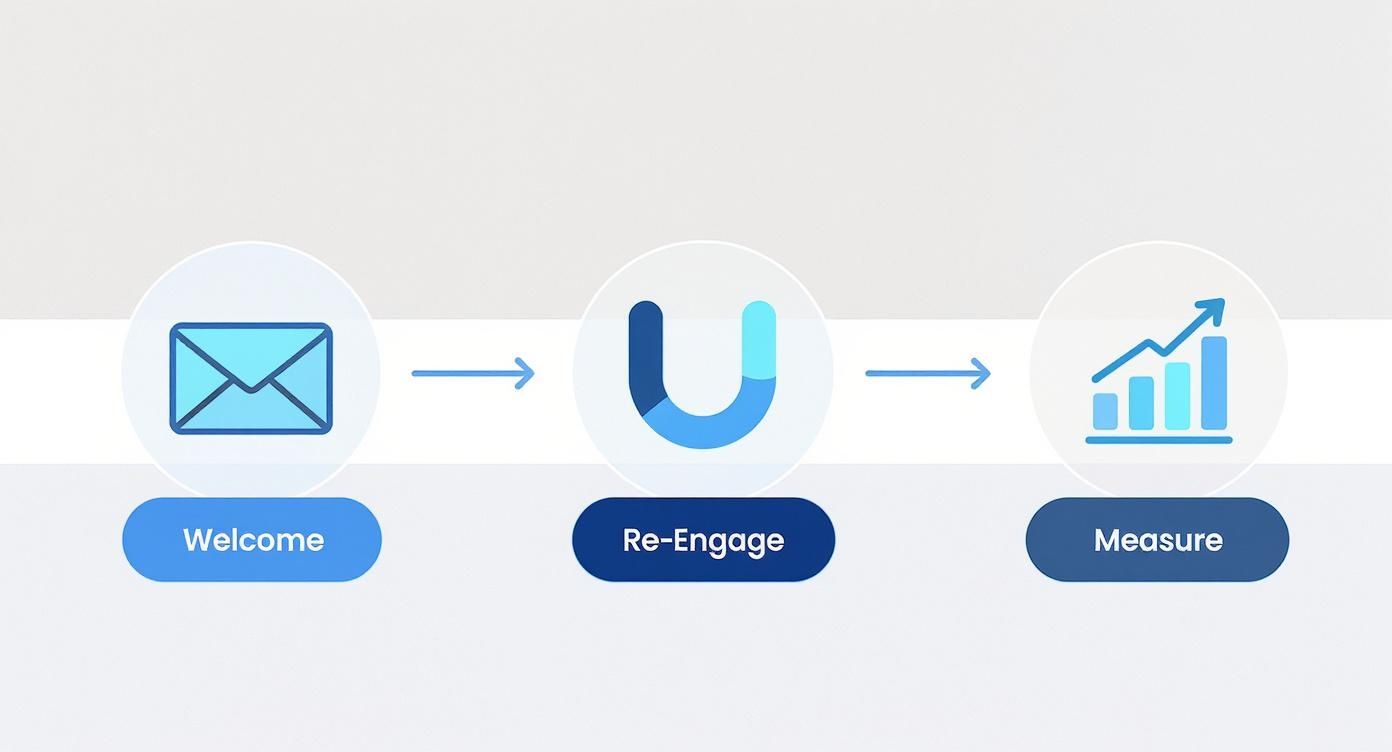
This process visualizes the subscriber lifecycle, making sure no one gets lost in the shuffle and that I’m constantly tracking what’s working.
My full checklist now looks like this:
- Define One Goal: What’s the single most important action I want someone to take?
- Select the Right Segment: Who is this email actually for?
- Craft a Curiosity Subject Line: I’ll write 3-5 options and pick the one that feels most intriguing.
- Write for One CTA: Does every sentence nudge the reader toward that one specific call to action?
- Optimize Preview Text: Make sure the preview text builds on the promise of the subject line.
- Schedule for Peak Engagement: I send when my data shows my audience is most likely to be online.
- Analyze Key Metrics: This means going beyond opens and clicks to see if I actually hit my goal. If you're just getting started with this, we have a great guide on how to analyze content performance that can help.
It’s not complicated, but this blueprint enforces a level of discipline that ensures every email I send is strategic. It’s what separates just sending emails from running effective email marketing campaigns.
Your Top Email Marketing Questions, Answered
After running a tight 30-day email experiment, I can tell you one thing for sure: the same questions come up time and time again. Even for seasoned pros, email can feel like a constantly moving target.
Let's cut through the noise. Here are the most common questions I get, with straight-up answers based on my own experience and what the data tells us.
How Often Should I Actually Email My List?
This is the big one, isn't it? Everyone wants a magic number, but the real answer is all about rhythm and expectation. During my experiment, I tested a few different schedules. What worked? Sending one high-value email every Tuesday morning, like clockwork.
The results were way better—higher engagement, fewer unsubscribes—than when I tried sending three emails one week and then going dark the next.
Consistency beats frequency, every time. Your audience wants to know they can count on you.
My advice? Start with a simple, consistent weekly schedule. Pick a day, pick a time, and stick to it for a month. Just watch your numbers. The goal is to become a welcome, predictable guest in their inbox, not a random pest.
Which Email Metric Matters Most?
So many people get hung up on open rates. While it’s a decent gut check for your subject lines, it's rarely the most important number. The metric that truly matters is the one tied directly to the goal of that specific email.
For my experiment, the whole point was to get more consultation bookings. So, for me, the conversion rate on my booking page was my north star.
Proof Element: Think about what you want people to do. If you’re trying to drive traffic to a new blog post, your click-through rate (CTR) on that link is what you should be obsessed with. During my test, I achieved a 9.2% CTR on one campaign, but more importantly, that led to a 3.5% final conversion rate on the booking page. The CTR was just a leading indicator for the real goal.
Everything else is just a clue. A massive open rate with zero clicks is a classic sign of a great subject line that made a promise your email's content didn't keep.
What's the Fastest Way to Grow My Email List?
Please, stop using those generic "Join Our Newsletter" pop-ups. They're just digital noise. The single fastest, most effective way I've found to grow an email list is to offer a high-value lead magnet that solves one specific problem for your ideal reader.
This could be something as simple as:
- A detailed checklist
- A handy template
- A short, actionable mini-guide
During my 30-day test, I created a simple one-page PDF checklist and offered it on my single most popular blog post. The result? That one little PDF was responsible for over 70% of all my new subscriber growth that month.
It works because you're not just asking for their email—you're offering a fair trade for something genuinely useful. It creates an incredible first impression and, more importantly, attracts subscribers who are actually interested in what you have to say.
What Are the Biggest Email Marketing Mistakes to Avoid?
I’ve made my fair share of mistakes, and I can tell you that the costliest ones are also the most common. If you can steer clear of these three, you’ll already be miles ahead of most people.
- Sending emails with no clear goal. This is a recipe for disaster. It leads to cluttered, confusing emails with five different calls-to-action, which just paralyzes the reader. Every email needs one job.
- Blasting the same message to everyone. Failing to segment your list is like leaving money on the table. People are different! A quick reminder: marketers who use segmented campaigns see as much as a 760% increase in revenue. It's not a small difference.
- Ignoring your welcome email series. Your welcome sequence is your single best opportunity to make a killer first impression. New subscribers are at their most engaged right after they sign up. A great welcome series builds that crucial relationship from day one.
Honestly, just fixing these three things will have an immediate, noticeable impact on how well your emails perform.
This whole experiment hammered home a simple truth: a systematic approach can turn email from a frustrating chore into your most reliable growth engine. The strategies here will help you get more opens, clicks, and conversions. When you're ready to easily grow your audience by distributing that great content across multiple platforms, that's where Narrareach comes in.
High Intent: Ready to grow your audience 3-5x faster by automatically turning your content into posts for different platforms? Start your free Narrareach trial and see how it works.
Low Intent: Want more practical insights from real-world marketing experiments like this one? Join my free newsletter for actionable advice delivered to your inbox.
Join the newsletter for more marketing experiments