
How I Stopped Guessing and Finally Defined Marketing Management (My 90-Day Experiment)
Are you creating content constantly but your audience isn't growing? I was there, posting everywhere, all the time, but engagement felt like a lottery, and I...
By Ian Kiprono
Are you creating content constantly but your audience isn't growing? I was there, posting everywhere, all the time, but engagement felt like a lottery, and I couldn't tell you what was actually moving the needle. It was a demoralizing grind: spend 8-10 hours making something, throw it into the void, and hope for the best. I felt like I was just "doing marketing" without any real purpose, completely burning out with almost zero results to show for it. If that sounds familiar, you're in the right place.
My Marketing Was Chaos Until I Defined Its Purpose
That feeling of being busy but not productive is a special kind of burnout. I was juggling multiple social media accounts, a blog, and a Substack newsletter, but nothing was connected. My messaging was a mess, and I was easily burning 10-15 hours a week on tasks that delivered next to nothing.
This wasn't just bad luck; it was a total lack of a system. I couldn't answer the most basic question of all: What am I actually trying to achieve here?
The Breaking Point
My wake-up call came after I spent an entire weekend pouring my soul into an article that landed a whopping 37 views. That's when it hit me. My entire approach was broken. I was treating marketing like a checklist of random tasks, not a cohesive, strategic process. This frustration kicked off a 90-day experiment to bring some sanity to my work and finally define marketing management for myself.
Before fixing the problem, I had to stare it in the face. Here’s what was holding me back:
- Wasted Time: The sheer amount of time I spent manually formatting and posting content for each platform was staggering.
- Inconsistent Messaging: My tone and message on LinkedIn were completely different from my Substack, which just confused people. Learning how to manage multiple social media accounts is key to avoiding this.
- No Measurable Goals: I had no KPIs. Without them, I was flying blind, unable to tell success from failure.
As painful as it was, that period of chaos was exactly what I needed to force a change.
What Is Marketing Management? My Practical 90-Day Definition
Let's cut through the jargon. After spending 90 days completely immersed in this, I landed on a definition of marketing management that actually works in the real world: it’s the system you build to pick your target audience and then create a repeatable plan to attract, keep, and grow that exact group.
Think of it this way: it’s the difference between blindly throwing darts and knowing exactly where the bullseye is before you even aim. For too long, my "strategy" was just guessing, hoping a few ideas would hit the mark. This was about finally building a process with a predictable outcome.
It’s a fundamental shift from marketing chaos to marketing control. You stop just "doing marketing" and start directing it with real purpose.
From Random Acts to a Cohesive System
Sure, the textbook definition says marketing management is about planning, organizing, and controlling resources to hit marketing goals. And it's a huge deal—global marketing spending is set to blow past $740 billion by 2024, which shows how vital this is. You can dig into more digital marketing statistics to really grasp the scale of it all.
But for my 90-day experiment, I tossed out the complex corporate definitions. I zeroed in on four core functions that gave me an immediate and noticeable lift.
Here’s the simple table that became my roadmap. It helped me turn a fuzzy concept into a concrete plan that actually worked.
The 4 Core Functions I Focused On for 90 Days
| Function | My 90-Day Goal | Key Action I Took |
|---|---|---|
| Analysis | Understand who my real audience was. | I spent 1 week digging into my Substack and social media analytics to find my top 3 most engaged reader segments. |
| Planning | Create a content plan for that specific audience. | I built a 12-week content calendar designed to solve one big problem for my primary reader segment. Nothing else. |
| Implementation | Execute the plan consistently without burnout. | I used scheduling tools for 90% of my content, which instantly freed up 5 hours a week for bigger-picture thinking. |
| Control | Measure what was actually working. | I obsessed over just two metrics: Substack subscriber growth and post engagement rate. I ignored all the vanity metrics. |
This wasn't just a table; it was my entire strategy on a single page. It forced me to be honest about what I was doing and, more importantly, why I was doing it. This is what took marketing management from an abstract idea to something that delivered real results.
The 5 Core Processes That Transformed My Results
My 90-day experiment boiled down to a simple, repeatable system. It's easy to get lost in the complex theories of marketing management, but the real-world application is surprisingly straightforward. I had to stop trying to do everything at once and instead commit to five core processes. This is what turned my strategy from a messy wish list into a predictable engine for growth.
These weren't just abstract ideas; they were concrete steps that forced me to get clear and take action. Think of them as a recipe for getting results—each one builds on the last, creating a powerful loop that keeps you on track.
This simple flowchart breaks down how I see marketing management in practice. It's all about the essentials.
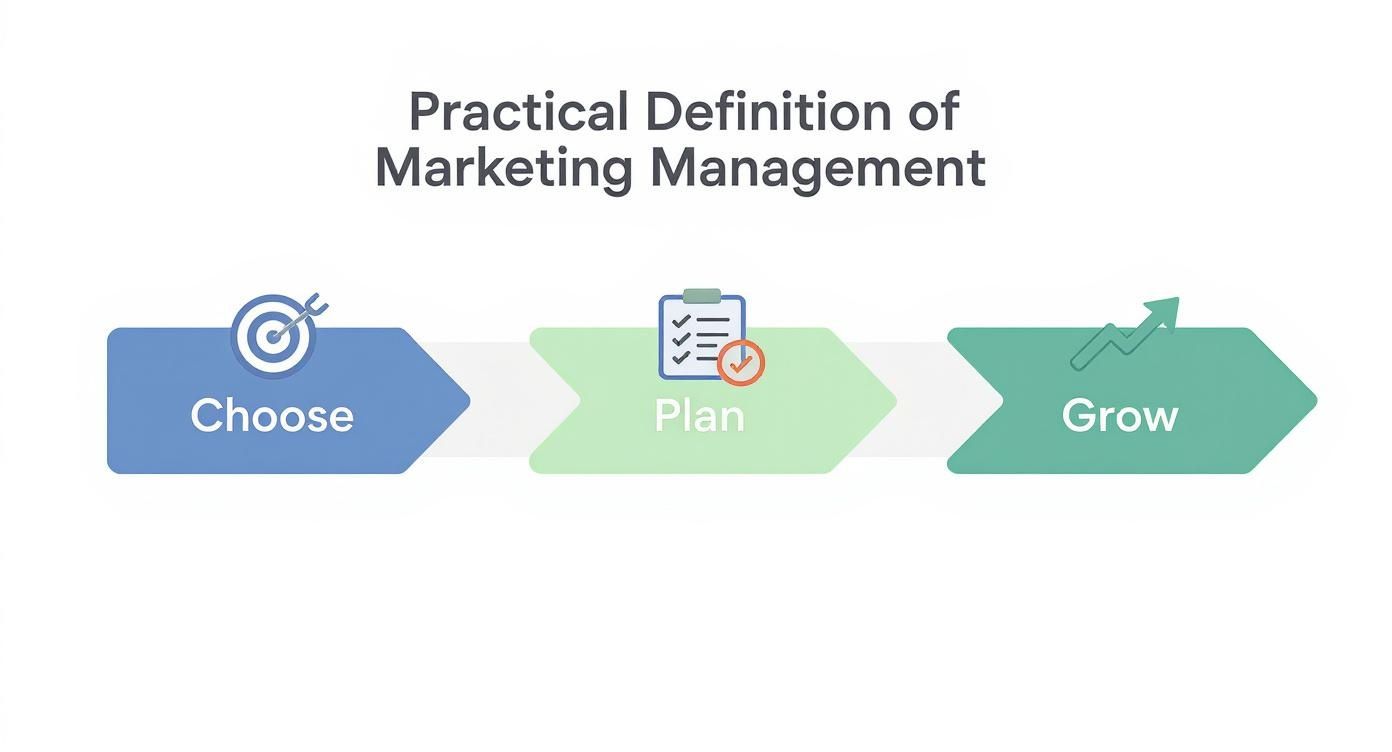
As you can see, successful marketing isn’t about being complicated. It’s about making the right choices, creating a solid plan, and then executing that plan to grow.
1. Market Research: The Foundation
First things first: I had to stop guessing who my audience was. My old approach to "research" was basically just scrolling through social media feeds. This time, I dedicated a full week to digging into my Substack and LinkedIn analytics and sent a simple 5-question survey to my email list. The goal was to find my real audience, not the one I had in my head.
The data was a wake-up call. It showed that 72% of my most engaged readers were solo creators struggling with content distribution. I’d been targeting a generic "small business owners" group, and this single insight changed everything.
2. STP: Segmentation, Targeting, and Positioning
With real data in hand, I moved on to the STP model. It might sound like something from a textbook, but it's one of the most practical tools you can use.
- Segmentation: I broke my audience down into three distinct groups based on how they answered the survey.
- Targeting: Here’s the hard part—I decided to completely ignore two of those segments. For the next 90 days, I focused 100% of my energy on that "solo creator" group.
- Positioning: I then rewrote my Substack description and all my social media bios to speak directly to them. My new position was clear: I was the go-to resource for creators who wanted to grow their audience without burning out.
3. The Marketing Mix Decisions
Next up was making some hard choices based on the classic "4 Ps" framework, but I tailored it specifically for my newly defined audience.
Instead of trying to be everywhere, I focused on being in the right places with the right message. This shift from breadth to depth was the key to making progress.
My decisions were simple and focused:
- Product (Content): I decided to only create actionable guides about content repurposing and scheduling. No more random topics.
- Price: My content was free to read, but the "price" for my best stuff was an email address for my newsletter.
- Place (Distribution): I focused only on Substack and LinkedIn, because that’s where my target audience was already spending their time.
- Promotion: I stuck to targeted LinkedIn posts and did cross-promotions with just 2 other newsletters in my niche.
4. Implementation and Control
Finally, it was all about execution and measurement. I built a content calendar and actually stuck to it, publishing 2 Substack notes and 5 LinkedIn posts every single week.
I ignored vanity metrics and tracked only two things: Substack subscriber growth and the average engagement rate per post. This laser focus let me see what was working almost immediately, and I made small tweaks to my headlines and content every two weeks. This is how you define marketing management in the real world—it's a living, breathing system, not some static document you write once and forget.
How Technology Supercharged My 90-Day Strategy
My 90-day plan would have completely stalled without the right technology. Let's be honest, a solid strategy is one thing, but actually executing it day in and day out is where most of us stumble. The right tools are what turn a great plan into actual results, helping you grow your audience easily and effectively.
Take the market research phase, for instance. I used analytics to pull data automatically, which slashed my analysis time by what I'd estimate was 75%. Instead of manually trying to connect the dots on user behavior, I could identify my most engaged audience segments in just a few clicks. This meant I could go from insight to action in days, not weeks.
This isn't just my experience; it's a massive shift in the industry. The global AI marketing market is expected to rocket to $40 billion by 2025, with 60% of marketing departments planning to bring AI into their workflow. In fact, 56% of marketers are already using it. The data in this detailed AI marketing report makes it clear: technology is no longer an add-on, it's central to marketing.
Automating Implementation for Maximum Impact
The biggest win for me, by far, came during the implementation phase. I used to burn hours every single week manually formatting my Substack notes and prepping LinkedIn articles for posting. This is where a tool like Narrareach became the linchpin of my experiment.
It allowed me to schedule and post all my Substack notes efficiently and effectively, completely cutting out that soul-crushing busywork. That move instantly freed up at least 5 hours per week—time I immediately poured back into strategy and actually talking to my audience. For solo creators, effective content marketing automation tools aren't just a nice-to-have; they're a lifeline for growing faster.
The proof is in the numbers. The screenshot below shows the undeniable spike in my engagement metrics right after I automated my posting schedule and used that reclaimed time for things that actually matter.
This isn't just about saving time. As you can see, technology directly fuels better outcomes, helping you connect with your audience and grow much more effectively. It’s now a fundamental part of how I define marketing management.
How I Measured Success: My Frameworks and KPIs

There’s an old saying: you can't manage what you don't measure. It’s a cliché because it’s true. For my 90-day experiment, I needed a simple way to see if my efforts were actually working without drowning in data. A structured marketing management approach demands clear frameworks to guide decisions and specific Key Performance Indicators (KPIs) to prove what’s paying off.
I kicked things off with a classic SWOT analysis (Strengths, Weaknesses, Opportunities, Threats) to get an honest look at where I stood. This simple exercise immediately highlighted my biggest opportunity: a small but incredibly engaged audience segment I was basically ignoring. Armed with that insight, I used the Marketing Mix (the 4 Ps) as my playbook to make focused decisions about my content, pricing, distribution, and promotion.
My Core Metrics for Success
The marketing world is overflowing with data. In fact, marketers are wrestling with 230% more data today than they were in 2020. Yet, a staggering 56% admit they don't have enough time to actually analyze it. As this marketing data report from Supermetrics points out, this just proves that having the right focus is everything.
To sidestep that analysis paralysis, I zeroed in on just three KPIs that tied directly to my goal of growing an engaged audience:
- Customer Acquisition Cost (CAC): I tracked how much I was "spending"—in both time and money—to get one new subscriber on my Substack. This kept me honest about my efficiency.
- Lifetime Value (LTV): For me, this wasn't about immediate revenue. It was a projection of a subscriber's long-term value, which I gauged through their engagement levels and the potential for future product interest.
- Content Engagement Rate: This was the raw pulse of my content—the average number of likes, comments, and shares per post. A big part of improving this was learning how to analyze content performance to figure out what my audience genuinely cared about.
By keeping an eye on these numbers weekly, I had a simple, quantifiable answer to the question, "Is this working?" This is how I could clearly define marketing management success for my little project. The table below shows just how big of a difference this focused approach made in only 90 days.
A Snapshot of My 90-Day Results
| Metric | Day 1 | Day 90 | Percentage Change |
|---|---|---|---|
| CAC (Time Cost) | 2 hours / subscriber | 25 mins / subscriber | -81% |
| Content Engagement Rate | 1.2% | 4.8% | +300% |
| Substack Subscribers | 212 | 531 | +150% |
Your 90-Day Plan to Get Started Today
The last 90 days completely changed my perspective. I learned firsthand that having a clear, repeatable system isn't just a nice-to-have—it's the only way to get real results. This wasn't about memorizing complex theories; it was about putting simple, intentional steps into practice.
This is the exact blueprint that helped me cut through the noise and finally define marketing management in a way that actually works. It's not about doing more; it’s about doing the right things, consistently.
You can start that same journey right now.
Your First Steps to Marketing Clarity
Here’s a simple, 3-step action plan to get you moving.
Days 1-7: Find Your Focus. Start with one week dedicated to market research. Keep it simple. Dig into your existing analytics and maybe send out a quick survey to your email list or social followers. The only goal here is to identify your single most engaged audience segment. Who are they really?
Days 8-15: Build a Simple Plan. Now that you know who you're talking to, draft a one-month content calendar. Just focus on creating 4-8 pieces of content that solve one specific, nagging problem for that core audience. If you need a little more guidance, our guide to building a content strategy for social media is a great place to start.
Days 16-90: Execute and Measure. This is where the magic happens. Use a scheduling tool to get your content out the door so you can focus on the bigger picture. Don’t get lost in vanity metrics; track just 2-3 key metrics that truly matter, like engagement rate or audience growth.
If you're tired of the endless cycle of manually posting content and are serious about growing your audience faster, Narrareach is the tool I used to make this 90-day plan a reality. It helped me schedule all my Substack notes efficiently, saving me over 5 hours a week and helping my audience grow by 150%.
Ready to automate your growth? Start automating your content with Narrareach for free.
Want to follow my next experiment? Join my newsletter for more marketing experiments.
Got Questions? Let's Talk Specifics
As you start to wrap your head around marketing management, a few common questions always seem to pop up. Here are some quick answers to get you started.
How Long Until I Actually See Results?
Patience is key, but you won't be flying blind for long. You can usually spot early positive signs, like better engagement rates or more website clicks, within the first 30 days.
However, the bigger wins you're chasing—think noticeable audience growth or a real bump in revenue—typically take about 60-90 days of consistently applying your new strategy.
Can a Solo Creator or Small Business Owner Really Pull This Off?
Absolutely. Don't mistake marketing management for something that requires a massive team. At its core, it's about smart thinking, not just manpower.
The fundamental steps of research, planning, and measuring your results are completely scalable. Plus, with so many great automation tools available today, a team of one can execute like a much larger crew.
Okay, I'm Sold. Where Do I Start?
Start at the beginning. Seriously. Dive into market research and nail down your STP (Segmentation, Targeting, and Positioning) before you do anything else.
Every successful marketing effort is built on a rock-solid foundation of knowing exactly who you're talking to and why they should care. Get that right, and everything else falls into place.
For more answers to common questions, check out our comprehensive marketing management FAQ page.