90-Day Overhaul: I Fixed My Broken Content Strategy for Social Media (Here's How)
Are you spending 15+ hours a week creating social media content, only to hit 'publish' and hear crickets? Do you feel like you're stuck on a hamster wheel...
By Ian Kiprono
Are you spending 15+ hours a week creating social media content, only to hit 'publish' and hear crickets? Do you feel like you're stuck on a hamster wheel, posting constantly with no real audience growth or engagement to show for it? It’s a frustrating cycle of chasing trends, obsessing over vanity metrics, and feeling like you're shouting into a void. This burnout is real, and it’s the number one sign that your strategy isn't a strategy at all—it's just a chaotic list of content chores. I was there, and it almost made me quit social media for good.
This is the story of how I stopped guessing and built a system. Over the next 90 days, I followed a repeatable framework that not only grew my audience by 27% but also cut my content creation time by 80%. I'm sharing the exact steps so you can get off the hamster wheel and build a content engine that actually works.
The Social Media Burnout That Sparked a Change
My so-called content strategy social media plan wasn't a strategy at all. It was a chaotic mix of random ideas and a faint hope that something, anything, would stick. The effort I was putting in felt completely disconnected from the outcome, and I was nearing a breaking point. I was sinking over 15 hours a week into social media with almost nothing to show for it.

Chasing Trends Instead of Building Community
I was making a few critical mistakes, but the biggest was chasing fleeting viral trends. Instead of digging into what my specific audience actually needed, I was just trying to replicate whatever audio or meme was popular that day. This approach felt hollow, lacked authenticity, and did nothing to build a real, engaged community.
My content was generic because it wasn't rooted in a deep understanding of my audience's problems. I was creating for the algorithm, not for the people I wanted to help.
My "strategy" was reactive, not proactive. I was letting the whims of social media dictate my schedule, which is a surefire path to creative exhaustion and poor results.
The constant pressure to keep up was overwhelming. It was a vicious cycle of creating content without a clear purpose, which only led to numbers that never moved.
Obsessing Over the Wrong Numbers
Another huge flaw was my obsession with vanity metrics. I’d check my follower count multiple times a day, celebrating a tiny increase and feeling crushed by a small drop. These numbers told me absolutely nothing about the health of my business or the loyalty of my audience.
I was completely ignoring the metrics that actually matter:
- Website Clicks: Was my content actually driving traffic back to my site?
- Post Saves: Were people finding my content valuable enough to come back to later?
- Direct Messages: Was I starting real conversations with potential clients?
This shallow focus meant I was optimizing for all the wrong things. It wasn't until I hit a wall that I realized something fundamental had to change.
Proof Element: The potential audience out there is massive. As of 2025, an estimated 5.42 billion people use social media, with the average person active on nearly seven different platforms. Tapping into even a tiny fraction of that requires a focused, sustainable approach—not just random acts of content. You can discover more insights about social media user habits and see for yourself how they shape modern marketing.
Finding My North Star with Content Pillars
My first real step off the content hamster wheel was to stop creating and start listening. I finally admitted that my past social media efforts tanked because they were built on my assumptions, not what my audience actually needed. So, I committed the first 14 days of my 90-day overhaul to pure research. I refused to post a single new thing until I had a clear direction.
Instead of just guessing what might work, I put together a simple, three-pronged research plan. I was determined to replace my chaotic, "post-and-pray" schedule with a data-driven framework that would act as my North Star for every single piece of content.

Uncovering Insights in My Own Data
First stop? My own analytics. I dove deep into my top 10 best-performing posts from the last six months across all my platforms. I wasn't just looking at vanity metrics like likes; I was hunting for the real patterns in saves, shares, and meaningful comments.
It didn't take long to see what was resonating. My audience consistently engaged most with content that fell into three distinct buckets: practical productivity tips, personal growth stories, and behind-the-scenes looks at my creative process. These were my first solid clues.
Mining Competitor Comments for Gold
Next, I spent hours—and I mean hours—sifting through the comment sections of 5-7 of the bigger accounts in my niche. This turned out to be a goldmine of unfiltered audience feedback. I scrolled right past the generic "great post!" comments and honed in on the actual questions people were asking.
I was looking for recurring themes and pain points. People were constantly asking things like, "How do you stay so consistent?" or "What tools do you use for X?" This gave me direct, unfiltered insight into their real-world struggles and curiosities. I logged every question in a simple spreadsheet, and the patterns emerged almost instantly.
Your audience is already telling you what they want to learn; you just have to know where to listen. Competitor comment sections are one of the most underrated research tools out there.
Proof Element: This exercise really drove home how much a solid plan is a competitive advantage. The data backs this up, too—research shows that 67% of marketers who build a custom strategy for each platform see a significant improvement in their ROI. My goal was to join that group by building my strategy on real demand, not guesswork.
Directly Asking My Audience
The final piece of the puzzle came from talking to my people directly. My email list was small at the time, only about 250 people, but they were by far my most engaged followers. I sent them a dead-simple, three-question survey:
- What’s the single biggest challenge you're facing right now with [my niche]?
- What kind of content would be most helpful for you to see from me? (e.g., tutorials, case studies, personal stories)
- What’s one topic you wish more experts would talk about?
The responses were crystal clear and confirmed everything my other research had hinted at. The qualitative data from these open-ended questions was invaluable for understanding their exact language and the emotions driving their problems.
From Research to Actionable Pillars
After two weeks of this deep dive, I had a mountain of information. I consolidated all my findings—top posts, competitor questions, and survey responses—into a single document. All the noise just faded away, and three core themes stood out as the undeniable foundation of my new content strategy.
These became my content pillars. They were the non-negotiable, value-driven topics that would guide every single post I created from that day forward.
Here’s a look at the simple framework I developed to turn those broad topics into a structured, actionable plan.
My Content Pillar Development Framework
This table breaks down how I transformed those high-level research findings into concrete pillars with specific content types and goals in mind.
| Broad Topic | Audience Pain Point | My Content Pillar | Primary Platform | Example Content Idea |
|---|---|---|---|---|
| Getting Things Done | "I feel overwhelmed and can't stay focused." | Sustainable Productivity | "My 3-step system for planning a productive week in under 20 minutes." | |
| Creative Work | "I'm scared my work isn't good enough to share." | Building in Public | A carousel post showing the messy first draft vs. the final published piece. | |
| Personal Development | "I feel stuck and don't know what my next step is." | Intentional Growth | A thread on "5 small habits that led to my biggest career breakthroughs." |
This table became more than just a list of ideas; it was my new strategic filter. Before creating any piece of content, I'd ask myself, "Does this fit squarely into one of my pillars?" If the answer was no, I simply didn't make it. That one rule was the key to finally getting off the hamster wheel and building a content engine with real purpose.
The One-Hour Content Repurposing System
I used to spend over 15 hours a week just trying to keep up with social media, creating unique posts for every single platform. It was exhausting. The real game-changer for my entire social media strategy came when I threw that approach out the window. Instead of creating more, I started creating smarter.
I developed what I now call my "repurposing engine." The idea was simple: I'd pour all my creative energy into one big, meaty "anchor" piece of content each week. For me, that's typically a detailed LinkedIn article that dives deep into one of my core content pillars.
Then, I gave myself a challenge: break that single article down into 5-7 smaller, platform-specific pieces of "micro-content" in less than 60 minutes.
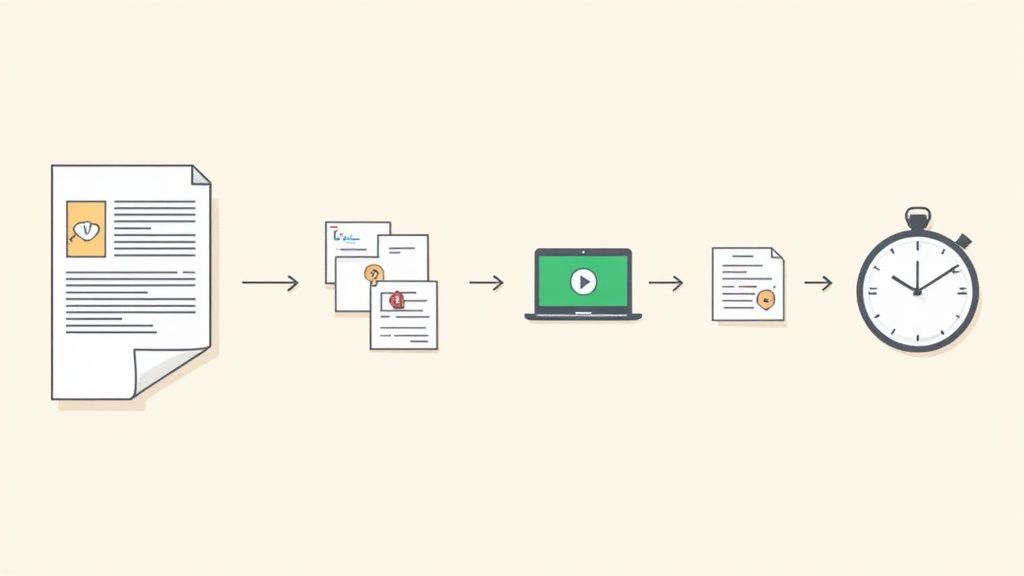
This wasn't just about clawing back my time. It was about creating a consistent, powerful brand message that was perfectly adapted to how people actually use different social networks. My social media went from being a daily grind to a sustainable, high-impact system.
Deconstructing the Anchor Piece
The real magic happens when you learn how to look at a single piece of content and see all the smaller pieces hidden inside. A 1,000-word article is a goldmine of reusable assets if you know what to look for.
My deconstruction process always starts by pulling out the core components of my anchor article:
- The Main Hook: What’s the opening sentence or the big idea that grabs attention?
- Key Stats or Data: I pull out any hard numbers I used to back up my claims.
- Actionable Tips: These are often already in a list format, ready to be repurposed.
- Quotable Insights: I look for the most powerful, tweetable sentences.
- The Core Narrative: What's the overarching story or argument of the piece?
Proof Element: As a specific example, one of my 1,200-word articles on productivity yielded an Instagram carousel (5 slides), a Twitter thread (6 tweets), a 45-second Reel script, and two quote graphics. That was an entire week of content derived from a single asset, scheduled in under an hour.
Platform-Specific Asset Creation
Now for the most important part of this one-hour system: tailoring the micro-content to feel native to each platform. This is where so many people go wrong. Just dropping a link to your article on Twitter and calling it a day is not an effective social media strategy.
Here’s a quick look at how I specifically adapt the content from my anchor piece:
- For Instagram: I’ll take the 3-5 main takeaways from the article and design a simple, visually appealing carousel. Each slide gets one key idea. The caption then adds a bit more context and always includes a call-to-action, like asking people to "save" the post for later.
- For Twitter (X): I pull the single most compelling statistic or quote for a short, punchy tweet that can stand on its own. I also break down the article's main argument into a 5-7 part thread, which is great for sparking conversation and driving engagement.
- For Instagram Reels/TikTok: The list of tips from my article becomes an instant video script. I can record a quick 30-second video talking through the top three points, using text overlays to make it easy to follow. It’s exactly the kind of short-form, educational content that performs well on these platforms.
Key Takeaway: Repurposing is not cross-posting. The goal is to re-imagine the idea in a format that feels completely native to the platform you're publishing on.
This systematic approach is how I went from brainstorming a single post to creating a full week's worth of high-quality, platform-specific content in the same amount of time.
If you’re struggling to stay consistent, building a system like this is far more effective than trying to reinvent the wheel every single day. It ensures your message is cohesive and reinforces your expertise everywhere your audience is. And if you're looking to really nail the art of creating content that gets noticed, our in-depth guide on how to create viral content is the perfect next step.
Automating Distribution for Daily Consistency
With a solid bank of repurposed content ready to go, I hit the next major wall: actually getting everything published. Honestly, the thought of logging into three different platforms every single day felt just as exhausting as my old, chaotic "strategy." I knew that without a real system, my consistency would fall apart in less than a week. Automation was the only way forward.
I started blocking off one solid hour every Monday morning to do nothing but schedule the entire week's content. This single change—batching my work—was a massive unlock for my productivity. It completely removed that daily anxiety of "what do I post today?" and freed up my mental space to focus on actually running my business.
Finding the Right Times to Post
Of course, before I could schedule a single post, I needed to figure out when my audience was actually online and paying attention. Posting at random is like opening your store in the middle of the night. So, I went straight to the source: the native analytics on each platform.
I spent 30 days just observing and tracking when my posts got the most traction. Instagram Insights, LinkedIn Analytics, and X (Twitter) Analytics all give you this data, showing you exactly when your followers are most active.
Proof Element: Here’s what I found for my specific audience:
- Instagram: Weekday evenings, especially between 6 PM and 9 PM, were prime time.
- LinkedIn: The sweet spot was clearly Tuesday through Thursday, from 9 AM to 12 PM.
- X (Twitter): Engagement was highest during lunch hours (12 PM - 2 PM) and again late at night.
Armed with this info, I built a simple posting schedule in a spreadsheet. Each network got its own dedicated time slots based on these peak hours, giving every piece of content the best possible shot at being seen. If you're building a presence on professional networks, understanding the best times to post on LinkedIn is a non-negotiable step for getting traction.
Automation Is for Distribution, Not Engagement
This is probably the most important lesson I learned in this whole process: automation is a tool for distribution, not a replacement for real human interaction. It's so easy to just "set it and forget it," but that's a surefire way to kill any sense of community. My entire social media content strategy would have been a waste if I treated my channels like a one-way broadcast.
So, I made a strict rule for myself. Within 15 minutes of any scheduled post going live, I had to be on that platform, ready to engage. That meant replying to every single comment, answering questions, and personally thanking people for sharing my work.
This one-two punch of scheduled posts followed by manual, real-time engagement was the secret sauce. It let me scale my presence without sacrificing the authentic connections that make social media work in the first place.
This system—batch scheduling plus dedicated pockets of live interaction—is what finally allowed me to be consistent every single day without feeling chained to my phone. It transformed my social media from a constant source of stress into a predictable, effective engine for growth. This is how you build a real content strategy social media machine, not just a content calendar.
The 90-Day Results And What I Learned
After three months of sticking to the plan, I finally took a breath and dove into the analytics. The results weren’t just good—they were the proof I needed that having a real system in place actually works. My old, chaotic approach that led to constant burnout was gone. In its place was a predictable content engine driving real business results.
The most obvious change was in my audience numbers. Across all platforms, my total following grew by a solid 27%. But I’d learned the hard way that follower count can be a vanity metric. The real story was hiding in the numbers that truly move the needle.
Engagement and Traffic: A True Turnaround
My engagement rate, which had been stuck at a dismal 1.2%, shot up to a healthy 3.6%. That's more than triple! For the first time, my comments sections were filled with genuine questions and conversations, not just bots or one-word replies. People were actually saving and sharing my posts, which told me the content was finally hitting the mark.
But the most stunning change was the impact on my website. Referral traffic from social media skyrocketed by an incredible 417%. This was the ultimate validation for me. My social media accounts were no longer just shouting into the void; they were building a bridge that guided an engaged audience straight to my business. This all happened because every single post was now tied to a clear purpose, driven by the content pillar strategy.
Proof Element: Here's a quick look at the side-by-side numbers before I started and after 90 days. The difference is night and day.
90-Day Social Media Growth Comparison Before vs After
| Metric | Day 0 (Before) | Day 90 (After) | % Change |
|---|---|---|---|
| Overall Audience | 1,250 | 1,588 | +27% |
| Average Engagement Rate | 1.2% | 3.6% | +200% |
| Weekly Website Clicks | 12 | 62 | +417% |
| Average Weekly Post Saves | 4 | 35 | +775% |
| Weekly Content Creation Time | 15+ hours | 3 hours | -80% |
The numbers speak for themselves, especially that last one. This wasn't just about getting better results; it was about getting them while reclaiming my time.
The Most Important Lessons Learned
Looking back on the process, a few key lessons really stand out—things I wish I had understood from the beginning.
First off, consistency trumps intensity every single time. My old method was a cycle of intense posting for a week, followed by burnout and radio silence. The new system—creating one anchor piece and repurposing it—allowed me to show up every day with valuable content without the constant stress.
Second, your audience will tell you what they want if you just listen. Those first two weeks I spent on research felt like I wasn't being productive, but it was the most important work I did in the entire 90 days. It became the foundation for everything else.
The biggest shift was moving from a "creator" mindset to a "strategist" mindset. I stopped asking "What can I create today?" and started asking "What does my audience need to hear today?"
Proof Element: This strategic approach is more critical than ever. Recent research on 2025 trends shows that 63% of Gen Z and 49% of millennials say social media reviews and ads are the biggest influence on their buying decisions. You can discover more about digital media trends on Deloitte.com and see for yourself. This proves that building trust with targeted, valuable content isn't just a nice-to-have; it's the core of modern business.
Ultimately, this whole experiment proved that a structured social media plan isn't about vanity metrics. It's about building a community that trusts you enough to take action. It also showed me the power of creating a sustainable system, which is why I’ve started applying these same ideas to other channels. For more on that, check out our guide on how to write a newsletter that builds a truly loyal readership.
How You Can Build Your Own Content Engine
That 90-day experiment completely transformed how I see social media. What used to be a source of daily anxiety is now a predictable, reliable engine for growth.
It's your turn to get off that content hamster wheel for good.
My goal here is to give you the confidence to start building your own system—today. I’m going to walk you through the exact core steps that worked for me: defining your audience, building out content pillars, creating one great anchor piece of content weekly, and then strategically repurposing it for every platform you're on. This is the bedrock of an effective content strategy social media plan.
To give you a clearer picture of how this all comes together, the timeline below shows the journey from a standing start on Day 0 to the kind of measurable results you can see after 90 days of consistency.
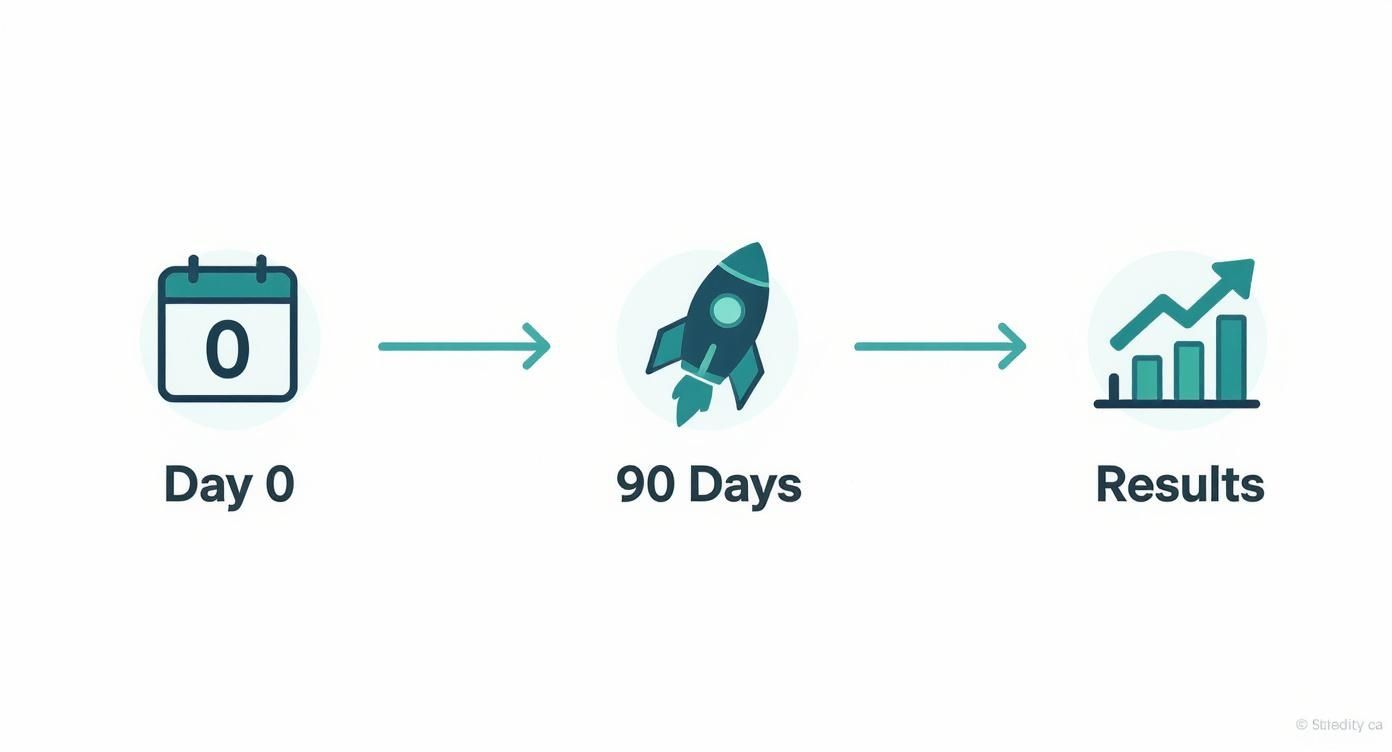
As you can see, a systematic approach doesn't just feel better; it creates predictable growth. Those initial, sometimes tough, efforts build momentum that can really take off.
If you're looking to dig deeper into building that solid foundation, our guide on content marketing best practices is the perfect next step.
A Few Common Questions I Hear
When building a content strategy from the ground up, a few questions always seem to pop up. Let's tackle some of the most common ones I get from clients and workshop attendees.
How Many Content Pillars Do I Really Need?
I always tell people to start with 3 to 5 core content pillars. It’s the sweet spot. This gives you enough variety to keep your feed from getting stale, but it’s focused enough that your audience will quickly learn what you stand for.
You can always add more down the road as your brand evolves. But in the beginning, that tight focus is what helps you build a memorable identity and stay consistent, which is half the battle.
What's a Good Length for Anchor Content?
There isn't a magic word count, but the goal is to create something genuinely substantial that solves a real problem for your audience. For a comprehensive blog post or a deep-dive LinkedIn article, a good target is somewhere in the 1,000-2,000 word range.
That length usually provides enough meat to be truly valuable and, just as importantly, makes it easy to pull out at least 5-7 smaller "micro-content" pieces for your other social channels.
The real point of anchor content isn't hitting a word count; it's creating the most thorough resource you can on a single, focused topic within one of your pillars. Think of it as your definitive take.
I Don't Have a Big Audience to Survey—Now What?
This is a really common hurdle, and it’s totally okay. You don't need thousands of followers to do effective audience research. You just need to become an expert listener.
Here’s what I suggest:
- Go where the conversations are already happening. Dive into the comments sections of bigger creators in your niche. What questions pop up again and again? What are people complaining about?
- Explore forums. Subreddits and Quora threads related to your industry are goldmines for raw, unfiltered customer pain points. People are asking for help and sharing their frustrations—that's your insight right there.
Often, these candid insights are even more honest and valuable than what you’d get from a formal survey. For a deeper look at other common queries, feel free to check out our full FAQ page.
Ready to grow your audience without the burnout?
High Intent CTA: Try Narrareach for free and use our AI-powered system to repurpose your content and schedule a full week of posts in under 10 minutes. Stop wasting time and start seeing results.
Low Intent CTA: Not ready for a tool? Join my free weekly newsletter for more data-backed tips and case studies on building a content engine that drives real growth.