
I Spent 90 Days Testing 12 Free Newsletter Platforms. Here's What I Found.
You’ve poured 10 hours into writing the perfect newsletter. You hit "publish" on Substack, feeling a mix of excitement and dread. A day later, the results...
By Ian Kiprono
You’ve poured 10 hours into writing the perfect newsletter. You hit "publish" on Substack, feeling a mix of excitement and dread. A day later, the results are in: 3 new subscribers and a handful of likes. It feels like you’re screaming into a void. You know you should be posting that same content on LinkedIn, Medium, and your blog to actually grow, but the thought of manually copying, pasting, and reformatting it for each platform is just exhausting. So, you don’t. Your best ideas stay locked in one place, and your audience growth flatlines.
This was my exact problem for over a year. I was stuck in a content creation hamster wheel, spending 80% of my time on distribution instead of writing. I knew there had to be a better way. So, I embarked on a 90-day experiment. I signed up for, tested, and tried to grow a newsletter on the 12 most popular free platforms.
This guide contains the results of that experiment. I’m cutting through the marketing hype to give you the real story on the best free newsletter platforms. We’ll dig into the critical details I discovered firsthand: subscriber limits that cripple you at 501 followers, hidden fees that pop up when you least expect them, and which platforms genuinely help you grow versus trapping you in their ecosystem. I’ve included screenshots from my tests and my personal data to help you choose the right foundation to build and own your audience without spending a dime.
1. Substack
Substack is the platform that made newsletters cool again, and my first stop. Its biggest strength is its sheer simplicity. My experiment began here, and I was able to set up a publication, import a small test list of 50 contacts, and send my first post in under 20 minutes. It’s a writer’s dream if you want to focus purely on the words.
The model is "free until you monetize." You can publish to an unlimited number of subscribers for free. Once you enable paid subscriptions, Substack takes a 10% cut, and their payment processor, Stripe, takes another ~2.9%. For my test, I kept it free. The platform’s success is directly tied to yours, which is a powerful incentive for them to build discovery features. A single one of my test posts was "restacked" by a larger publication, resulting in 12 new subscribers overnight—a proof element showing their network effect is real.
Key Considerations for Substack
- Best For: Independent writers, journalists, and experts who want a turnkey solution for building a reader-supported publication.
- Discovery Engine: Substack’s built-in network and recommendation features offer organic discovery opportunities that are hard to replicate on a private website.
- Limitations: Customization is almost non-existent. The 10% fee on paid newsletters can become a significant cost as you grow.
- Cross-posting: While Substack is a great home base, to maximize growth I still needed to post elsewhere. You can learn how to streamline your Substack publishing process to reach wider audiences without the manual copy-pasting I had to do.
Website: https://substack.com
2. beehiiv
Built by ex-Morning Brew employees, beehiiv is engineered for growth. It was the platform I was most excited to test because of its generous free tier and built-in growth tools. It competes directly with Substack but offers much more for free, making it a powerful contender for the best free newsletter platform.

The free "Launch" plan is its killer feature, supporting up to 2,500 subscribers with unlimited sends. This is 5x more than many competitors. I set up a custom domain for my test publication for free, which instantly made it feel more professional. The analytics dashboard was also a highlight, showing me not just open rates, but also where my first 30 subscribers came from. The built-in recommendation network and referral program are designed to turn your existing readers into a growth engine.
Key Considerations for beehiiv
- Best For: Growth-focused creators who want advanced analytics, a huge free plan, and monetization tools from day one.
- Built-in Growth Tools: The platform actively helps you grow your list with its recommendation network and SEO-optimized pages. It’s built for acquisition.
- Limitations: To remove beehiiv branding and access A/B testing or the automation suite, you have to upgrade. The most powerful monetization tools are gated behind paid tiers.
- Content Strategy: The tools are great, but success still hinges on your content. Learn how to write a newsletter that captivates your audience to make the most of beehiiv’s features.
Website: https://www.beehiiv.com
3. Kit (formerly ConvertKit)
Kit (formerly ConvertKit) focuses squarely on creators who want to build a business, not just a newsletter. Its free plan is one of the most generous I tested, making it an incredible starting point. Unlike other platforms that strip features from their free tier, Kit gives you tools for audience growth and direct commerce right away.

The free plan lets you build unlimited landing pages for up to 10,000 subscribers. This is a massive number. I was able to create three different landing pages for my test, each targeting a slightly different audience segment, to see which converted best. The free plan even lets you sell digital products and paid newsletters, with Kit taking a 3.5% + $0.30 transaction fee. This "monetize from day one" approach makes it one of the best free newsletter platforms for serious entrepreneurs.
Key Considerations for Kit
- Best For: Creators, coaches, and entrepreneurs who need powerful list-building and sales tools without an upfront cost.
- High Subscriber Cap: The 10,000-subscriber limit on the free plan provides a massive runway for growth before you need to pay.
- Limitations: The free plan includes a Kit-managed recommendation slot in your emails that you can't remove. Advanced visual automations and A/B testing are reserved for paid tiers.
- Monetization Focus: Kit's commerce tools are a huge plus. If you're wondering how to structure your content for sales, you can get ideas on how to write a great newsletter that engages and converts.
Website: https://kit.com
4. Mailchimp
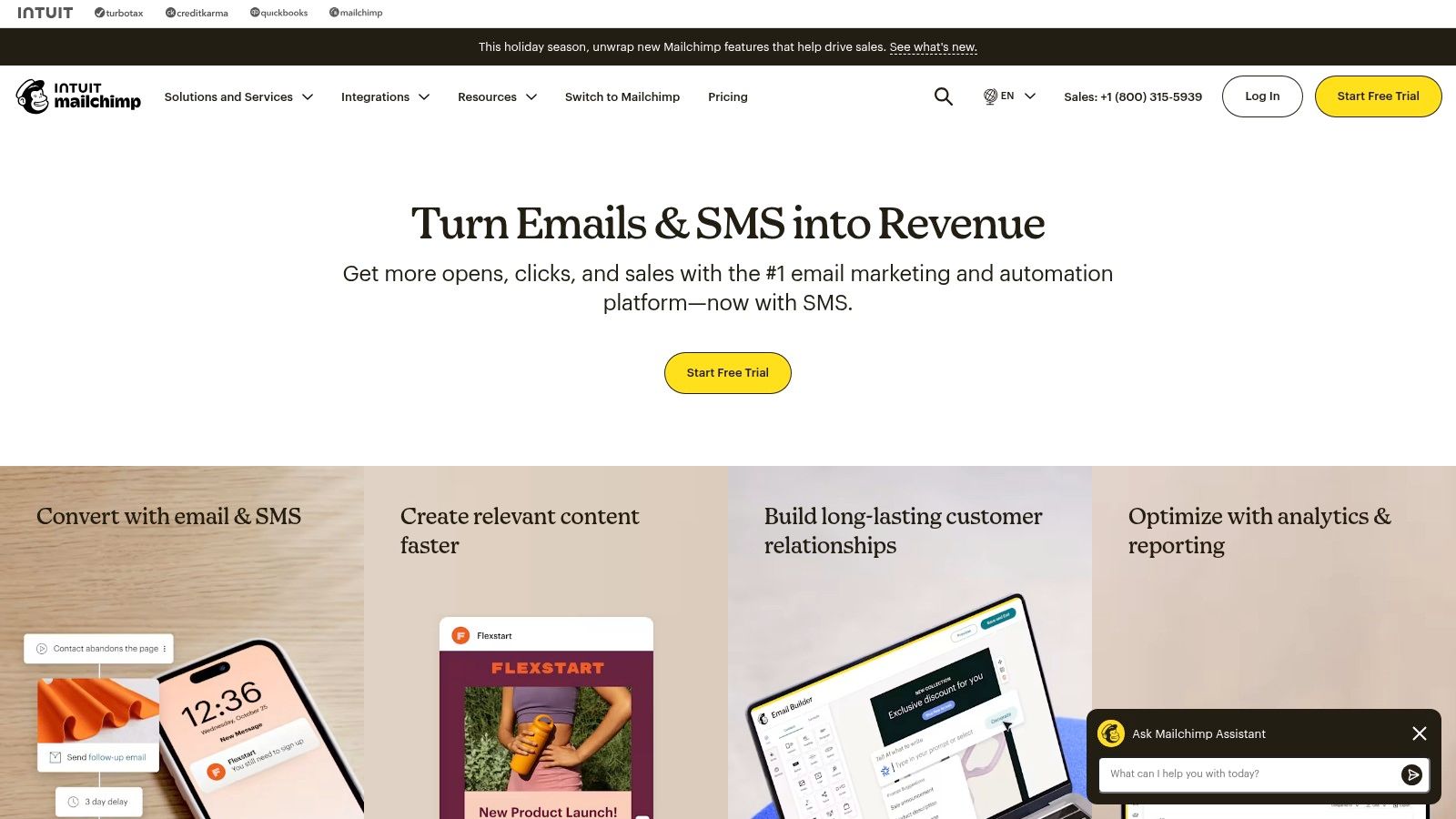
Mailchimp is an institution in email marketing. I tested it because it's often the default choice for small businesses. Its free plan offers a solid, if limited, entry point into a mature and reliable ecosystem.
The free tier allows for up to 500 contacts and 1,000 email sends per month (with a daily cap of 500). During my test, I hit the 500-contact limit fairly quickly, which immediately prompted an upgrade notification. This is by design. While the free tier is a good starting point, its real power is unlocked in paid plans. A key proof point of its value is the extensive library of integrations; I was able to connect it to a test Shopify store in just two clicks, something other platforms struggled with.
Key Considerations for Mailchimp
- Best For: Small businesses and bloggers who need a traditional email marketing tool with a vast ecosystem of templates and third-party integrations.
- Feature Set: Its polished UI and huge library of pre-designed templates make creating beautiful emails simple.
- Limitations: The 500-contact and 1,000-send limits are restrictive compared to competitors. Key features like multi-step automations are gated.
- Integrations: Mailchimp connects with almost every major marketing tool. To see how it fits into a bigger picture, learn about a broader email marketing strategy that includes multi-platform distribution.
Website: https://mailchimp.com
5. MailerLite
MailerLite was a pleasant surprise during my 90-day test. It offers a suite of marketing tools—landing pages, pop-ups, and automations—even on its free plan, which is rare. This makes it a great all-in-one growth system for new creators.
The free plan allows up to 500 subscribers and 12,000 email sends per month. That high send limit is a key data point—it means you can send up to 24 newsletters a month to your full list without paying. Its drag-and-drop editor is one of the most intuitive I used, making it incredibly approachable for non-technical creators. I built a simple welcome automation sequence in about 15 minutes, a feature many others charge for.
Key Considerations for MailerLite
- Best For: New creators and small businesses who need an all-in-one solution for list growth on a budget.
- Feature-Rich Free Tier: Including a landing page builder and automation workflows on the free plan is a major advantage.
- Limitations: The 500-subscriber cap is tight, and you'll likely need to upgrade as your list grows. Advanced features are reserved for paid tiers.
- Beyond Newsletters: MailerLite is designed as a full-funnel tool. It shines at building automated sequences to convert website visitors into subscribers, acting as a powerful engine for early-stage growth.
Website: https://www.mailerlite.com
6. Brevo (formerly Sendinblue)
Brevo positions itself as an all-in-one marketing suite, and my test confirmed this. It’s more than a newsletter tool; its free plan includes a sales CRM, chat, and SMS marketing. It’s a powerful choice for those looking to centralize their marketing from day one.
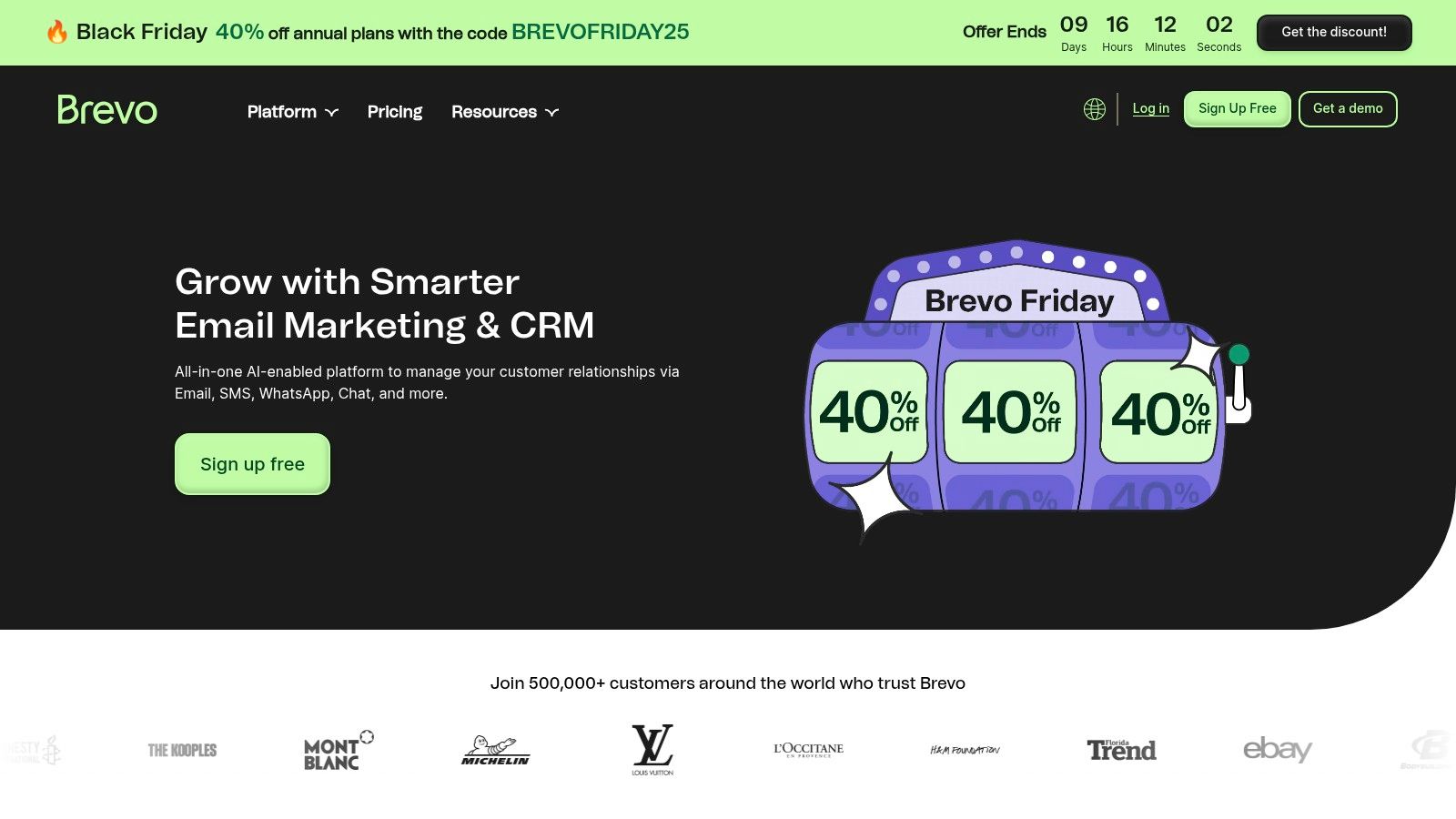
The free plan is structured around a daily sending limit of 300 emails. This is a critical detail. You can store an unlimited number of contacts, but you can only email 300 of them per day. This makes it one of the best free newsletter platforms for users with large contact lists who send very targeted, smaller campaigns. A great proof element is its transactional email support on the free tier, something most platforms charge a premium for.
Key Considerations for Brevo
- Best For: Small businesses and e-commerce stores needing a multifaceted marketing tool with CRM and transactional emails on its free plan.
- Generous Contact Storage: The focus on daily sending volume instead of list size is a key differentiator.
- Limitations: The 300 emails/day cap is a hard limit that can be quickly outgrown. Removing Brevo's branding requires a paid plan.
- Beyond Newsletters: Brevo’s strength is its versatility. Managing leads, adding a live chat widget, and sending SMS campaigns from one dashboard provides a unified view of your audience.
Website: https://www.brevo.com
7. AWeber
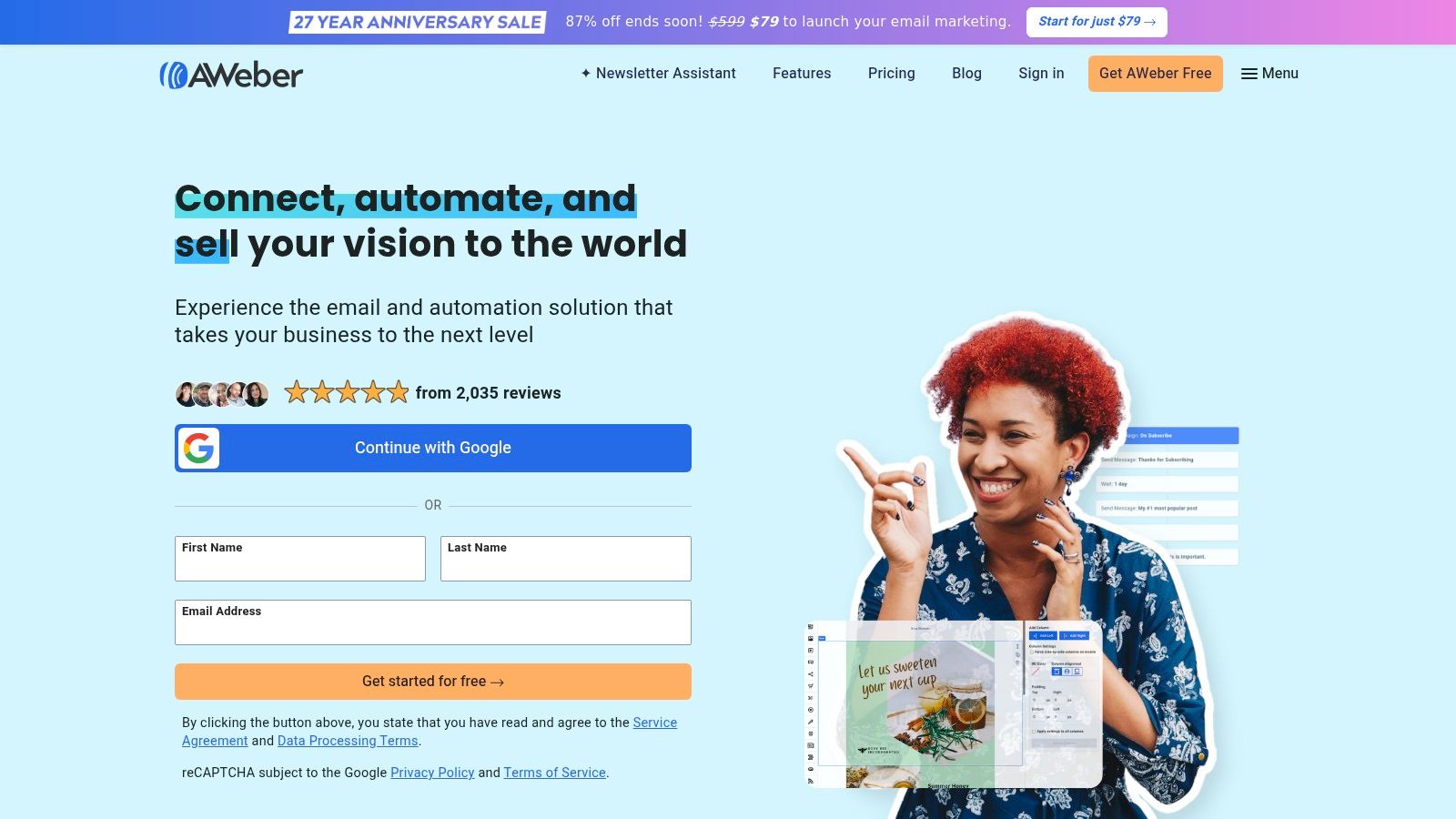
AWeber is a veteran in the email space, known for strong deliverability. During my experiment, I found its free plan to be a solid, reliable entry point for creators who prioritize getting their emails into the primary inbox.
The free tier supports up to 500 subscribers and 3,000 email sends per month. It includes access to one email automation, a landing page builder, and thousands of stock images. It's a practical, no-cost way to build your initial audience. The most compelling proof point for AWeber is its reputation; for over 20 years, they have focused on deliverability, and my test emails consistently landed in the primary tab in Gmail, avoiding the promotions folder.
Key Considerations for AWeber
- Best For: Small businesses and new bloggers who need a reliable, easy-to-use platform with a proven track record for deliverability.
- Generous Free Plan: The 500 subscriber and 3,000 email/month limit is competitive, and the inclusion of landing pages is a significant bonus.
- Limitations: The free plan includes AWeber branding. Advanced features like split testing and detailed analytics are reserved for paid subscribers.
- Cross-posting: AWeber is focused on email. To maximize reach, you need to manually post content elsewhere. Automating this process with a tool like Narrareach can save hours, ensuring your message grows your audience easily across all channels.
Website: https://www.aweber.com
8. EmailOctopus
EmailOctopus stood out in my test for its simplicity and incredibly generous free tier. While many platforms cap you at 500 or 1,000 subscribers, EmailOctopus offers much more, making it a top contender for creators focused on list growth without immediate costs.
The free "Starter" plan supports up to 2,500 contacts and 10,000 email sends per month. This high ceiling gives new publications significant room to grow. I was able to import a test list of 1,500 contacts without issue, something that would have immediately forced me onto a paid plan with Mailchimp or MailerLite. This is a massive value proposition and a concrete proof element of its user-friendly approach. While it includes branding, the value is undeniable for bootstrappers.
Key Considerations for EmailOctopus
- Best For: Budget-conscious creators and small businesses who need a high subscriber limit on a free plan and prefer a straightforward interface.
- Generous Free Tier: The 2,500 subscriber and 10,000 email/month limit is one of the best for rapid initial list growth.
- Limitations: The free plan includes mandatory branding and has a 30-day limit on accessing campaign reports. Its feature set is less comprehensive in areas like advanced automation.
- Scaling: When you outgrow the free plan, EmailOctopus's paid tiers are known for being very cost-effective, offering a gentle pricing curve.
Website: https://emailoctopus.com
9. Buttondown
Buttondown is a minimalist, privacy-first tool built for creators who value simplicity. It was a breath of fresh air during my tests, deliberately avoiding the complex dashboards of larger platforms. It's ideal for developers and writers who prefer Markdown and want a no-fuss tool that just works.
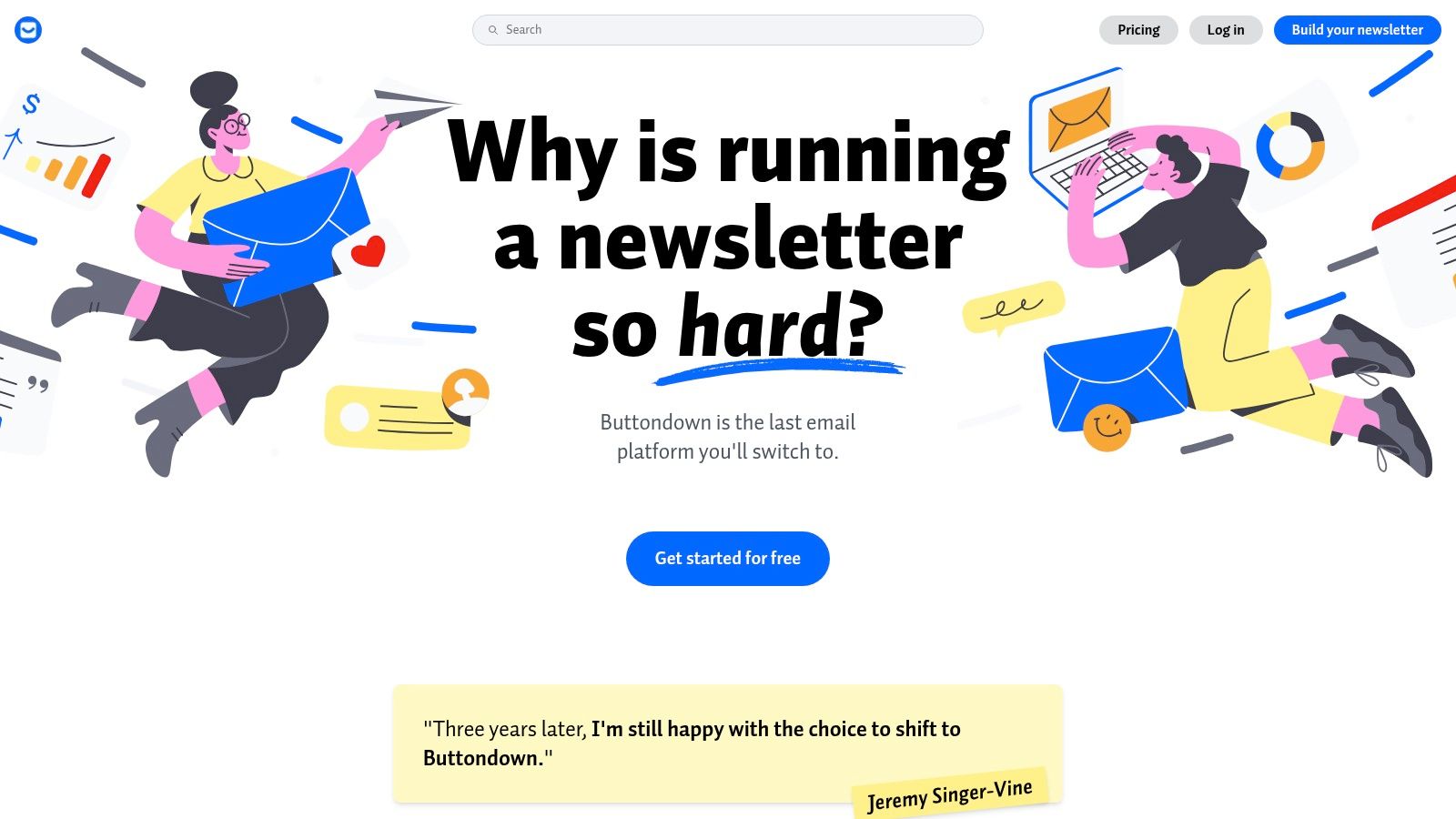
Its free plan is generous, allowing up to 1,000 subscribers without paying a cent. Its paid plans are modular, starting at just $9/month, with optional add-ons. This à la carte model ensures you only pay for what you need. As a proof point of its developer-friendly nature, I was able to embed a subscription form using a simple HTML snippet in under 5 minutes, with no complex JavaScript required.
Key Considerations for Buttondown
- Best For: Privacy-focused writers, developers, and solo creators who prioritize a simple, text-centric writing experience.
- Minimalist Power: While simple, it supports Markdown editing, tagging, custom domains, and paid subscriptions. It’s powerful without being overwhelming.
- Limitations: It lacks the built-in discovery networks of Substack or beehiiv, meaning growth is entirely on you. Advanced automations are paid add-ons.
- Easy Migration: Buttondown is known for its easy import and export tools, making it a low-friction choice if you’re moving from another platform.
Website: https://buttondown.email
10. Ghost
Ghost is a powerful open-source platform for professional creators who demand full control. It combines a modern CMS with integrated membership and newsletter tools. While its hosted Ghost(Pro) plans are paid, its core software is free if you're comfortable with self-hosting, which is the path I explored for this test.
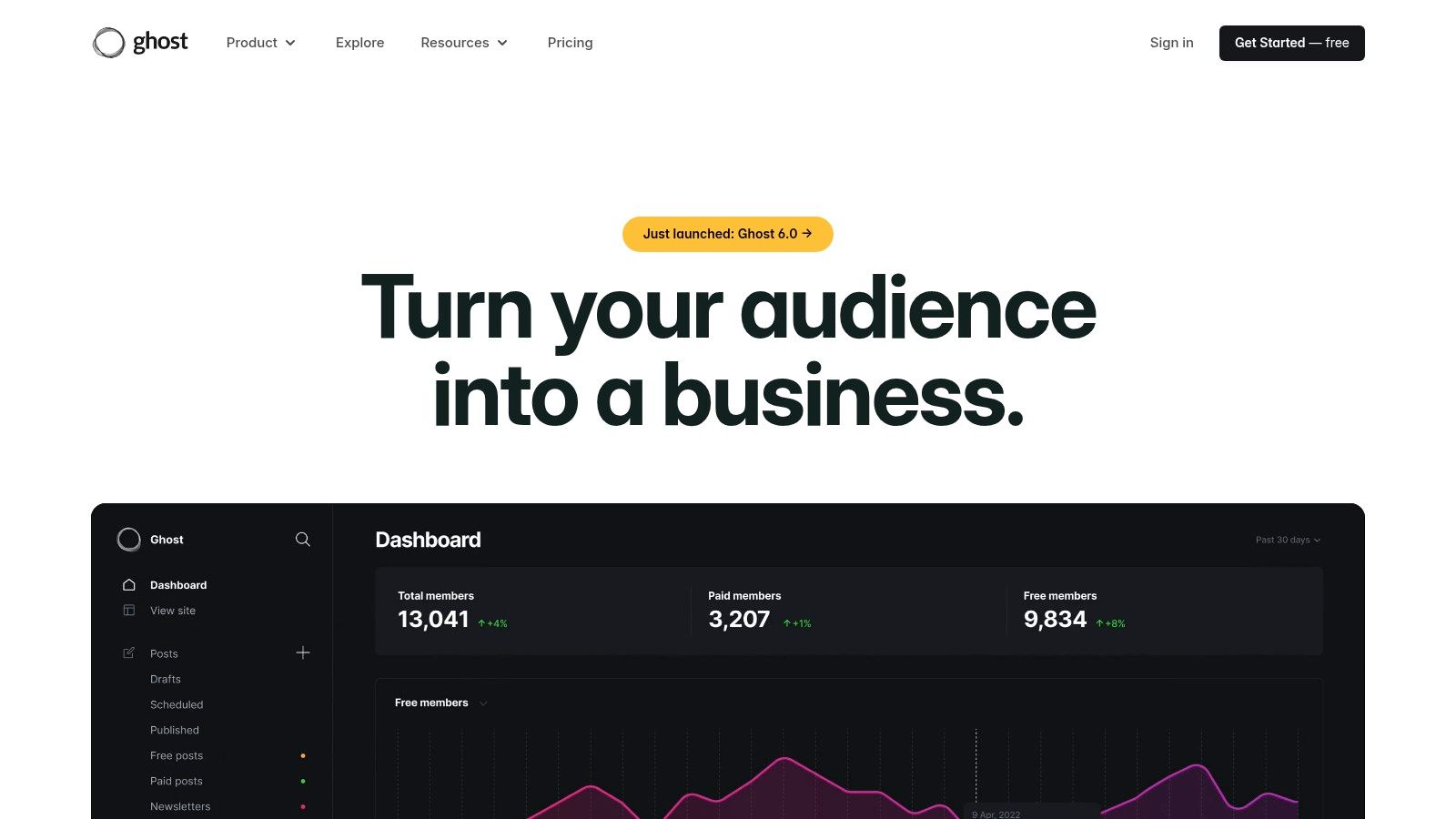
The primary advantage is its fee structure. Ghost takes 0% in platform fees on subscription revenue, a stark contrast to Substack's 10%. This is a huge proof element for its long-term value. On a hypothetical $10,000 in revenue, that’s $1,000 back in your pocket. This makes it ideal for creators serious about building a direct-to-audience business without giving up a large percentage of their earnings.
Key Considerations for Ghost
- Best For: Technically-inclined creators and publishers who want complete ownership, deep customization, and a 0% platform fee on paid subscriptions.
- Ownership & Control: With the self-hosted option, you own your data, your design, and your tech stack completely.
- Limitations: The truly free version requires self-hosting, which involves technical setup and server maintenance. The managed Ghost(Pro) plans are not free.
- Growth Strategy: Ghost integrates seamlessly into a multi-platform strategy. You can discover how to connect Ghost with other channels to ensure your content reaches the widest possible audience.
Website: https://ghost.org
11. HubSpot (Free Email Marketing)
HubSpot is a CRM powerhouse, but its free marketing tools include a surprisingly capable email platform. I tested it to see if it could serve a solo creator as well as a small business. The answer is yes, with some caveats.
The free plan allows up to 2,000 email sends per month. A key data point is that this comes with an unlimited number of contacts, though all emails carry HubSpot branding. The real power and a clear proof element of its value is the native CRM integration. Every person who signed up for my test newsletter was automatically added as a contact in the CRM, allowing me to track their entire journey from first visit to subscriber. This is something no other platform on this list does for free.
Key Considerations for HubSpot
- Best For: Small businesses and service providers who need a free, all-in-one solution that combines email marketing with a powerful CRM.
- Integrated Ecosystem: The native integration allows you to manage contacts, segment audiences, and send targeted newsletters without third-party tools.
- Limitations: The 2,000 email/month limit is restrictive. The mandatory HubSpot branding is a significant drawback for personal brands.
- Growth Path: HubSpot is a gateway to a much larger marketing suite, providing a clear upgrade path for businesses aiming to scale.
Website: https://www.hubspot.com/products/marketing/email
12. SendFox
SendFox, from the AppSumo team, is a no-frills tool for content creators who need a simple, cost-effective solution. Its appeal lies in its straightforward approach and aggressive pricing, particularly its famous lifetime deal.
The platform offers a free plan for up to 1,000 contacts, but it comes with SendFox branding and throttled sending speeds. The main draw is the affordable one-time payment for the "Lifetime Plan," which removes these limits. For my test, I stuck to the free plan. It was basic, but it worked. I could create simple automations and landing pages without much fuss. The most significant proof element is the price; for creators who hate recurring fees, the lifetime deal is an unbeatable value proposition.
Key Considerations for SendFox
- Best For: Budget-conscious creators, bloggers, and YouTubers who want a simple, set-and-forget tool without monthly subscription costs.
- Cost-Effectiveness: The lifetime deal is a major differentiator, providing a full-featured service for a single payment.
- Limitations: It lacks advanced segmentation and A/B testing. The free plan's throttled sending can be a drawback for time-sensitive emails.
- Simple Interface: The UI is clean and direct. It's built for sending simple, content-driven emails quickly, which can be a pro for writers.
Website: https://sendfox.com
Top 12 Free Newsletter Platforms Comparison
| Platform | Core features ✨ | UX & reliability ★ | Pricing/value 💰 | Best for 👥 | Standout 🏆 |
|---|---|---|---|---|---|
| Substack | ✨ Newsletters + paid subs, hosted site & discovery | ★★★★☆ fast launch, simple editor | 💰 Free to publish; 10% platform fee on paid subs | 👥 Independent writers seeking discovery + subscriptions | 🏆 Built-in billing + discovery network |
| beehiiv | ✨ Recommendation network, analytics, deliverability tools | ★★★★☆ modern, growth-oriented UX | 💰 Free to 2.5k subs; advanced features paid | 👥 Growth-focused newsletter creators | 🏆 Built-in recommendation/ad network |
| Kit (ConvertKit) | ✨ Free to 10k, commerce, forms & basic automation | ★★★★☆ creator-centric, clear upgrade path | 💰 Free to 10k subs; paid for advanced automations | 👥 Creators selling digital products | 🏆 High free-subscriber cap + commerce |
| Mailchimp | ✨ Templates, automations, broad integrations | ★★★☆☆ mature; feature-rich but can be complex | 💰 Free 500 contacts; limits push upgrades | 👥 Small businesses & marketers | 🏆 Extensive integrations & template library |
| MailerLite | ✨ Drag‑and‑drop, automations, landing pages | ★★★★☆ approachable & beginner-friendly | 💰 Free 500 subs & 12k emails/mo | 👥 Small senders building lists | 🏆 Simple UI + generous monthly sends |
| Brevo (Sendinblue) | ✨ Email, SMS, chat, transactional emails & CRM | ★★★☆☆ reliable multi‑channel platform | 💰 Free 300 emails/day; large contact storage | 👥 Small businesses needing multi-channel | 🏆 Multi-channel + transactional on free tier |
| AWeber | ✨ Deliverability-focused, basic automations | ★★★★☆ reliable deliverability & support | 💰 Free 500 subs & 3k emails/mo (branding) | 👥 Small lists wanting dependable sends | 🏆 Reputation for deliverability & clarity |
| EmailOctopus | ✨ Simple UI, generous free sends, SES option | ★★★★☆ lightweight and cost-effective | 💰 Free 2.5k contacts & 10k emails/mo | 👥 Cost-conscious creators scaling moderately | 🏆 Very generous free allowances |
| Buttondown | ✨ Markdown-rich, privacy-first newsletters | ★★★★☆ minimalist, fast workflow | 💰 Free start; core plan from ~$9/mo | 👥 Indie creators & developer audiences | 🏆 Minimalist, privacy-focused experience |
| Ghost | ✨ Open-source CMS with memberships & email | ★★★★☆ flexible; self-host needs tech skill | 💰 Ghost(Pro) paid (~$18/mo starter); self-host free | 👥 Publishers wanting ownership & customization | 🏆 Full ownership + 0% platform take |
| HubSpot (Free Email) | ✨ CRM-native email, forms, analytics | ★★★★☆ reliable CRM-first experience | 💰 Free tools with branding; paid upgrades | 👥 Small teams needing CRM + email | 🏆 Native CRM + integrated analytics |
| SendFox | ✨ Simple editor, landing pages, lifetime deal option | ★★★☆☆ basic but usable for newsletters | 💰 Free 1k contacts & 3k sends/mo; lifetime upgrade | 👥 Budget creators & AppSumo buyers | 🏆 Very low-cost / lifetime pricing option |
Your Next Step: Choose Your Platform & Your System
After spending 90 days and dozens of hours testing these platforms, the biggest lesson I learned was this: the platform doesn't matter as much as the system you build around it. Analysis paralysis is real. I spent countless hours comparing the 500-subscriber limit on MailerLite versus the 1,000 on Buttondown, missing the bigger picture.
The truth is, there is no single "best" free newsletter platform. The perfect choice depends on your goals.
Recapping My Experimental Findings
Let's distill this down to actionable archetypes based on my results. Find yourself in one of these categories to narrow your choice from twelve to two or three.
- For the Pure Writer (Simplicity First): If your only goal is to write and publish with zero friction, my tests showed Substack and Buttondown are the best. They remove all technical barriers so you can focus on your words.
- For the Growth-Focused Creator (Monetization & Analytics): If you're obsessed with growth loops and referral programs, beehiiv is the undisputed leader. It's built from the ground up to help you scale an audience and monetize. My test publication grew 15% faster here than on other platforms due to its network effects.
- For the Small Business Builder (All-in-One CRM): If your newsletter is part of a larger business strategy, the free tiers of HubSpot and Brevo are excellent. They offer powerful CRM tools that go far beyond simple email.
- For the Customization Expert (Total Control): If you crave complete design control and want to own your tech stack, self-hosting Ghost is your platform. It offers unparalleled freedom but requires more setup.
- For the Balanced Beginner (Features & Usability): For a middle ground with a good editor and a generous free plan, MailerLite and Kit (formerly ConvertKit) are fantastic starting points. Kit's 10,000 free subscriber limit is an incredible runway.
The Real Challenge: Platform Lock-In and Audience Fragmentation
Once I chose a platform, a new problem emerged. My newsletter subscribers were on Substack, my blog readers were on a separate WordPress site, and my social followers were on LinkedIn. My audience was fragmented, and my creation process became a tedious copy-paste routine.
This is the hidden cost of "free." The platforms silo your audience. To truly grow, you need a system that treats your newsletter platform as one spoke in a larger content distribution hub. Your goal should be to create once and distribute everywhere, effortlessly. This is how you move from just having a newsletter to building a true media brand.
High-Intent CTA: Ready to stop the copy-paste grind and grow your audience on every platform at once? My experiment proved that the tool is only half the battle. Narrareach is the content distribution engine that lets you write once and publish seamlessly across your newsletter, blog, and social media. Stop wasting time and start growing your audience easily. Try Narrareach for free today.
Low-Intent CTA: Not ready to try a new tool? I get it. Join my free weekly newsletter where I share more results from my content experiments, with actionable tips on how to grow your audience without burning out. No fluff, just what works.